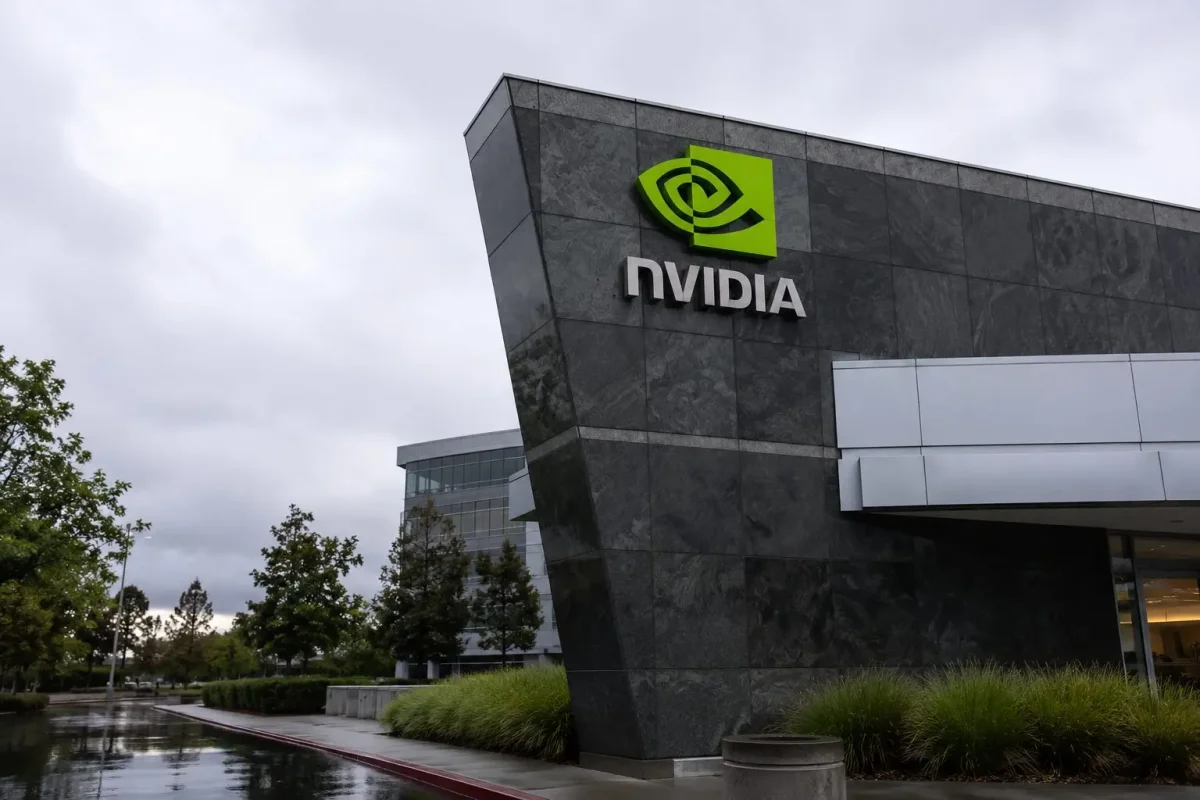
Nvidia Corporation (NASDAQ:NVDA) experienced a dramatic week, adding approximately $373 billion to its market capitalization over the five trading sessions ending Friday, only to see roughly $69 billion erased in premarket trading Monday morning. The chip sector broadly slipped as investors reassessed valuations. By 8 a.m. ET, Nvidia shares were trading at $208.11, down 1.35% from Friday's close of $210.96.
While the percentage decline appears modest, for a company of Nvidia's size, each 1% move represents about $51 billion in market value. Year-to-date, Nvidia shares have risen 13.1%, significantly underperforming the Philadelphia Semiconductor Index, which has surged 83% in 2026—a gap of nearly 70 percentage points.
This lag has pushed Nvidia's forward price-to-earnings (P/E) ratio to approximately 19 times expected earnings for the next year, the lowest level in over a decade. In contrast, forward P/E multiples for Advanced Micro Devices (NASDAQ:AMD) and Intel Corporation (NASDAQ:INTC) both trade above their long-term averages. “We’ve never seen this kind of extreme earnings growth,” said Steve Sosnick, chief market strategist at Interactive Brokers Group (NASDAQ:IBKR). ORTEX co-founder Peter Hillerberg noted that the recent rise in sector short interest reflects “caution and hedging,” not a crowded short.
The implied earnings per share based on the 19-times multiple is around $11.10, representing a roughly 70% increase over Nvidia's trailing EPS of $6.53 from the last 12 months. This gap highlights the market's aggressive expectations for future profitability. A sensitivity analysis shows that if earnings drop 10% and the multiple contracts to 17 times, the implied share value would fall to about $169.88, a 19.5% decline from Friday's close. Conversely, a 10% earnings beat with the same multiple would push shares to $232.06.
Supply chain indicators remain robust. Taiwan Semiconductor Manufacturing Co (NYSE:TSM), a key Nvidia supplier, reported June revenue up 67.9% year-over-year to NT$442.68 billion. Second-quarter revenue reached a record NT$1.27 trillion, up 36% and slightly above analyst expectations. TSMC will report full quarterly results on Thursday.
Nvidia has guided for $91 billion in revenue for the current quarter, plus or minus 2%, excluding any data-center computing sales to China. This represents an 11.5% increase from last quarter's record $81.6 billion. Data-center revenue alone was $75.2 billion in the prior quarter. While the rapid growth justifies the low multiple, it leaves less room for shipping disruptions, unfavorable product mix, or margin compression.
Market positioning has become more nuanced. U.S. technology funds attracted $9.71 billion in the week ended July 8, the largest weekly inflow since mid-June, even as Nvidia lagged other tech names. This suggests investors are still allocating to technology but with greater selectivity within the AI supply chain.
The broader market felt the impact. Nasdaq 100 futures dropped 0.94%, and the iShares Semiconductor ETF (NASDAQ:SOXX) was down 2.6% early Monday, while oil prices jumped over 3% amid escalating U.S.-Iran tensions. “The shock was disrupting the momentum trade once again,” said Kathleen Brooks, research director at XTB (GPW:XTB).
For investors, the central question is no longer the scale of AI spending but how effectively Nvidia can convert that spending into earnings per share. Last week's $373 billion rally reflected bets on that conversion. Monday's modest decline, though minor in percentage terms, underscores how quickly market sentiment can shift when growth expectations are this extreme.