New York, July 13, 2026 — Escalating U.S.-Iran tensions sent oil prices surging on Monday, dragging Nasdaq futures down about 1%. However, the most notable market movement came from SK Hynix (KRX:000660; NASDAQ:SKHY), where a significant price gap emerged between its U.S. and Korean listings.
SK Hynix's American Depositary Receipts (ADRs), which allow U.S. investors to trade the Korean memory-chip maker, were indicated 9.2% lower at $152.50 in premarket trading. Despite this decline, the ADRs still traded approximately 24% above the Seoul-listed shares, based on a simple calculation. Reuters reported that Friday's $168 ADR close represented a 37% premium over Monday's close in Korea. With the Korean price and exchange rate held constant, the drop to $152.50 narrows the gap to 24.4%.
The local Korean stock plunged more than 15%, its steepest one-day drop in nearly 20 years, as the KOSPI index slid 9%, triggering a 20-minute trading halt. The discrepancy highlights dual pressures: rising oil prices stoking inflation and rate-hike fears, while heavy losses in memory stocks point to elevated leverage and questions about the payoff from AI spending.
Market Reactions and Sector Impact
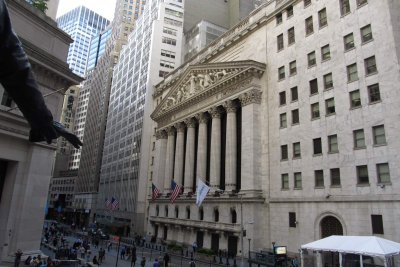
Wall Street's cash market remained closed, with the New York Stock Exchange set to open at 9:30 a.m. EDT. Dow futures edged up 0.05%, but S&P 500 futures slipped 0.31% and Nasdaq 100 futures dropped 1.01%. The 1.06-point gap between Nasdaq and Dow futures indicated specific pressure on long-duration stocks—companies with profits expected far in the future—rather than a broad equity selloff.
Among chip and storage peers, Micron Technology (NASDAQ:MU) fell 5.2% premarket, Western Digital (NASDAQ:WDC) dropped 6%, and SanDisk (NASDAQ:SNDK) declined 6.6%. The average drop of 5.9% for these three stocks was nearly six times the Nasdaq futures move and well above the 2.7% decline in the iShares Semiconductor ETF (NASDAQ:SOXX). Kathleen Brooks, research director at XTB, noted that the oil spike was "disrupting the momentum trade once again," as recent winners were hit hardest.
Macro Context and Fed Tightening
Brent crude rose 3.8% to $78.86, adding fresh inflation pressure. The two-year Treasury yield climbed to 4.2393%, its highest level since February 2025, as markets priced in more Federal Reserve tightening. This wasn't a typical flight to safety: government bond prices fell, the dollar strengthened, and gold sold off. Spot gold slipped 1.2% to $4,072.49, as higher yields outweighed its haven appeal. Ole Hansen at Saxo Bank commented that "higher bond yields and a stronger dollar" were diminishing gold's luster. Fed funds futures implied 39 basis points of tightening by year-end.
Oil and Geopolitical Factors
Oil prices remain sensitive to developments in the Strait of Hormuz. Iran claims the strait is still closed, but U.S. officials report that ships are getting through, with about 20 vessels escorted in the past day. Ship-tracking data, however, shows little movement. Before the conflict, the strait handled roughly one-fifth of global oil and LNG shipments.
SK Hynix ADR Premium Explained
The persistent gap between SK Hynix's ADR and Korean share price stems from structural factors. Each ADR represents one-tenth of a Korean share. The $152.50 premarket quote was still 2.3% higher than last week's $149 offer. A leveraged Hong Kong fund attempting to double the stock's daily move ended down more than a third. James Ooi, strategist at Tiger Brokers, explained that the U.S. premium is supported by "broader investor access, deeper liquidity," while conversion restrictions limit arbitrage—buying the cheaper market and selling the pricier one.
Fundamentally, U.S. buyers may still justify the premium. SK Hynix derived 58% of first-quarter revenue from high-bandwidth memory, chips stacked for faster AI data processing, compared to Micron's 21%. Morningstar's Lorraine Tan noted that AI "monetisation remains uncertain," and another analyst at Morningstar sees increased supply in 2027 and 2028 pushing prices down. However, SK Hynix CEO Kwak Noh-jung forecasts the industry's "most severe supply shortage in 2027."
Outlook and Key Events
This week's calendar could determine which narrative prevails. Tuesday brings the U.S. CPI report and Fed Chair Kevin Warsh's congressional testimony, both capable of shifting a market that currently prices in at least one more quarter-point rate hike this year. Second-quarter S&P 500 earnings are on track for a 23.7% gain. Bank of America (NYSE:BAC) analysts note that hyperscalers—large cloud operators—have already spent $234 billion this year and are set to post negative forward free cash flow for the first time since at least 2007.
The price gap likely remains wide for now. ADRs may stay expensive due to conversion hurdles and greater U.S. liquidity. If shipping finds a temporary fix, oil and yields could decline. Jefferies economist Mohit Kumar suggested the U.S. could settle for "some version of a deal before mid-terms." However, a prolonged Hormuz issue combined with weaker AI cash returns could lock in higher rate bets and squeeze chip trade leverage.