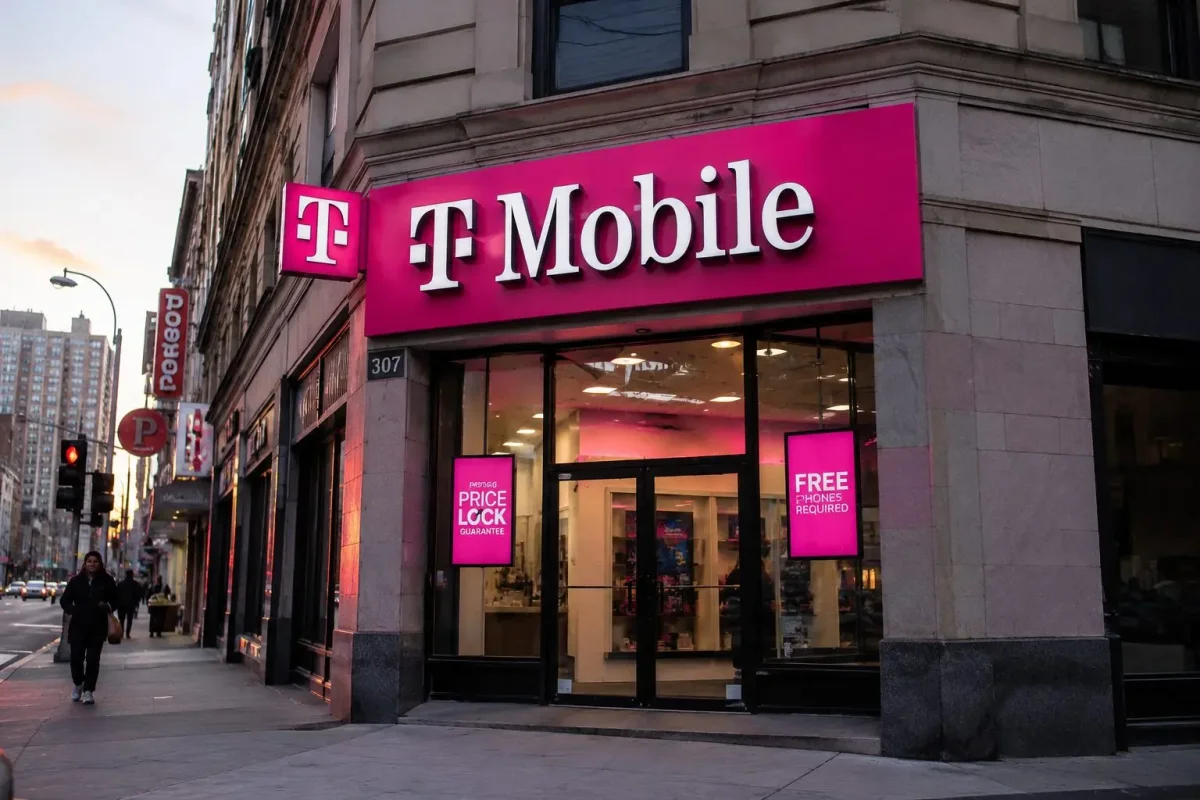
T-Mobile US (NASDAQ:TMUS) has tightened eligibility for its most generous switching incentives, limiting reimbursements that can reach $800 per line and $3,200 per account to new wireless accounts only. The change, effective July 13, 2026, exempts customers whose existing relationship is limited to T-Mobile Home Internet or T-Satellite services.
Dominick Miserandino, CEO of retail-technology firm RTMNexus, described the policy shift as “a deliberate play to cross-sell and diversify its customer base into other high-growth products.” This strategic move aims to deepen engagement with existing customers while encouraging single-product households to add wireless lines.
Financial Impact on Customers
For a four-line household affected by both the legacy-plan price increase of up to $6 per line and the elimination of the $10-per-line KickBack credit, the annual cost could rise by as much as $768. This upper-bound scenario represents 24% of the maximum $3,200 subscriber-acquisition subsidy available through the Keep and Switch program. T-Mobile has not disclosed how many accounts will face the full increase or how many qualifying KickBack lines remain.
Operational and Competitive Context
The carrier is retiring approximately 1,100 legacy billing codes covering plans such as Magenta, Simple Choice, and ONE. Chief Operating Officer Jon Freier stated that removing old plans “reduces significant complexity.” In the first quarter, T-Mobile’s postpaid average revenue per account (ARPA) rose 3.9% to $151.93, and net account additions increased 6% to 217,000. However, postpaid account churn edged up to 1.04% from 0.94% a year earlier.
CEO Srini Gopalan emphasized the company’s ability to “deepen the engagement with our existing base.” For investors, revenue from existing households is more profitable because it does not require fresh device-payoff reimbursements. Keeping switching offers available to Home Internet- or satellite-only accounts provides a pathway to convert single-product customers into full wireless households.
Competitive Landscape
Verizon Communications (NYSE:VZ) is advertising its Simplicity plan at $30 a line for switchers using AutoPay, compared to its standard $45 price. AT&T Inc. (NYSE:T) markets Value 2.0 at $30 a line for four lines after a $5 monthly bring-your-own-device credit for up to 36 months, along with switching reward cards up to $800. Verizon reported 55,000 postpaid phone net additions in the first quarter, its first positive first-quarter result since 2013, a significant improvement of more than 340,000 from the prior year.
Consumer commentary suggests Verizon’s Simplicity plan is gaining traction. A July 4 analysis from Android Authority ranked it as the strongest current postpaid choice among the three national carriers, though it noted that prepaid service may still be cheaper and that Simplicity does not include a subsidized phone. T-Mobile’s historical position as a price disruptor is increasingly contested.
Investor Outlook
The investor math remains an upper-bound estimate. T-Mobile has not disclosed how many accounts will receive the full $6 increase, how many KickBack lines qualify, or how often it pays the maximum switching reimbursement. Higher churn, heavier retention discounts, or a price response from Verizon and AT&T could absorb much of the revenue lift.
The key test will be whether T-Mobile can sustain ARPA growth while stabilizing account churn and converting more Home Internet- or satellite-only customers to voice lines. If these metrics move in tandem, the policy changes will appear as disciplined growth. If churn rises again, the extra bill revenue may prove expensive.