Nvidia Corporation finds itself in a perplexing market position as its stock valuation contracts to levels not seen in over seven years, even while the company continues to secure massive orders for its artificial intelligence processors. The chipmaker's forward price-to-earnings ratio has declined to approximately 19.6 times projected earnings, marking its lowest point since the first quarter of 2019. This represents a nearly 20% retreat from the record highs reached in October of last year, placing the stock's valuation slightly below the S&P 500's average multiple, which currently hovers near 20.
The valuation compression appears particularly stark against Nvidia's robust financial outlook. Wall Street analysts anticipate the company's profits will surge more than 70% during the current fiscal year, dramatically outpacing the S&P 500's projected earnings growth of roughly 19%. This divergence between fundamental performance and market pricing suggests investors are reassessing the premium traditionally awarded to AI-focused technology leaders amid broader economic concerns and competitive pressures.
Substantial Orders Continue Amid Valuation Reset
Despite the market's cooling sentiment, demand for Nvidia's hardware shows no signs of abating. In a significant development this week, French AI firm Mistral confirmed it secured $830 million in debt financing specifically to acquire 13,800 Nvidia chips for a new data center near Paris. Mistral CEO Arthur Mensch emphasized the investment was "critical" for scaling European AI infrastructure and maintaining regional innovation autonomy.
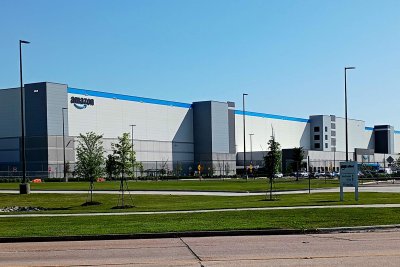
Furthermore, Amazon Web Services has made a landmark commitment to purchase 1 million Nvidia graphics processing units, along with associated networking equipment and AI technology, before the conclusion of 2027. Ian Buck, Nvidia's vice president for hyperscale and high-performance computing, noted that "inference is wickedly hard," explaining that AWS plans to deploy seven different Nvidia chip variants for these complex tasks. This order alone represents one of the largest semiconductor procurement agreements in recent industry history.
Leadership Maintains Bullish Long-Term Outlook
Nvidia's management continues to project extraordinary growth trajectories. During the company's recent GTC conference, CEO Jensen Huang projected that revenue from the Blackwell and Rubin AI systems could reach at least $1 trillion by 2027. Huang declared that "the inference inflection has arrived," referring to the transition where AI systems increasingly handle real-time queries and operational tasks rather than just model training.
This optimism follows Nvidia's strong financial guidance provided last month, where the company projected first-quarter revenue of $78 billion, exceeding Wall Street expectations. This forecast came after Nvidia's January-quarter results similarly surpassed analyst estimates. However, market observers noted that investor focus has shifted from pure growth metrics to capital returns and sustainable profitability. Ken Mahoney of Mahoney Asset Management suggested much of the AI optimism was already "baked in to the cake" regarding Nvidia's valuation.
Competitive Landscape Intensifies
Analysts point to growing competitive headwinds as a factor in Nvidia's valuation reassessment. As AI workloads evolve from training to inference, some of this activity is migrating to central processing units and custom silicon specifically designed for particular tasks. This shift provides opportunities for rivals like Advanced Micro Devices and creates incentives for major cloud providers to develop proprietary chip solutions.
Summit Insights analyst KinNgai Chan estimates Nvidia still controls more than 90% of both training and inference markets but anticipates that share will begin eroding in 2027 as in-house chip development efforts reach commercial scale. This competitive dynamic represents a significant departure from Nvidia's previously unchallenged dominance in accelerated computing for artificial intelligence applications.
Macroeconomic and Geopolitical Considerations
Broader market conditions are also influencing technology valuations. This week, Morgan Stanley assigned an "equal weight" rating to global equities, citing capital flows toward cash and U.S. Treasuries driven by Middle East tensions. Brent crude oil has surged 59% this month to trade above $116 per barrel, with the bank warning that sustained prices between $150 and $180 could depress global equity valuations by approximately 25%.
Federal Reserve officials have additionally expressed concern that rising energy and gasoline costs could destabilize inflation expectations, potentially triggering selloffs in expensive technology stocks that are particularly sensitive to interest rate expectations. These macroeconomic crosscurrents create challenging conditions for high-multiple growth companies like Nvidia.
The company also continues navigating complex geopolitical waters regarding the Chinese market. Earlier this month, Huang confirmed Nvidia has resumed production of a compliant H200 variant for Chinese customers after securing necessary licenses and orders. However, these China-specific units are not included in the company's $1 trillion revenue projection for Blackwell and Rubin systems through 2027.
Nvidia currently occupies an unusual position in the semiconductor landscape. While demand fundamentals remain exceptionally strong with record orders and ambitious revenue projections, the market appears to be reclassifying the company from AI royalty to a more conventional chipmaker. Investors increasingly prioritize demonstrable returns on investment and sustainable competitive advantages over sheer growth metrics, signaling a maturation in how the financial community evaluates artificial intelligence infrastructure providers.