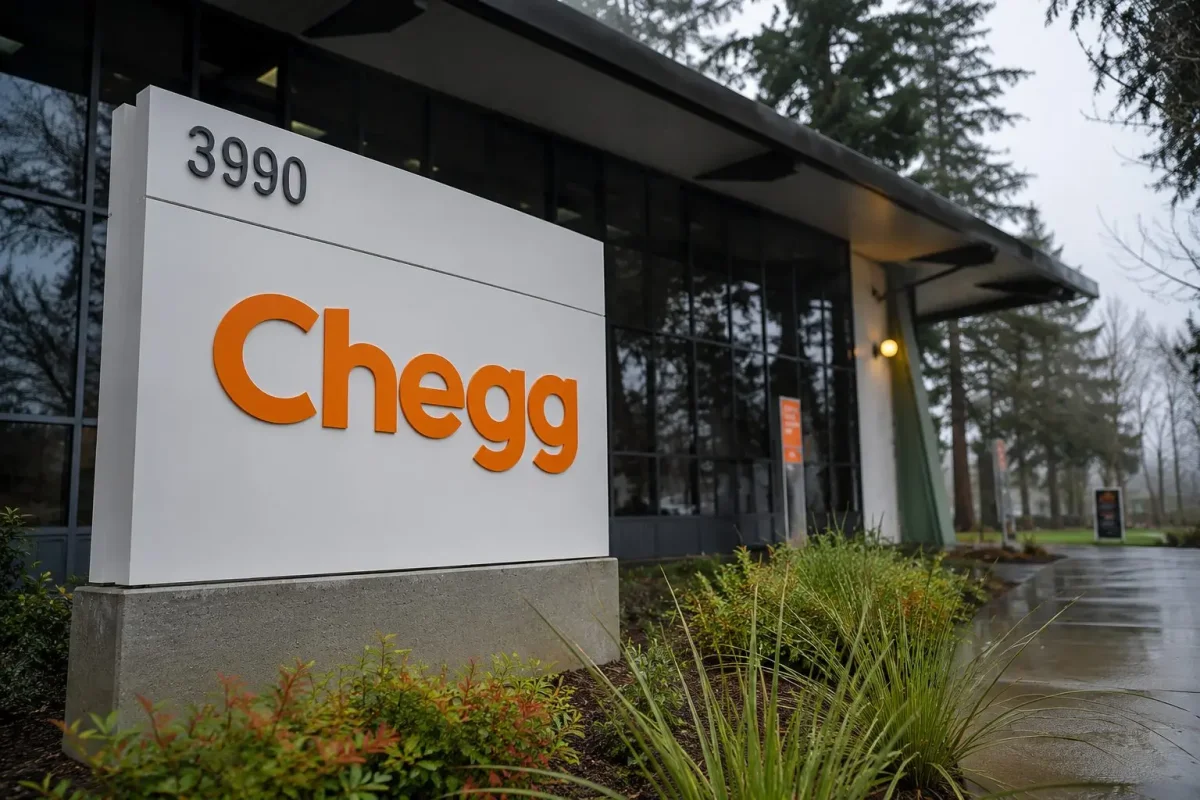
The New York Stock Exchange has issued a fresh non-compliance notice to Chegg Inc. (NYSE: CHGG), just weeks after the company regained compliance in June. The warning comes as the stock continues to trade below the $1 minimum price threshold, with shares closing at $0.9619 on Friday, July 25, 2026.
Despite a 17% gain over the past week, Chegg's stock price remains under pressure. The NYSE's notice points to an average closing price below $1 through July 23 as the primary reason for the new deficiency. To regain compliance, Chegg must meet two separate standards by the end of a calendar month: its closing share price and its 30-trading-day average must each be at least $1.
Publicly available closing figures show that the 30-day average as of July 23 stands at approximately $0.988. On July 31, six June closes, which average roughly $1.11, will be removed from the calculation. This means the next five closing prices would need to average about $1.21, or approximately 26% higher than Friday's close, to meet the threshold.
The recovery has been short-lived. Chegg was reinstated by the NYSE on June 1 after a previous compliance period. However, on June 17, the company's board announced it would halt a reverse stock split. The fresh notice came just 37 days later, highlighting the fragility of the situation.
Importantly, the notice does not immediately result in delisting. Chegg's stock can continue trading throughout a six-month window to regain compliance. If the company fails to meet the requirements, the process for suspension and delisting will begin. The board retains authorization from shareholders to proceed with a reverse stock split, which would automatically boost the quoted price. Investors approved a reverse split ratio from 1-for-4 up to 1-for-15 at the June 12 annual meeting.
However, a reverse split carries risks. While it would mechanically increase the stock price, Chegg's business performance would remain unchanged. According to the company's proxy statement, liquidity may decline and transaction costs could rise. Any price increase from a split might also be short-lived if market sentiment does not improve.
Chegg's financial outlook remains mixed. In the first quarter of 2026, revenue dropped 48% to $63.3 million. Skilling revenue, a key growth area, increased 9% to $17.6 million, and adjusted EBITDA was $15.5 million. CEO and Executive Chairman Dan Rosensweig described Q1 as "a strong quarter" and stated that "the foundation for future growth is now in place."
Looking ahead, management has forecasted second-quarter revenue between $49 million and $50 million, indicating a sequential decrease of approximately 21% to 23%. Adjusted EBITDA is projected at $5 million to $6 million, a drop of 61% to 68%. Investors are now focused on Friday, July 31, when the compliance test will be applied. Simply closing above $1 is not enough; the trailing average must also exceed this threshold.
Chegg's second-quarter results are scheduled for release on August 6 at 8:30 a.m. ET. The report will be closely watched to assess whether growth in skilling can counteract the overall decline in revenue. For now, the company faces a critical test of its market resilience and strategic direction.
