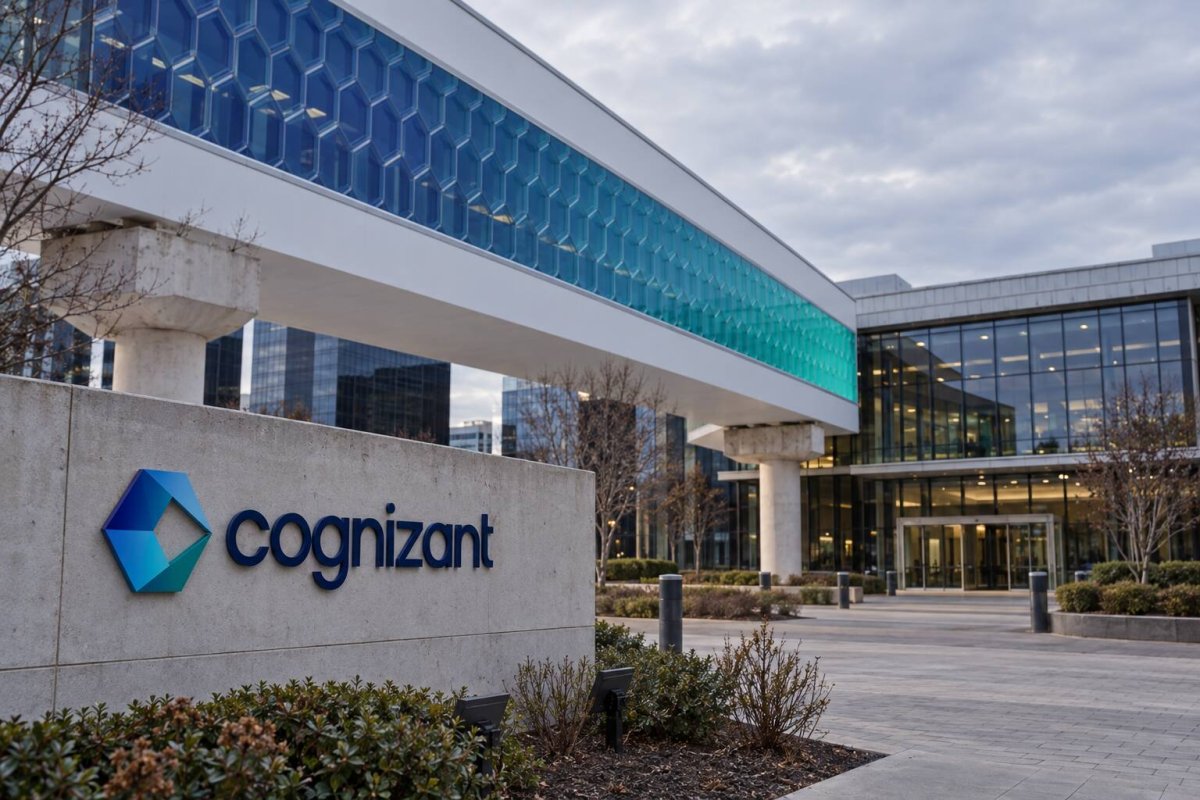
Cognizant's stock took a notable hit on Tuesday, closing at $59.92, a decline of 3.84%. This move leaves investors pondering a critical question: Is the IT services giant genuinely undervalued, or does the low price-to-earnings ratio signal deeper concerns about artificial intelligence disrupting its core business model? The answer, based on current projections, is nuanced.
At Tuesday's close, the stock trades at roughly 10.4 times the midpoint of management's 2026 adjusted earnings-per-share guidance of $5.76. Additionally, the annualized dividend of $1.32 offers a yield near 2.2%. These metrics suggest support, but they also hinge on future demand that the upcoming earnings report must validate.
The drop occurred on volume of about 5.9 million shares, with no new company-specific news. The last financial update was the second-quarter report released on July 29. This price action appears to be a reassessment of the stock's valuation amid ongoing skepticism about the prospects of outsourced technology services.
Q2 Results Were Solid, But Bookings Mix Raises Concerns
Cognizant's second-quarter performance was respectable: revenue reached $5.48 billion, up 4.5% year-over-year (4.1% in constant currency). Adjusted operating margin expanded by 40 basis points to 16.0%, and adjusted EPS rose 4.6% to $1.37. The Financial Services segment was a standout, with revenue jumping 12%, signaling continued strength in bank and insurer spending.
However, the order book tells a less comfortable story. Trailing-12-month bookings stood at $29.1 billion, up 5% year-over-year, with a book-to-bill ratio of 1.3 times. Yet, second-quarter bookings fell 6% from the prior-year period. This discrepancy between a strong rolling total and a soft quarter raises questions about the trajectory into 2027.
Management updated its full-year constant-currency revenue growth guidance to 4.0%-5.5% and raised adjusted EPS outlook to $5.70-$5.82. Notably, about two percentage points of third-quarter growth is expected to come from acquisitions, meaning organic acceleration—not just headline growth—will be key in the next report.
AI: Both the Pitch and the Risk
Cognizant markets itself as an "AI builder," assisting clients in deploying new tools. This could expand demand for engineering and data services. However, the counterargument is that AI can automate coding, testing, and support tasks traditionally billed by labor hours. Investors need evidence that new AI projects can outpace the compression of legacy revenue and pricing.
The company's Project Leap initiative is a visible part of this transition. Cognizant recorded $84 million in related costs in Q2 and expects $230 million to $320 million for the full year. These restructuring efforts may protect margins, but they don't necessarily translate to durable organic growth.
Capital allocation also presents a trade-off. Cognizant spent $1.6 billion on buybacks in the first half, with $2.3 billion remaining authorized. It also paid about $634 million for Astreya and drew $1 billion from its credit facility. While buybacks are accretive at a low multiple if earnings hold, they are less compelling if the market is correctly pricing in structural pressures.
What Would Make CTSH Truly Cheap?
For the bull case to strengthen, three things must happen: quarterly bookings need to stabilize and translate into organic revenue; growth must broaden beyond Financial Services, as Products and Resources and Health Sciences only grew 1.2% and 1.4% respectively; and the company must maintain its 16.0%-16.2% adjusted margin target while absorbing Project Leap changes.
The bear case is that a 10-times multiple is appropriate for a business facing automation-driven margin compression and acquisition-masked growth. The bull case is that stable margins, a 1.3 times book-to-bill, a 2.2% dividend, and aggressive buybacks offer too much support for the discount to persist.
Tuesday's drop didn't settle the debate—it merely lowered the entry price. The next decisive evidence will be the composition of growth and the direction of quarterly bookings, not just the AI narrative.