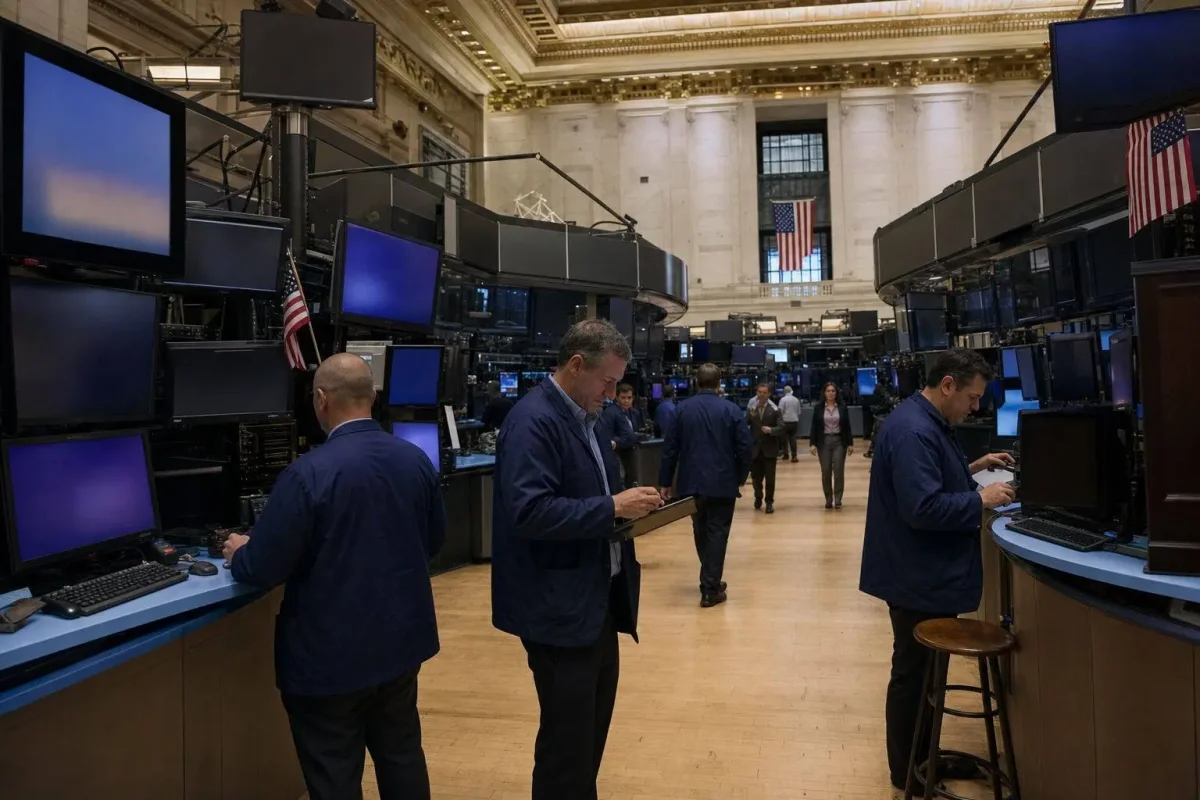
NEW YORK – Brent crude futures settled above the $90 mark on Monday, climbing 2.7% to $90.49 per barrel, as fresh U.S.-Iran hostilities injected a geopolitical risk premium into oil markets. The surge in energy prices rippled through Wall Street, dragging the Dow Jones Industrial Average down by 374.09 points, or 0.70%, to close at 53,185.90. The S&P 500 slipped 0.3% to 7,686.14, while the Nasdaq Composite edged lower by just 0.1% to 26,370.89.
The market's divergence was stark: energy stocks rallied as crude prices soared, but the broader index suffered from rising bond yields and inflation concerns. The 10-year Treasury yield added three basis points to reach 4.76%, its highest level in recent sessions. This combination of higher oil and higher yields weighed on most sectors, with only energy and technology managing gains.
Oil Shock Reshapes the Tape
Sunday's U.S. military strike on two missile launchers on Iran's Larak Island prompted traders to re-establish a "meaningful near-term supply premium," according to Gelber & Associates. The direct confrontation between the two nations has heightened fears of supply disruptions in the Strait of Hormuz, a critical chokepoint for global oil shipments.
The energy sector, as tracked by the Energy Select Sector SPDR Fund (XLE), surged 2.04% on the day, making it the standout performer. Exxon Mobil (XOM) climbed 2.7%, while Chevron (CVX) advanced 2.1%. These gains were driven purely by the crude price spike rather than broader economic optimism.
Breadth Remains Weak
Despite the late-session rebound in equity prices, market breadth remained subdued. Declining issues outnumbered advancers by a ratio of 3.15 to 1, with 372 S&P 500 members falling versus just 118 advancing. SPY trading volume came in at 34.35 million shares, approximately 86% of the 20-day average, indicating cautious participation.
The final hour of trading saw some buying interest, with SPY gaining 0.14% and QQQ rising 0.29% between 15:00 and 16:00 EDT. This late-day recovery helped narrow losses but failed to flip the overall session into positive territory.
Fed's Inflation Dilemma
The rise in oil prices adds to inflationary pressures at a time when the Federal Reserve is grappling with how to proceed on interest rates. Brock Weimer of Edward Jones noted that the Fed has "limited tolerance for meaningful upside inflation surprises." With the August jobs report due later this week and the inflation report scheduled for September 11, both data releases are likely to have a stronger impact on rate expectations given the elevated oil price environment.
Utilities and Industrials Drag
While energy led gains, other sectors struggled. Utilities (XLU) fell 1.17%, industrials (XLI) dropped 1.14%, and communication services (XLC) declined 1.35%. The weakness was broad-based, reflecting concerns over higher input costs and the potential for the Fed to maintain a hawkish stance.
Stock Movers: PG&E and Edison Hit Hard
California utilities faced significant pressure on Monday. PG&E Corporation (PCG) plunged 20.1% and Edison International (EIX) tumbled 23.1% after wildfire laws failed to include investor safeguards many had anticipated. Analysts at Wells Fargo, BMO Capital, and Mizuho downgraded PG&E, cutting price targets modestly. Aon (AON) also fell 8.6% following its announcement to acquire USI for $17 billion.
On the upside, Tesla (TSLA) gained 5.5%, though no specific catalyst was confirmed, with traders attributing the move to megacap buying interest.
Market Outlook
The session's close reflects a rotation rather than capitulation. Energy stocks widened their lead while the final-hour bid narrowed index losses. However, weak breadth leaves the recovery fragile. Investors are now watching for any escalation in Middle East tensions, which could push crude prices higher, yields up, and equity volatility in tandem. Conversely, a de-escalation could quickly remove the supply premium from energy prices.
All four major benchmarks ended August with gains, but the start of September has been marked by heightened volatility and geopolitical uncertainty.