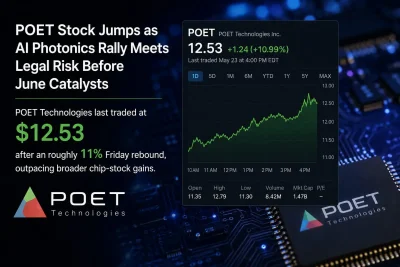
POET Technologies shares rallied approximately 10% in early Nasdaq trading on Tuesday, recovering from last week's steep decline as investors rotated back into the volatile AI-hardware name. The stock traded at $15.24, up $1.35 from Monday's close, with an intraday range of $14.06 to $15.67 on heavy volume of 12.3 million shares.
The move comes after a 17.1% drop last week, which occurred despite gains in the broader market, including the S&P 500 and Nasdaq Composite. Motley Fool contributor Keith Noonan noted the lack of company-specific news behind the slide, suggesting the pullback was driven by broader market dynamics rather than fundamental changes.
Key Catalysts: Financing and Supply Agreement
At the heart of Tuesday's rebound is POET's $400 million registered direct offering, which closed in May. The company sold 19,047,620 common shares along with warrants for the same number to a single institutional investor, generating $400 million in gross proceeds. While such deals provide a cash infusion, they also pose dilution risks for existing shareholders.
Another critical driver is the supply agreement with Lumilens for electrical-optical interposer (EOI) engines. The initial order is valued at $50 million, with the potential to exceed $500 million over five years, contingent on meeting development milestones and future purchase commitments. CEO Suresh Venkatesan emphasized that the company is expanding wafer production and optical-engine assembly capacity by roughly tenfold to support this and other high-volume projects.
Market Context and Challenges
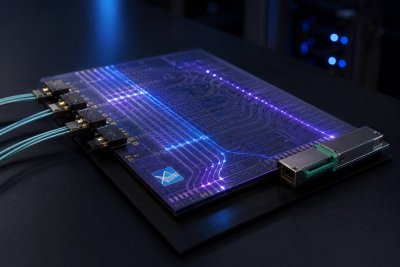
POET's optical interposer technology, which integrates chips and photonics, aims to reduce costs, power consumption, and hardware size for AI data centers. The company is targeting 800G, 1.6T, and faster optical engines for AI clusters and large-scale data centers. However, POET remains in a ramp-up phase, with first-quarter revenue of just $503,389 and a net loss of $12.3 million. The company is not yet a full-scale production story, and its success hinges on hitting key milestones.
CEO Venkatesan highlighted partnerships with LITEON, Lessengers, and Lumilens as evidence of growing demand, but the path to meaningful revenue remains uncertain. The Lumilens deal, in particular, depends on engineering samples expected in late 2026 and production scaling with hyperscaler rollouts in 2027. CEO Ankur Singla of Lumilens noted that GPU interconnects are becoming a defining bottleneck for scaling AI, underscoring the strategic importance of the partnership.
Risks and Headwinds
POET faces several risks, including the cancellation of purchase orders from Marvell Semiconductor, which acquired Celestial AI. Marvell terminated all orders after alleging POET breached confidentiality by disclosing order and shipping details. POET is working with other customers, including a separate order worth about $5 million.
Additionally, POET expects to be classified as a passive foreign investment company (PFIC) for U.S. tax purposes in 2025, which could trigger extra taxes for American investors. CFO Thomas Mika stated that the board plans to redomicile the company to the U.S., with a shareholder vote possible at the June 26 annual meeting.
Tuesday's rally may be driven more by trading flows than fundamental shifts. The Lumilens order remains contingent on achieving development, qualification, and mass-production milestones. POET's own filings caution that actual outcomes may differ from expectations, and the company still faces the challenge of transitioning from modest quarterly sales to significant product shipments. Any delays in samples, capacity issues in Malaysia, or customer sign-offs could reignite dilution and Marvell-related concerns.