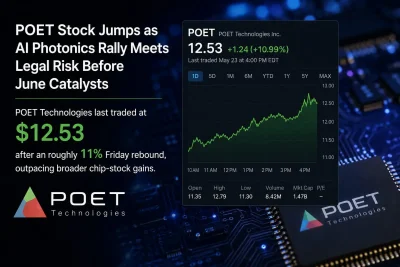
POET Technologies Inc. saw its stock climb sharply on Friday, trading at $12.735, up $1.485 or about 13.2% from the prior close, with volume exceeding 17 million shares and an intraday range of $11.00 to $12.79. The move underscores the stock's volatile nature as a Nasdaq-listed AI photonics play, where buyers are betting on the company's optical-engine technology transitioning from development-stage promise to commercial scale, while sellers remain focused on lawsuits, order risk, and potential dilution.
Legal Overhang and Class-Action Reminders
The latest news flow around POET has centered on securities-class-action reminders rather than a new operating announcement. Pomerantz LLP said Thursday that a class action had been filed against POET, with investors who bought during the class period having until June 29 to seek appointment as lead plaintiff. Rosen Law Firm's June 11 notice indicated the case covers purchases between April 1 and 8:57 a.m. ET on April 27, including allegations over POET's PFIC status and disclosures around business relationships. These allegations have not been proven, and no class has been certified yet.
The legal overhang traces back to POET's April 27 purchase-order update, when Marvell Semiconductor, which had acquired Celestial AI, canceled all purchase orders from Celestial AI, citing alleged confidentiality violations tied to purchase-order and shipping information. This disclosure was a major stock-price event because orders are especially critical for development-stage companies; when a future revenue stream is canceled, investors often mark down the stock to reflect lower expected sales and higher business risk. POET stated at the time it remained focused on other customer deliveries, including a separate purchase order valued at about $5 million.
Capital Infusion and Commercial Progress
The bull case for POET is that it has since secured enough capital to pursue scale. On May 18, the company closed a $400 million registered direct offering to a single institutional investor, issuing about 19.05 million common shares plus a warrant for the same number of shares. The proceeds are intended to support manufacturing expansion, research and development, acquisitions, light-source products, and working capital. CEO Dr. Suresh Venkatesan said POET was "expanding our capacity by roughly ten-fold," signaling management's positioning for higher-volume production rather than small engineering programs.
The commercial centerpiece is POET's agreement with Lumilens. POET said Lumilens placed an initial $50 million purchase order for EOI-based optical engines, with the broader relationship potentially scaling to more than $500 million in cumulative purchases over five years. EOI, or Electrical-Optical Interposer, is a platform intended to combine electrical and optical functions at wafer level, which POET says could help address bandwidth bottlenecks in AI data centers. However, fulfillment and related revenue depend on successful development, module qualification, and manufacturing scale-up; engineering samples are expected in late 2026, with production ramp aligned to 2027 deployments.
Bear Case: Revenue Gap and Dilution Risks
The bear case is that the valuation still rests heavily on future execution. In the first quarter, POET reported non-recurring engineering and product revenue of just $503,389 and a net loss of $12.3 million, or 8 cents per share. Non-recurring engineering (NRE) refers to project-specific work rather than steady, repeat product sales. That gap between today's revenue base and the stock's AI-infrastructure expectations leaves the shares sensitive to any delay, failed qualification, customer cancellation, or financing concern. The May financing also came with warrants, which if exercised can bring in cash but also create dilution, reducing existing holders' ownership percentage.
Upcoming Catalysts: Shareholder Meeting and Legal Deadline
The next major catalyst is POET's June 26 virtual annual meeting, with the U.S. redomiciling plan in focus. POET has said it may be treated as a PFIC (Passive Foreign Investment Company) for 2025, which can create adverse U.S. tax consequences for American shareholders unless mitigating elections are made. The company's board has approved redomiciling in the U.S. to eliminate the possibility of future PFIC classification, but there is no assurance the move will be completed. The June 29 lead-plaintiff deadline then follows as a second near-term legal milestone.
On verified facts, POET looks risky today rather than clearly attractive or fairly valued. Stocks rise when investors decide a company's future profits or strategic value are worth more, and they fall when lawsuits, dilution, lost orders, or execution doubts make that future less certain. Friday's rally shows traders are still willing to pay for POET's AI photonics upside, but the company must convert the Lumilens program and other customer work into qualified products, repeat revenue, and credible manufacturing scale before the stock can be judged on fundamentals rather than expectation.