Quantinuum Inc. shares edged lower in premarket trading on Friday, slipping below their initial public offering price just a day after a volatile market debut. The stock was last seen at $58.86, a decline of 2.52% from Thursday's close of $60.38 and below the $60 IPO price, as market participants weighed the company's early-stage financials against the long-term promise of quantum computing.
The Honeywell-backed quantum firm raised $1.68 billion in an upsized IPO, selling 28 million Class A shares at $60 each. Underwriters have the option to purchase an additional 4.2 million shares over the next 30 days. The stock trades on Nasdaq under the ticker "QNT."
Market Context
The premarket dip comes amid a broader softness in U.S. stock futures, dragged down by chip stocks and ahead of the May payrolls data. Nasdaq and S&P 500 futures slipped in early trade, reflecting cautious sentiment across the market.
Quantinuum's debut had initially sparked enthusiasm, with shares opening at $68 on Thursday, giving the company a valuation near $17.6 billion. However, gains quickly faded, and the stock closed at $60.38, just above the IPO price.
Financials Under Scrutiny
Investors are closely examining Quantinuum's financials, which highlight the early-stage nature of the quantum computing industry. In the first quarter, the company reported revenue of $5.2 million, a sharp decline from $19.1 million in the same period a year ago. The net loss widened to $136.6 million from $30.5 million. For the full year 2025, revenue totaled $30.9 million with a net loss of $192.6 million.
Bookings, which measure the total dollar value of customer contracts in a given period, were $79.3 million for 2025 but only $1.3 million in the first quarter. This uneven flow has raised questions about the company's ability to convert pilot deals into repeatable commercial contracts.
Quantum Computing Landscape
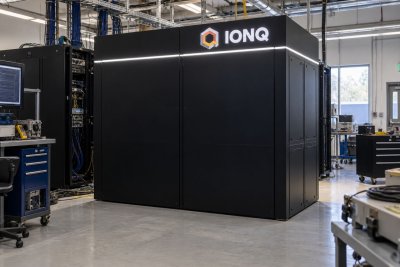
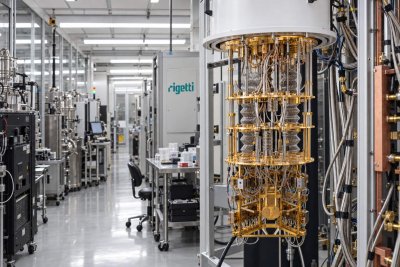
Quantinuum operates in a highly competitive field, with rivals including IonQ and Rigetti Computing. Both Quantinuum and IonQ use trapped-ion systems, while Rigetti relies on superconducting qubits. The company's prospectus highlights two-qubit gate fidelity as a key performance metric, comparing itself to these peers.
CEO Rajeeb Hazra has expressed optimism about quantum's commercialization, calling it "started small, but exhilarating." The company is pursuing a roadmap to Apollo, its first commercial-scale, fully fault-tolerant quantum computer, expected by the end of the decade. Fault-tolerant systems can correct errors during long calculations, a critical step for practical applications.
Investor Sentiment
IPOX Schuster analyst Kat Liu noted that the pitch was about the "long-term potential of quantum computing," with government support playing a significant role due to the technology's strategic importance for national security, AI, communications, and advanced computing.
However, the risks are substantial. Quantinuum has acknowledged that commercially viable fault tolerance faces "substantial scientific and engineering uncertainty," and its roadmaps could run late or fall short. The company expects to post operating losses in the near term, testing investor patience.
If QNT cannot sustain above the $60 IPO price, the public market's first take on Quantinuum may be a test of patience rather than a vote of confidence in quantum's promise.