Quantum computing stocks IonQ (NYSE:IONQ), D-Wave Quantum (NASDAQ:QBTS), and Rigetti Computing (NASDAQ:RGTI) experienced a significant rally on Monday, with shares climbing between 8.6% and 10.7% in early trading. The surge comes as all three companies prepare to release their second-quarter earnings reports by Thursday evening, with investors closely watching for signs of progress in the nascent quantum sector.
However, the rally has done little to ease concerns about valuation, particularly given the wide disparity in revenue generation among the trio. Benchmark's mean potential upside across its target prices for the three stocks has dropped to 51.3%, down from 66.0% over the weekend—a reduction of 14.8 percentage points, or roughly 22% of the prior projection. The figures are based on prices captured around 10:59 a.m. EDT on Monday.
Revenue Concentration Raises Flags
A closer look at the companies' financials reveals a stark contrast in scale. IonQ generated a staggering 89.9% of the combined $71.9 million in first-quarter revenue for the three firms, while accounting for only 53.7% of their total market capitalization. This concentration has led analysts to question whether smaller players like D-Wave and Rigetti are justified in their current valuations, which rely heavily on future contract wins and hardware advancements.
D-Wave and Rigetti together contributed just 10.1% of total revenue but represent 46.3% of the group's market value. D-Wave, for instance, reported bookings of $33.4 million—11.7 times its quarterly revenue—and had $42.4 million in remaining performance obligations, with management expecting 54% to be realized over the next 12 months. Rigetti, meanwhile, saw its revenue nearly triple year-over-year to $4.4 million, though its operating loss widened to $26 million.
Benchmark Analyst Weighs In
Benchmark analyst Gary Mobley noted that quantum computing is "not a winner-takes-all situation," suggesting that a diversified portfolio approach could be prudent given the sector's early stage. Over the weekend, commentary was split, with some backing a basket of quantum stocks while others favored IonQ as the clear leader. The divergence highlights the uncertainty surrounding which companies will ultimately dominate the market.
Earnings Outlook and Key Developments
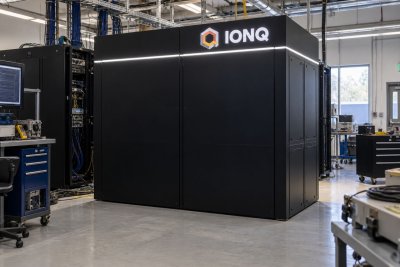
IonQ heads into its earnings announcement with the most specific near-term guidance, projecting second-quarter revenue of $65 million to $68 million and maintaining its full-year outlook of $260 million to $270 million. The company completed its U.S. foundry acquisition on July 31, which introduces additional integration tasks that could pose risks. IonQ is scheduled to report after market close on Wednesday.
D-Wave delivered the only major corporate news on Monday, announcing a proof-of-concept agreement with Nasdaq Inc.'s (NASDAQ:NDAQ) Verafin division to develop a financial-crime detection solution. CEO Alan Baratz called it an "important opportunity," though no financial terms were disclosed. D-Wave's report is due before Thursday's market open.
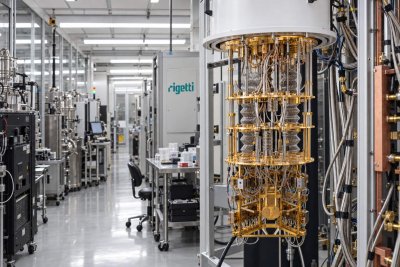
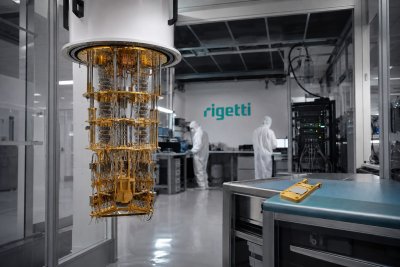
Rigetti will release its results on Thursday at 5 p.m. EDT. The company reported no debt and held $569 million in cash and investments at the end of the first quarter.
Valuation Metrics Under the Microscope
Using a simple run-rate calculation—market value divided by annualized first-quarter revenue—IonQ trades at 57 times, while D-Wave and Rigetti trade at 644 times and 309 times, respectively. These figures underscore the premium investors are paying for potential rather than current performance. However, D-Wave's revenue is subject to significant quarterly fluctuations due to the timing of system sales, which complicates comparisons.
Risks remain elevated across the board. Setbacks in technology development, contract delays, and substantial operating losses could impact valuations. IonQ faces additional integration risk from its foundry acquisition. With earnings due this week, any disappointing results could erase Monday's gains, leaving investors to weigh the sector's long-term promise against its near-term financial realities.