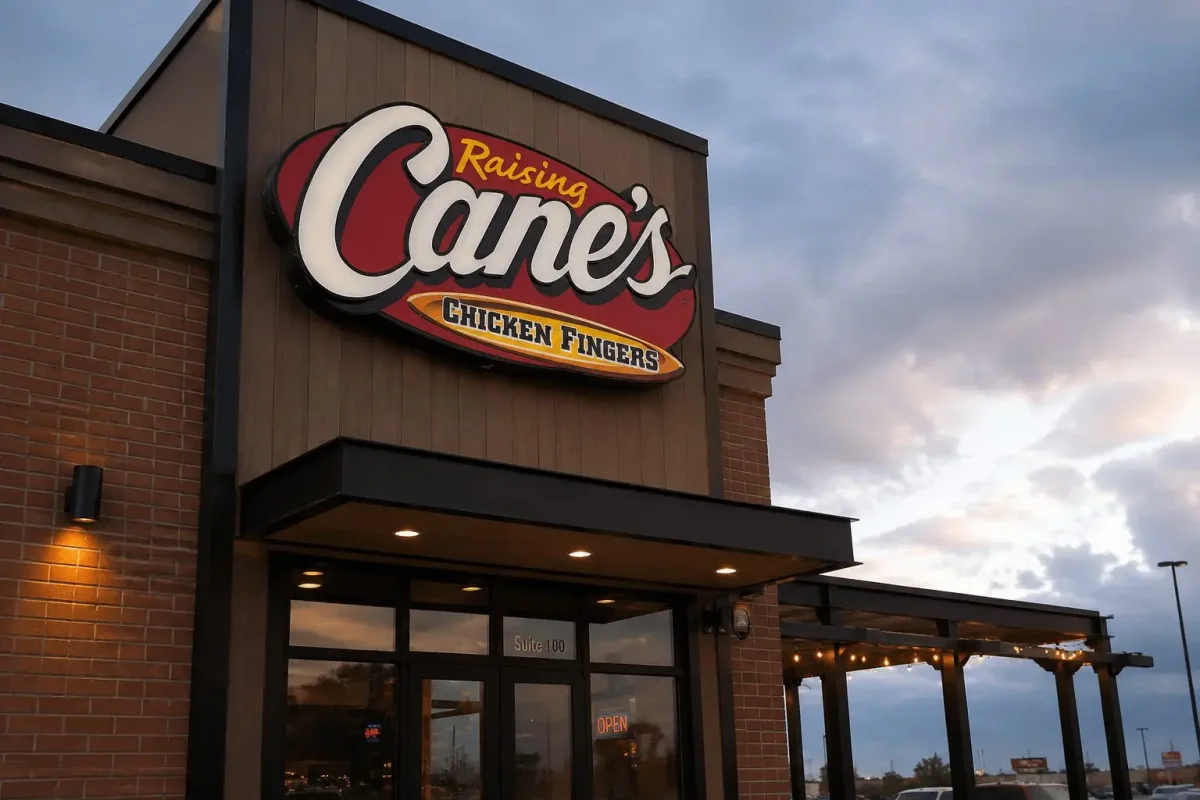
Raising Cane's, the privately-held chicken finger chain, is set to open seven new U.S. locations in August, alongside the relaunch of four renovated restaurants. The expansion reflects a strategic shift in the brand's growth trajectory, with a mix of market penetration and new market entry.
Five of the new restaurants will strengthen the chain's presence in existing markets, while the remaining two will mark the company's debut in Rocky Mount, North Carolina, and Statesboro, Georgia. This distribution means 71% of the new openings are in established territories, while just 29% represent first-time market entries.
The August schedule is part of Raising Cane's broader goal to open 100 new locations in 2026, a target the company announced after hitting its 1,000th store milestone in March. The seven August openings account for 7% of that annual objective. Early estimates suggest the pace of openings, when annualized, approaches 8%, which aligns closely with KFC's recent unit growth of 7% but remains well below Wingstop's aggressive 16% expansion rate.
The opening timeline is spread across four consecutive Mondays, with the bulk of activity in the latter half of the month. On August 3, locations in Novi, Michigan, and Rocky Mount, North Carolina, will open—one in an existing market and one in a new one. August 10 sees a single opening in Thousand Oaks, California. August 17 brings two more in Fontana, California, and Linden, New Jersey. The final wave on August 24 includes Tuscaloosa, Alabama, and Statesboro, Georgia.
In addition to new builds, Raising Cane's is reopening upgraded restaurants in Texas, Kentucky, Nevada, and Ohio. These renovations are part of the company's ongoing effort to refresh its store base and enhance the customer experience.
For investors, the most relevant public comparables are Wingstop (NASDAQ: WING), Yum! Brands (NYSE: YUM), and Restaurant Brands International (NYSE: QSR), which own the KFC and Popeyes chains. Recent results from these companies highlight the divergence between unit growth and same-store sales. Wingstop, for instance, opened 102 new locations in the second quarter, but domestic same-store sales fell 7.5%. Despite this, system-wide sales rose 5.3%, indicating that expansion is driving overall growth. CEO Michael Skipworth described the pipeline as "one of the strongest development pipelines in the industry," while maintaining a global unit growth forecast of 15% to 16%.
KFC, under Yum! Brands, reported 7% unit growth and a 2% increase in same-store sales, with system sales up 6% on a currency-neutral basis. However, U.S. KFC system sales declined 2%, a soft spot that was offset by international strength. Yum CEO Chris Turner emphasized the company's focus on "dependable growth, disciplined execution and long-term value creation."
Popeyes, part of Restaurant Brands International, saw same-store sales drop 6.5% in the first quarter, while net restaurant growth was just 1.2%. RBI is scheduled to report second-quarter earnings on Thursday at 8:30 a.m. EDT, which will provide further insight into Popeyes' performance.
Over the past week, the three public stocks have moved in different directions. Wingstop fell 4.2% from July 24 to July 31, closing at $129.49. Yum! Brands rose 2.9% to $153.28, and RBI advanced 2.1% to $74.02. These moves reflect investor sentiment amid mixed fundamental data.
Looking ahead, the market will closely watch the initial performance of Raising Cane's August openings, as well as RBI's earnings report. The Tuscaloosa location, set to open on August 24 at 9 a.m. CDT on McFarland Boulevard, will be the city's first standalone Cane's, complementing an existing outlet on the University of Alabama campus.
Risks remain, however. The opening schedule does not guarantee restaurant-level returns, and new locations could cannibalize sales from nearby existing stores. Rising labor and construction costs may also extend payback periods. Notably, Raising Cane's has not disclosed comparable-sales figures or unit-level return data, leaving investors with incomplete information to assess the chain's performance relative to its public peers.