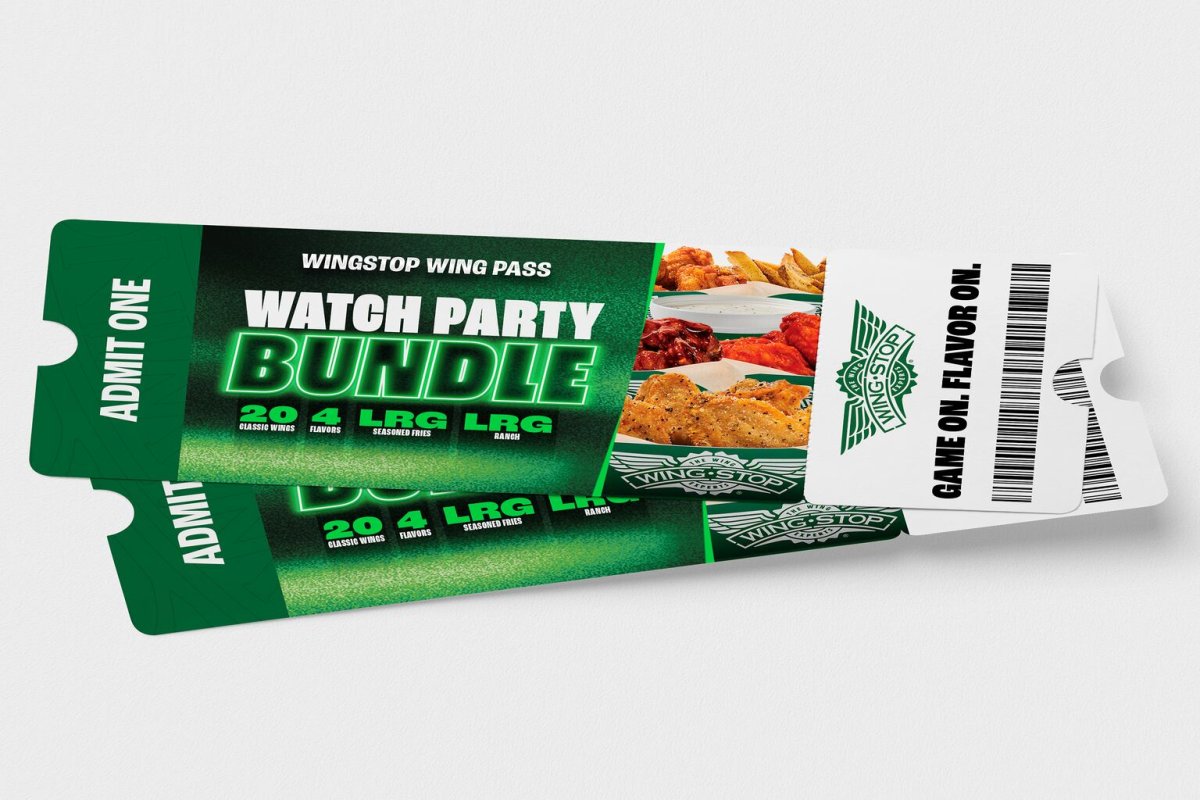
Wingstop (NASDAQ: WING) has launched its first-ever Wing Pass, a $27.99 offer that grants holders access to 18 weekly Watch Party Bundles throughout the football season. However, with only 100 passes available, the promotion is more of a loyalty experiment than a significant financial catalyst, which explains why the company's stock barely moved on the news.
At 1:19 p.m. ET on Thursday, shares of Wingstop were down 0.43% to $110.11, according to real-time Nasdaq data. The muted market reaction is logical: 100 passes cannot move the needle for a chain with over 3,000 restaurants.
What's in the Wing Pass?
The Wing Pass went on sale to Club Wingstop members at noon CT on Thursday, September 10, through wingshop.com. Each Sunday during the 18-week regular football season, passholders receive an offer in their Wingstop app for one Watch Party Bundle, which includes 20 classic wings in up to four flavors, a large seasoned fries, and a large ranch.
Wingstop notes that a single Watch Party Bundle normally costs the same $27.99 as the entire pass. A customer who redeems all 18 weekly offers would receive up to $503.82 in advertised menu value for just $27.99, implying a 94.4% discount before taxes and any limitations.
Across all 100 passes, the maximum potential redemption is 1,800 bundles: 36,000 wings, 1,800 large fries, and 1,800 large ranches. The nominal menu value totals $50,382, while the initial pass payments amount to only $2,799.
These figures are not an accounting estimate. Redemption rates may be lower than 100%, menu value does not equal restaurant cost, and the company has not disclosed how revenue or reimbursements will be allocated among franchisees. Still, they put the promotion's maximum scale into perspective.
Why the 100-Pass Limit Matters for WING Stock
Wingstop reported $1.411 billion in system-wide sales for its latest quarter. Even the full $50,382 menu value behind the Wing Pass represents just 0.0036% of that total, making the direct economics immaterial by design.
The more relevant aspect is distribution. The offer requires Club Wingstop membership, is delivered through the app weekly, and ties redemption to a recurring Sunday occasion. A scarce offer can generate attention while giving Wingstop 18 chances to observe whether passholders add drinks, sides, or extra food, and whether they continue ordering after the season.
This is a cleaner way to interpret the pass: as a small customer-acquisition and engagement test. The limit caps economic cost, while the headline value encourages sign-ups and social sharing.
The Same-Store Sales Challenge
Wingstop's second-quarter results highlight why repeat visits matter now. Domestic same-store sales fell 7.5% year-over-year, even as system-wide sales rose 5.3%, according to its July 29 report. The chain offset weaker sales at established restaurants by opening 102 net new locations, increasing the system-wide count by 16% to 3,255.
Digital orders already represent 71.6% of system-wide sales. Club Wingstop, launched nationally during the quarter, gives the company a direct channel for retention offers and customer-level data. The Wing Pass leverages this infrastructure rather than serving as a broad price cut.
The franchise structure also affects the investor calculus. At quarter-end, Wingstop had 2,671 domestic franchised restaurants, 527 international franchised restaurants, and only 57 company-owned domestic stores, according to the 10-Q. Any scaled version of the pass would need to generate incremental traffic without shifting too much food cost or labor burden to franchise partners.
The National Launch Is the Bigger Test
Alongside the pass, Wingstop introduced Lemon Pepper Chili Crunch and Lemon Pepper Chili Glaze to Club members. These flavors are scheduled to launch nationwide on September 15 for a limited time, joining Original Lemon Pepper as a three-flavor lineup.
That rollout reaches the full U.S. system and could influence traffic, mix, and repeat purchases in a way that 100 passes cannot. Investors should watch for improving domestic comparable sales and evidence that Club Wingstop changes order frequency. Without those results, the Wing Pass is clever marketing around a real traffic challenge—not a reason by itself to revise a WING earnings model.