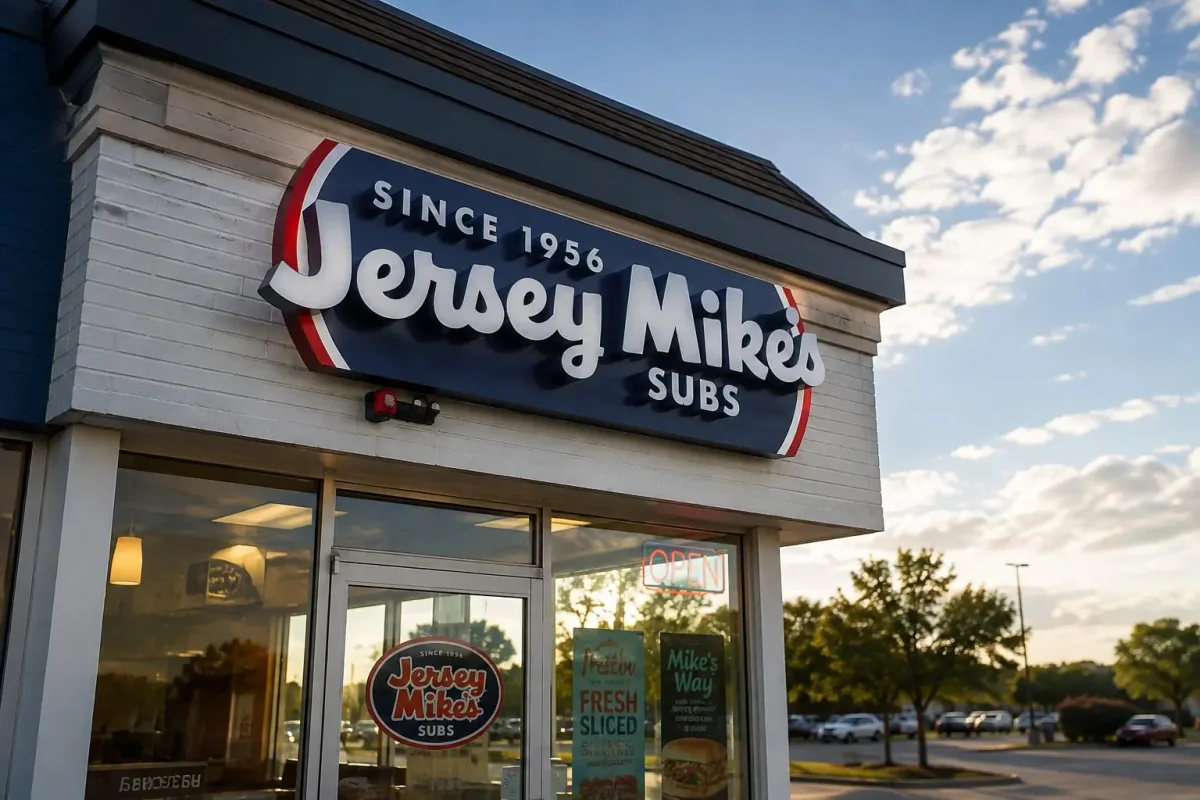
New York, August 1, 2026 – Jersey Mike's (NYSE:JMKE) shares closed the trading week at $23.00 on Friday, fully recovering from its disappointing market debut a day earlier. The stock advanced $1.37, adding approximately $435 million in equity value based on about 317.6 million shares on a fully exchanged basis. The rebound brought the sandwich chain's market capitalization to roughly $7.30 billion.
The initial public offering, which priced at $23 per share, saw the stock fall 6% on its first day of trading, a stark contrast to the average first-day gain of 17% seen across 80 U.S. IPOs this year, according to Dealogic. Friday's 6.3% climb erased that deficit, but the recovery did little to change the company's underlying financial structure.
Jersey Mike's raised approximately $301 million in net proceeds from the sale of 13.78 million new shares, while existing shareholders sold 29.70 million shares, pocketing about $683 million in gross proceeds. The company plans to use its share of the proceeds to pay down debt and for general corporate purposes. However, the bulk of the offering's value went to current investors, including private equity firm Blackstone (NYSE:BX), which retains nearly two-thirds of voting control.
Debt Remains a Key Concern
Despite the equity value recovery, Jersey Mike's faces a more challenging test in its balance sheet. The company entered the offering with $2.1 billion in fixed-rate debt and $232 million in cash, resulting in net debt of $1.87 billion. If the company uses all of its net IPO proceeds to reduce debt, net leverage could fall to approximately $1.57 billion, or 4.6 times projected 2025 adjusted EBITDA of $339 million. This is an improvement from the 5.5 times leverage before the offering, but it still represents a significant burden.
Using the optimal debt paydown scenario, the company's enterprise value stands at roughly $8.9 billion, translating to about 26.2 times its forecasted 2025 adjusted EBITDA. This premium valuation is supported by strong operational performance, with adjusted EBITDA growing 29% year-over-year to $339 million in 2025, outpacing revenue growth of 11% to $724 million. Systemwide sales rose 13% to $4.2 billion.
Growth Slows, Margins Expand
However, momentum at the store level is cooling. Same-store sales increased 2.3% in the latest 13-week period, down from 3.6% a year ago. Management noted that customer transactions improved during the quarter, but the deceleration in same-store sales growth is a warning sign for investors. Margin expansion has been notable, but the company's ability to sustain this growth while managing its debt load will be critical.
At $23 per share, Jersey Mike's trades at approximately 10.1 times estimated 2025 revenue, a significant premium to fast-casual peers like Cava Group (NYSE:CAVA) and Chipotle Mexican Grill (NYSE:CMG), which trade at roughly five to six times trailing sales. Peer stocks fell on Friday, with Cava down 1.8%, Chipotle off 3.3%, and Wingstop (NASDAQ:WING) declining 3.7%.
Long-Term Vision vs. Near-Term Risks
Chief Executive Charlie Morrison remains optimistic about the company's growth prospects, citing potential for 7,500 locations in the U.S. and another 7,500 internationally. Jersey Mike's currently operates more than 3,300 stores. "We're not disappointed with the pricing. We're playing the long game," Morrison said.
IPOX Research associate Lukas Muehlbauer offered a broader perspective, noting that raising roughly $1 billion for a sandwich chain is "already an impressive outcome." U.S. IPO proceeds have exceeded $140 billion this year, reflecting a robust market for new listings.
Looking ahead, investors will monitor whether the $23 offer price holds. Underwriters have the option to purchase up to 6.52 million additional shares from existing shareholders, which would not generate any proceeds for the company. No investor events are scheduled for next week.
Risk Factors
Key risks include a potential slowdown in consumer spending, which could impact traffic and franchisee earnings. Same-store sales gains have already softened, and elevated leverage leaves little room for operational missteps. Additionally, Blackstone's majority stake limits minority shareholders' influence, while fixed-rate debt shields against interest rate fluctuations but does not reduce principal obligations.
The stock's rebound on Friday restores its IPO value, but the capital raised falls short of the company's needs. Jersey Mike's must now demonstrate that its 29% EBITDA growth translates into meaningful debt reduction to justify its premium valuation. For now, investors are paying a high price for growth while the sponsor retains control.