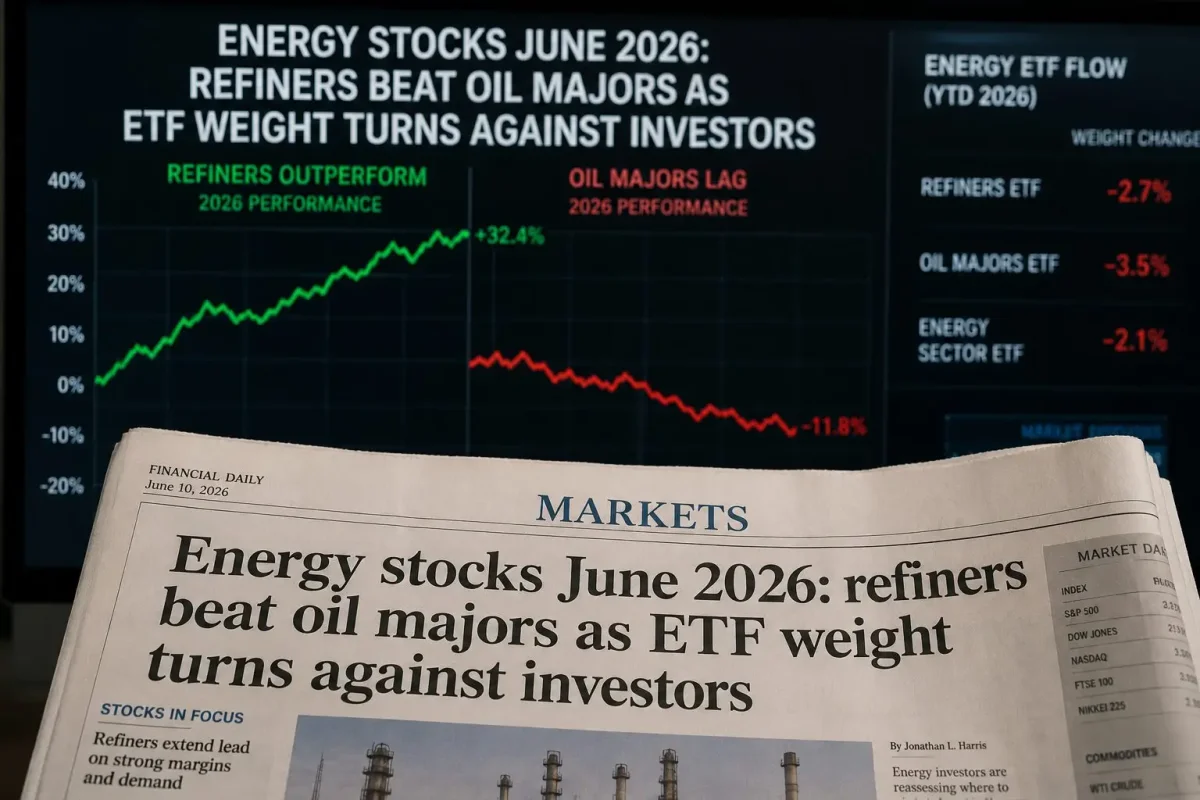
The Energy Select Sector SPDR Fund (XLE) fell 4.8% in June through Monday, dragged down by a heavy weighting in major integrated oil companies. In contrast, refiner stocks Valero Energy (VLO) and Marathon Petroleum (MPC) rose 8.8% and 4.2%, respectively, underscoring a sharp divergence within the energy sector.
As of June 26, Exxon Mobil (XOM), Chevron (CVX), and ConocoPhillips (COP) collectively accounted for 45.4% of XLE's index weight. Their combined decline subtracted roughly 3.2 percentage points from the fund's monthly performance, while the three refiners—Valero, Marathon, and Phillips 66 (PSX)—made up only 13.1% of the index, limiting their positive impact.
Refiner tailwinds from exports and margins
The outperformance of refiners was supported by robust product exports and favorable refinery margins. The U.S. Energy Information Administration (EIA) now forecasts record U.S. net petroleum product exports of 5.6 million barrels per day in 2026, providing a strong backdrop for domestic refiners. The International Energy Agency (IEA) also reported tightening global refined product supply, projecting global refinery crude throughputs will decline by 2 million barrels per day in 2026 to 82 million bpd, with a year-on-year drop of 4.7 million bpd in the second quarter.
Marathon Petroleum CEO Maryann Mannen highlighted the company's insulation from global crude supply disruptions, citing its reliance on U.S. and Canadian crude. Marathon reported a first-quarter refining and marketing margin of $17.74 per barrel, a 32.6% increase year-over-year.
Cautious outlook from Phillips 66
Phillips 66 CEO Mark Lashier struck a more cautious tone, noting that between 90 million and 100 million barrels of crude remain stuck in the Strait of Hormuz, which will take time to clear. He suggested a potential structural shift in the crude floor price. The company has reduced costs in its refining segment by about $1 per barrel so far, targeting $5.50 in savings, while improving yields of high-value products.
Macro risks and analyst downgrades
June's gains for refiners could reverse if crude flows normalize before product margins decline. On June 15, a U.S.-Iran deal to end the conflict and reopen the Hormuz Strait sent energy stocks lower, with Brent crude falling 5.5% to $82.55. However, Ashley Kelty at Panmure Liberum warned that crude supply is unlikely to resume pre-war levels for months.
Barclays lowered its Brent price forecast on June 26 to $96 per barrel for 2026 and $85 for 2027, down from prior estimates of $100 and $88, respectively. UBS also cut its Brent outlook to $85 per barrel for both end-September and end-December, from $105 and $95 previously. Both banks still expect a supply deficit in the third quarter due to slow production recovery.
Key data points at a glance
- XLE top three weight (Exxon, Chevron, ConocoPhillips): 45.4% of index; contributed -3.2 pts to June performance.
- XLE refiner trio (Valero, Marathon, Phillips 66): 13.1% of index; gains insufficient to offset major losses.
- EIA 2026 U.S. net petroleum product exports forecast: 5.6 million bpd (record).
- IEA 2026 global refinery throughput forecast: 82 million bpd, down 2 million bpd.
- Barclays 2026 Brent forecast: $96/bbl (cut from $100).
- UBS end-2026 Brent forecast: $85/bbl (cut from $105).
The market's focus now turns to whether the refiner rally can sustain amid potential normalization of crude flows and further analyst downgrades for upstream names.