Rigetti Computing (RGTI) shares advanced on Friday, continuing their upward trajectory after a fresh analyst endorsement. The stock touched an intraday high of $21.945 before settling near $21.27, up $0.64 from the previous close, on volume of roughly 23.9 million shares. The move underscores renewed investor interest in companies positioned to benefit from government-backed quantum research initiatives.
Wall Street provided the latest catalyst for the quantum-computing firm. On June 11, Rosenblatt Securities maintained its Buy rating and $40 price target on Rigetti, according to Benzinga's analyst-ratings tracker. MarketBeat noted that the target implied nearly 99% upside from the prior close, though that percentage shifts with the stock's price movements. This analyst support is significant because Rigetti's valuation hinges more on future technical and commercial milestones than on current earnings.
Rigetti's first-quarter results, reported in early May, illustrate the disconnect. Revenue came in at $4.4 million, while the company posted an operating loss of $26.0 million. As of March 31, it held $569.0 million in cash, cash equivalents, and available-for-sale investments. On a non-GAAP basis, which excludes stock-based compensation and warrant-value changes, the net loss was $14.7 million. At a market capitalization of approximately $7.13 billion, the stock trades at more than 400 times annualized first-quarter revenue, a price-to-sales ratio that signals aggressive valuation.
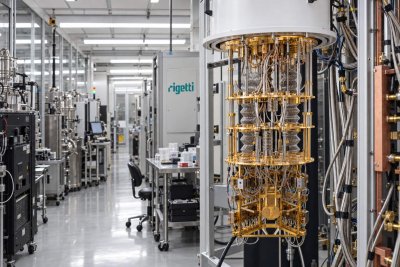
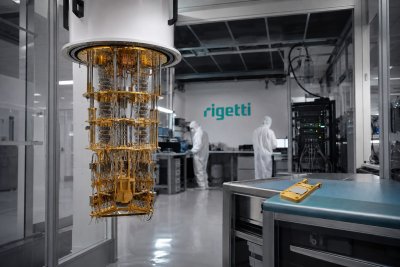
The bull case for Rigetti rests on tangible technology milestones and potential federal funding. The company recently made its Cepheus-1-108Q system, a 108-qubit superconducting quantum processing unit (QPU), available through Rigetti QCS, Amazon Braket, Microsoft Azure Quantum, and qBraid. Amazon highlighted that Cepheus-1-108Q is the first gate-based quantum device with more than 100 qubits on Amazon Braket, and Rigetti noted the system uses twelve interconnected 9-qubit chiplets.
Government support is another key pillar. In May, Rigetti signed a letter of intent with the U.S. Department of Commerce for up to $100 million over three years under the CHIPS Act. CEO Dr. Subodh Kulkarni said the investment would help tackle key scaling bottlenecks and move the company closer to utility-scale quantum computing, a term for systems capable of solving practical problems beyond experimental workloads.
However, the bear case is equally compelling. The stock already prices in substantial future success, and Rigetti remains loss-making on an operating basis. The Commerce letter of intent includes a potential equity stake for the government, which the company itself flags as a dilution risk for existing shareholders if definitive agreements are reached. Revenue is still tiny, and operating losses are significant. The stock's high valuation leaves little room for error.
Investors should monitor three key catalysts: whether Rigetti converts the Commerce letter of intent into definitive funding, whether the 108-qubit system drives broader customer adoption, and whether the company can improve gate fidelity at scale. In its first-quarter update, Rigetti reported 99.8% median two-qubit gate fidelity on its 9-qubit system and fidelities as high as 99.9% on prototype systems, but the market will need proof that performance can scale commercially.
Based on the numbers, Rigetti presents a high-risk, high-reward profile. The bull narrative includes analyst support, a large cash balance, 108-qubit availability, and potential federal funding. Yet the bear case is equally concrete: small revenue, significant operating losses, aggressive valuation, and uncertain timelines for future milestones. The next few quarters will be critical in determining whether the stock can justify its current price.