Rigetti Computing Inc. closed the trading week at $17.50, up a modest 0.29%, as the market braces for the company's first-quarter earnings report due after the bell on May 11. The stock, which has experienced a volatile spring, now faces a critical test as investors seek evidence that the quantum computing firm's technological advances are translating into sustainable revenue growth.
The upcoming earnings release marks Rigetti's first quarterly report since the launch of its 108-qubit Cepheus-1-108Q system, now accessible via the company's own cloud platform and Amazon Braket. In quantum computing, qubits represent the fundamental units of information, and higher qubit counts theoretically enable more complex calculations. However, industry observers caution that increasing qubit capacity does not automatically guarantee commercial success.
Wall Street expectations remain tempered. According to Zacks consensus estimates, Rigetti is projected to report a net loss of $0.05 per share on revenue of just $3.3 million for the quarter. This follows a full-year 2025 performance where the company generated only $7.1 million in revenue while posting a GAAP net loss of $216.2 million. The stark contrast between valuation and financial performance has raised eyebrows, with Rigetti's market capitalization hovering near $5.69 billion.
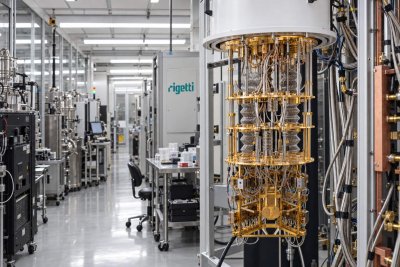
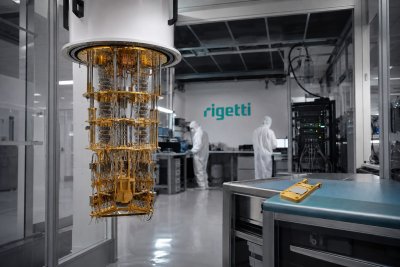
The company's technological roadmap includes a chiplet-based architecture, which uses smaller, interconnected modules rather than a single large chip. The Cepheus-1-108Q system, for example, integrates twelve 9-qubit chiplets and achieves a median two-qubit gate fidelity of 99.1% and a single-qubit gate fidelity of 99.9%. Gate fidelity measures the accuracy of quantum operations, a key metric for practical quantum computing. CEO Subodh Kulkarni described the system launch as a milestone, while Amazon Braket's Eric Kessler noted it offers customers another option for quantum research.
Beyond its domestic efforts, Rigetti has outlined international expansion plans. In March, the company announced an investment of up to $100 million in the United Kingdom, with a goal of deploying a system exceeding 1,000 qubits within three to four years. This marks Rigetti's first major international commitment and signals its ambition to compete globally in the quantum computing space.
Despite these developments, market sentiment has grown cautious. A May 2 analysis from Simply Wall St highlighted the need for proof of commercial demand for Rigetti's updated systems, noting that the company still faces challenges from choppy revenue streams tied to government contracts and significant cash outflows. Rigetti ended 2025 with $589.8 million in cash, cash equivalents, and available-for-sale investments, providing a cushion but also underscoring the cash burn rate.
The risks are substantial. Rigetti's annual filing reveals that a significant portion of its revenue depends on government contracts, and scaling quantum computers remains a formidable technical hurdle. Missed orders, delayed funding, or shifts in technology roadmaps could all reignite valuation concerns in future earnings calls.
As the May 11 report approaches, the focus is not on the future of quantum computing as a whole, but squarely on Rigetti's ability to execute in the present. Investors will be scrutinizing recognized revenue, system shipments, cash management, and a clear roadmap that moves beyond aspirational promises to tangible results. The earnings test will determine whether Rigetti's stock can regain its momentum or if the recent rally was merely a quantum mirage.