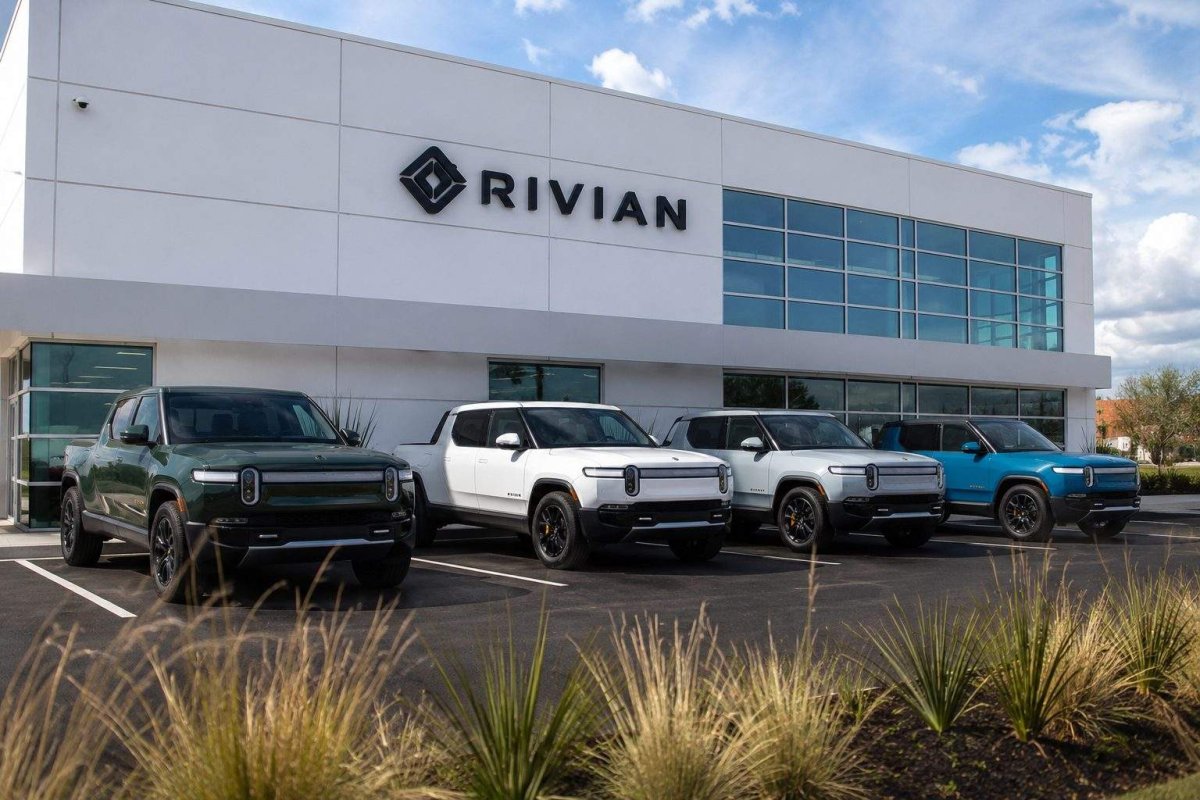
Rivian Automotive saw its stock climb sharply in late May, with shares rising 7.2% on Friday and posting a weekly gain of roughly 14.6%. The move came after the company confirmed that the first deliveries of its R2 SUV will commence on June 9. Shares closed at $16.30 on May 29, with trading volume near 59.3 million shares.
The rally stood out in a relatively calm market. The Nasdaq Composite edged up just 0.2% on Friday, while Tesla fell roughly 1.5% and Lucid gained 1.2%. Rivian's advance appeared tied to company-specific news rather than a broader EV sector move.
Rivian said the R2 Performance with Launch Package will be the first variant delivered, with the Premium trim following later in 2026 and the Standard trim scheduled for 2027. The company expects to deliver vehicles two to six weeks after order confirmation. According to TechCrunch, the initial R2 version starts just below $60,000, while the Standard version is priced at $48,490 and set for 2027.
The R2 launch positions Rivian to compete in the mass-market SUV segment, where Tesla's Model Y remains the benchmark. However, Rivian's production volumes are still a fraction of Tesla's. First-quarter revenue came in at $1.381 billion, up 11% year-over-year, with 10,365 vehicles delivered.
Despite the revenue growth, Rivian reported a net loss of $416 million for the quarter and burned $1.075 billion in free cash flow. The company did achieve a consolidated gross profit of $119 million, a positive sign for its cost management efforts. The free cash flow figure, which tracks cash from operations minus capital spending, is closely watched by investors as a measure of how quickly the EV maker is consuming its cash reserves.
For 2026, Rivian is targeting 62,000 to 67,000 deliveries, with an adjusted EBITDA loss between $1.8 billion and $2.1 billion. Capital spending is expected to range from $1.95 billion to $2.05 billion. Adjusted EBITDA, which excludes interest, taxes, depreciation, amortization, and other costs, provides a different perspective than net income.
Analysts have mixed views on the R2 launch. Itay Michaeli at TD Cowen called the shares a 'positive risk/reward' ahead of the rollout, while D.A. Davidson's Michael Shlisky cautioned that Rivian needs to deliver 'the best mid-size EV launch since 2021' in a market lacking tax credits and a mass dealer network.
Beyond the vehicle itself, Rivian is also emphasizing its software capabilities. Software head Wassym Bensaid told The Verge that 'voice has the chance to be the primary interface in the car,' noting that the R2 is the first Rivian to ship using new architecture linked to its Volkswagen joint venture. Investors are eager to see if that software bet translates into revenue.
Meanwhile, U.S. auto safety regulators have launched a preliminary investigation into 114,922 Rivian vehicles over potential issues with the rear toe link, a component affecting wheel alignment, following two owner reports of separations while driving. One incident resulted in a crash. Rivian stated that its data shows the R1 toe link joints are functioning as designed and is cooperating with regulators on the probe.
Looking ahead, traders will focus on Monday's open, R2 order flow, and developments in the safety review. If the timeline remains on track through June 9, Rivian could continue to trade on the launch momentum. However, any signs of delay, weak initial demand, a new Tesla price cut, or escalating regulatory issues could quickly deflate Friday's rally.