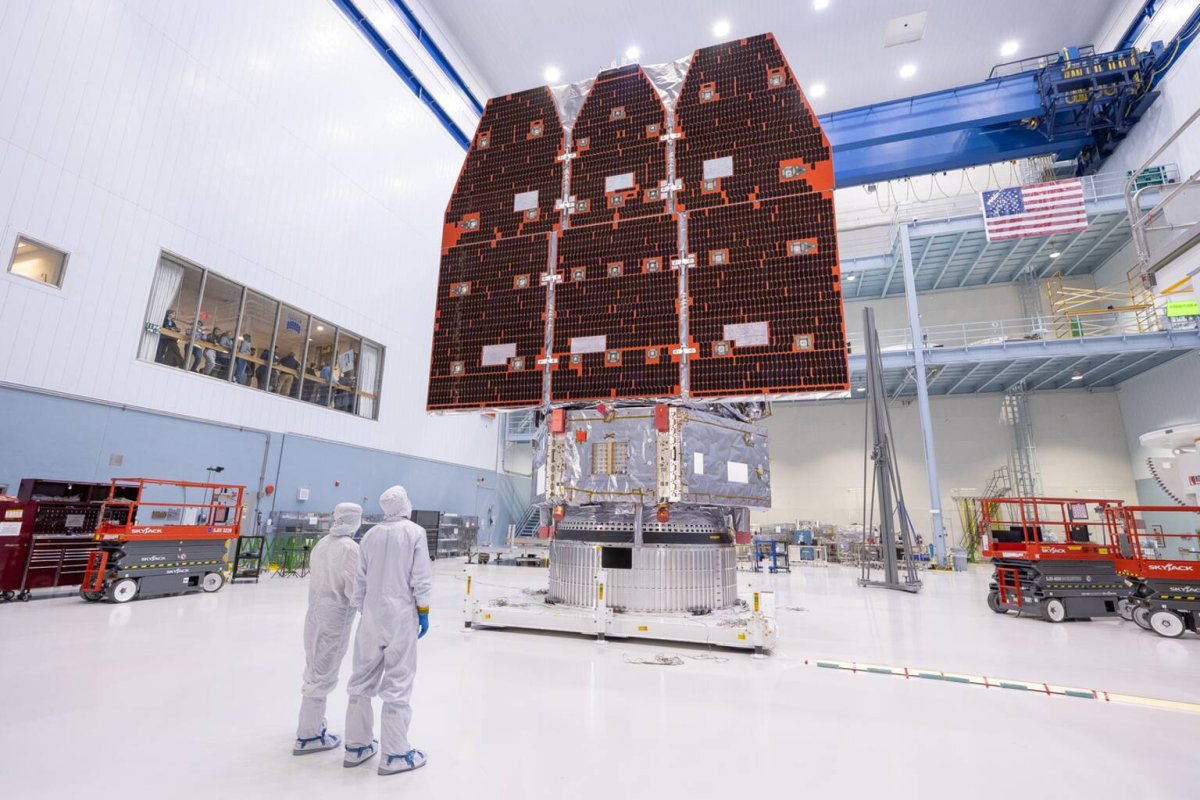
NASA's Nancy Grace Roman Space Telescope has achieved a significant milestone in its commissioning phase, demonstrating pointing stability better than one-hundred-thousandth of a degree during extended test runs. This precision is critical for the observatory's Coronagraph Instrument, which aims to directly image exoplanets by blocking starlight.
Between September 15 and 21, the telescope's fine-guidance system maintained pointing accuracy to within 0.00001 degrees for 30-minute observations using the Wide Field Instrument, and held that level for eight-hour coronagraph tests. This translates to 36 milliarcseconds of stability, a crucial factor because longer exposures give disturbances more time to blur a target.
While the recent focused star images captured on September 22 and 27 are promising, they represent only control-system and optical-path checks, not actual planet detections. The coronagraph must suppress a star's light to reveal far fainter nearby planets, a task that fails if the telescope drifts even slightly.
The mission team emphasizes that the in-flight results are not directly comparable to design specifications, which list 8 milliarcseconds for stability and 14 milliarcseconds for jitter. Different measurement definitions make a simple pass-fail comparison misleading, but NASA expects further tuning to improve performance.
Roman employs a layered control approach: star trackers and gyroscopes provide initial orientation, reaction wheels adjust the telescope, and fine guidance measures residual motion at the science focal plane. The system also avoids wheel-speed conditions that could introduce jitter, according to a 2025 technical paper.
The coronagraph, built by NASA's Jet Propulsion Laboratory, is designed to detect planets 100 million times fainter than their host stars—100 to 1,000 times better than existing space-based coronagraphs. Unlike Hubble and Webb, which use passive coronagraphs, Roman features active deformable mirrors that can correct for minute optical errors in space.
Roman's primary goal is not to photograph Earth-like worlds but to capture reflected visible light from Jupiter-like planets orbiting nearby stars. These older, colder giants present a more challenging contrast regime than the young, hot planets typically imaged directly, making Roman a crucial precursor for future observatories dedicated to finding terrestrial planets.
The next major milestone is spectral guiding, a novel technique where the telescope guides on wavelength patterns rather than point-like stars. This mode, never before used in space, could extend the control architecture and is expected to be validated within weeks.
As a technology demonstration, the coronagraph will operate for about three months over the mission's first 18 months, while the Wide Field Instrument conducts broader infrared surveys. The successful completion of these tests brings astronomers one step closer to unlocking the secrets of distant planetary systems.
