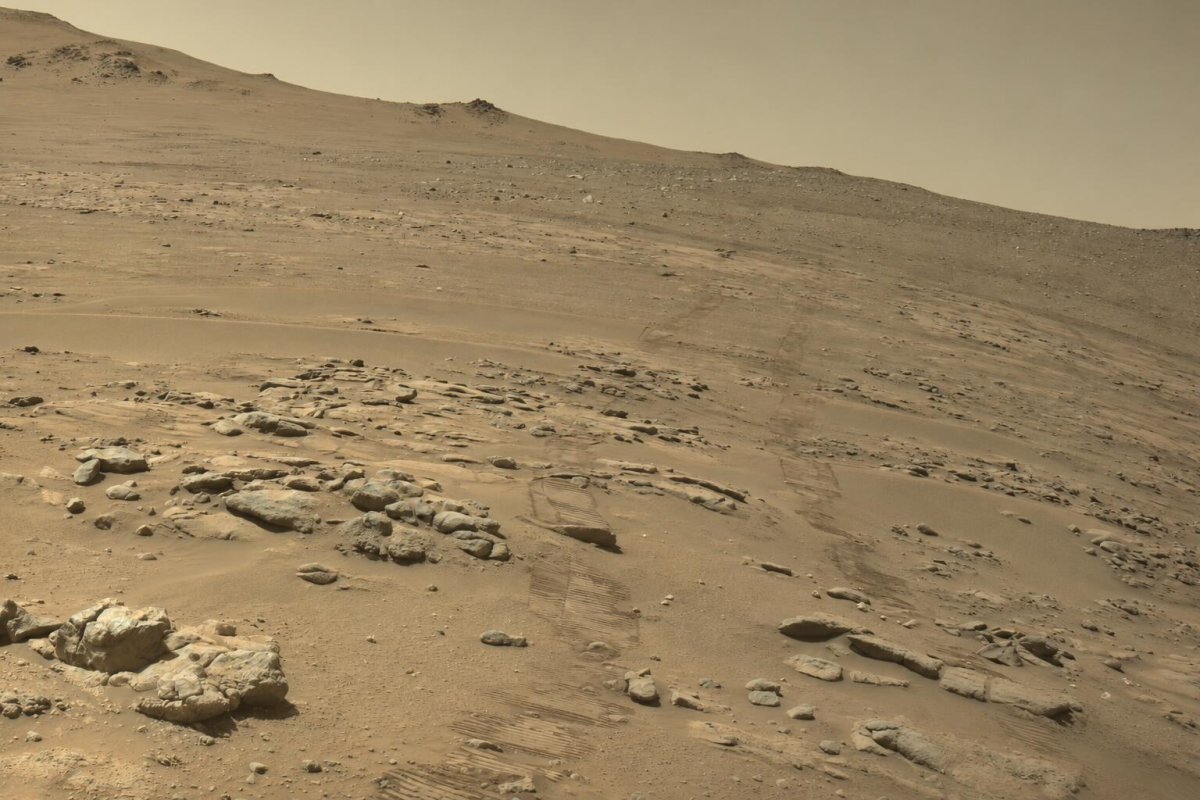
NASA's Perseverance rover has achieved a significant milestone on Mars, surpassing the previous driving distance record held by its predecessor, Opportunity. On October 11, 2026, Perseverance reached 45.22 kilometers, edging out Opportunity's 45.16-kilometer mark, according to a mission update released the following day. This achievement underscores the growing complexity of AI-driven navigation in extraterrestrial exploration.
Distinct Navigation Tasks
The record drive highlights a critical engineering reality: obstacle avoidance and position tracking are separate functions that require specialized systems. Perseverance is equipped with AutoNav, an onboard system that photographs the terrain, builds a three-dimensional hazard map, and selects a safe path between waypoints provided by mission planners on Earth. This allows the rover to adjust its route in real-time without waiting for commands from mission control. However, the rover's position estimates can drift over time due to accumulated errors in visual odometry, which tracks movement through successive camera images.
Global Localization System
To correct these position errors, Perseverance employs a Mars Global Localization system. This system matches images captured by the rover with orbital maps from satellites, providing a location estimate accurate to about 25 centimeters in roughly two minutes. The system uses a commercial processor originally intended for communication with the Ingenuity helicopter, which is carried aboard the rover. This hardware reuse adds computational resources but also introduces risks, as the processor is more susceptible to radiation-induced memory errors than the rover's hardened main computer.
According to NASA's February 2026 engineering report, the base-station processor runs the localization calculation repeatedly, while the main rover computer checks the results for consistency. Engineers have also isolated damaged memory bits to ensure reliability. This built-in redundancy is critical for long-duration missions where hardware failures could be catastrophic.
Performance Metrics and Testing
A research paper presented at the 2024 IEEE International Conference on Robotics and Automation (ICRA) benchmarked the localization system using 264 rover panoramas, reporting a mean localization error of 0.36 meters, with a maximum error of 1.07 meters and no errors exceeding five meters. Experts manually matched the comparison positions, with an expected accuracy of about 0.5 meters. These results provide confidence in the system's ability to support future drives, though they do not guarantee performance in all conditions.
Generative AI in Route Planning
In a separate development, NASA demonstrated a generative AI system for route planning. Vision-language models analyzed orbital imagery and slope data to propose waypoints for the rover. Engineers validated the commands using a virtual rover before transmitting them to Perseverance. The demonstration drives occurred on December 8 and 10, 2025, and were announced on January 30, 2026. This system is distinct from AutoNav and global localization, representing a future capability for more autonomous exploration.
Implications for Autonomous Systems
The Perseverance milestone serves as a case study for AI-driven autonomy in extreme environments. For robotics developers, the key takeaway is that route planning, obstacle avoidance, and position tracking must be treated as separate but complementary components. Reliable position estimates, checked computations, and physical operating limits are essential for safe and efficient operation.
In addition to navigation, the mission team has revised driving constraints based on thousands of simulations, setting a 24-degree tilt limit and a 20-centimeter minimum belly clearance. These parameters help the rover navigate challenging terrain while minimizing the risk of getting stuck or tipping over.
Market Context
While this news is primarily scientific, it has implications for the broader autonomous systems market, including companies like Tesla (TSLA) and Waymo (GOOGL), which are developing similar technologies for terrestrial applications. The ability to navigate without GPS, as Perseverance does on Mars, is a valuable testbed for future autonomous vehicles on Earth.
As AI continues to evolve, the lessons learned from Mars exploration will likely influence the design of autonomous systems across industries, from self-driving cars to robotic exploration of the deep sea and other planets.