Royal Caribbean Cruises Ltd. (NYSE: RCL) experienced a notable decline on Wednesday, with shares closing at $259.76, a drop of $4.74 or 1.79%, on trading volume of 2.41 million shares. This move extends the stock's recent slide, leaving it 15.7% below its August 10 close of $308. The broader market also faced headwinds, as the S&P 500 slipped 0.48% during the session, but Royal Caribbean's decline outpaced the index, signaling company-specific and sector-wide pressures.
The primary catalyst for Wednesday's sell-off was the surge in crude oil prices. Brent crude settled 3.4% higher at $101.21 per barrel, marking its first close above the $100 threshold since July. This spike heightened concerns about fuel costs for cruise operators, which are heavily dependent on marine fuel. However, the immediate impact on Royal Caribbean's bottom line may be cushioned by its hedging strategy.
Fuel Hedges Provide a Buffer, But Risks Remain
In its July 28 earnings report, Royal Caribbean provided a detailed outlook on fuel expenses. The company projected $1.338 billion in fuel costs for 2026, based on consumption of 1.756 million metric tons. Notably, 58% of the forecasted consumption is hedged, and management estimated that a 10% change in fuel prices would impact full-year results by $26 million. This sensitivity is relatively modest compared to the stock's daily movement, suggesting that the market's reaction may be more about sentiment than immediate earnings impact.
However, the protection is not absolute. The remaining 42% of fuel consumption remains unhedged, and the hedge ratio for 2027 is lower at 53%. If crude prices remain elevated, the cost of hedging in the future could rise, and the company's exposure could increase as hedges roll off. Additionally, sustained high oil prices could have a broader impact on consumer behavior, potentially dampening travel demand and onboard spending, which would be a more significant concern than the direct fuel cost increase.
Operational Milestone: Hero of the Seas Floats
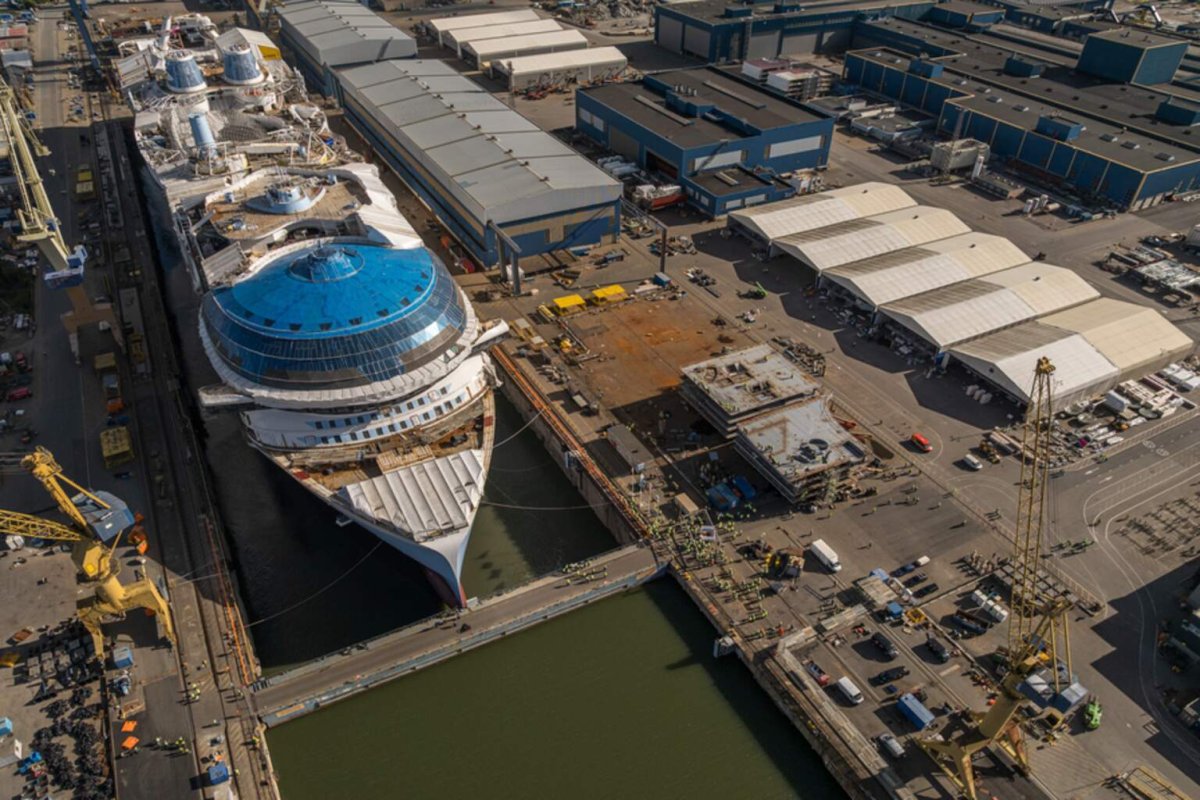
Amid the market turbulence, Royal Caribbean announced a positive operational development. On September 8, the company revealed that its fourth Icon-class ship, Hero of the Seas, achieved a significant milestone with its first float at the Meyer Turku shipyard in Finland. The dry dock was filled with over 90 million gallons of water, allowing the vessel to float for the first time. The ship is scheduled to enter service from Miami in August 2027, and bookings are already open.
While this is a meaningful step in the construction process, it does not alter near-term financial guidance. The stock's decline on Wednesday was not tied to any company-specific negative news but rather to the macro environment, particularly the oil price surge.
Valuation: Cheaper, But Not Necessarily a Bargain
At Wednesday's close, Royal Caribbean traded at approximately 14.6 times the midpoint of its 2026 adjusted earnings guidance of $17.80 per share (range $17.73 to $17.87). This is a significant de-rating from the 17.3 times multiple at the August 10 close. The stock has become more attractive on a valuation basis, but the discount is contingent on the company's ability to maintain its earnings outlook in the face of rising fuel costs and potential demand softness.
The company's second-quarter results were mixed. Revenue grew 6% to $4.832 billion, and capacity increased 5%, with 2.4 million guests sailing. Net yields rose 1.9% as reported. However, adjusted EBITDA declined to $1.830 billion from $1.851 billion, and the adjusted EBITDA margin narrowed to 37.9% from 40.8%. For the third quarter, management forecasts roughly flat net yields and adjusted EPS of $6.26 to $6.36, based on fuel prices, rates, and currencies as of July 28.
Balance Sheet and Liquidity
Royal Caribbean maintains a solid liquidity position, with $6.9 billion in available liquidity as of June 30 and an expanded revolving credit facility of $6.6 billion in July. The company returned $603 million to shareholders in the second quarter through dividends and buybacks. However, the company carries significant debt, with $875 million in cash, $1.573 billion in current debt, and $21.263 billion in long-term debt. Capital expenditures are expected to be around $4.7 billion in 2026, primarily for new ships and destinations. Debt maturities are scheduled to rise from $0.9 billion in 2026 to $2.7 billion in 2027 and $3.4 billion in 2028.
This leverage means that any sustained pressure on cash flow could heighten financial risk. Investors are essentially valuing a stream of operating cash flow that already has significant claims on it, making the stock sensitive to fuel price movements and booking trends.
Outlook: Bull vs. Bear Scenarios
For the bulls, a retreat in oil prices, continued strength in 2027 bookings, and stable net yields in the third quarter would support the current earnings guidance and potentially drive a rebound. The bear case hinges on persistent $100 oil, which could disrupt itineraries, reduce onboard spending, and force the company to absorb higher fuel costs as its hedge protection diminishes.
The execution of Hero of the Seas' construction timeline without cost overruns and the successful conversion of Icon-class demand into pricing power will be critical. The recent 15.7% decline has created a more compelling valuation argument, but it is not without risks. At 14.6 times adjusted earnings, the stock could recover if management protects earnings and bookings while the fuel hedge provides cover. However, if high oil prices begin to erode demand, the apparent discount could vanish quickly. The next key indicators will be booking commentary and any updates to fuel assumptions, rather than the spectacle of a new ship launch.