Intel's stock has crossed a threshold where the market's primary concern is no longer survival but execution. On September 9, the shares closed at $106.24, up 1.69%, with 96.6 million shares traded during the regular session, according to Yahoo Finance historical data. This marks a 10.9% gain over two sessions from the September 4 close.
For investors, the key takeaway is that Intel's operational recovery is genuine, but the current equity valuation of approximately $561.5 billion already prices in far more than a simple rebound in PC and server chip sales. The market is now expecting the foundry business to secure meaningful external customers, narrow its substantial losses, and ultimately convert Intel's expanded capital base into durable free cash flow.
What 6.24 Already Prices In
Intel's August stock sale reset the valuation math. The company sold 210.5 million shares at $95, and underwriters exercised their full option for an additional 31.6 million shares. The final SEC prospectus set the post-offering share count at 5.285 billion and net proceeds at approximately $22.62 billion.
Multiplying that share count by Wednesday's close yields the $561.5 billion figure. The stock is now 11.8% above the offering price in less than a month, a vote of confidence, but it comes with roughly 4.8% more shares outstanding than before the deal. The cash provides Intel with significantly more room to fund factories and absorb foundry losses, but the dilution raises the earnings hurdle for every existing share.
Simple annualized ratios illustrate the optimism embedded in the stock price. The current equity value is about 8.7 times second-quarter revenue run-rate. At $106.24, shares trade near 63 times annualized second-quarter adjusted earnings of $0.42 per share, and about 70 times the annualized midpoint of Intel's third-quarter adjusted EPS guidance. These are not forecasts, as semiconductor earnings are seasonal and a turnaround should not be valued based on a single quarter, but they show why "better" results may no longer be sufficient.
The Product Recovery Has Substance
There is evidence behind the rally. Intel's second-quarter results showed revenue of $16.13 billion, up 25% year-over-year. GAAP gross margin recovered to 40.4% from 27.5%, while adjusted net income reached $2.20 billion. Product revenue was $15.14 billion, and the product segment generated $4.80 billion of operating income.
Data Center and AI provided the clearest operating signal. Revenue rose to $6.26 billion as server revenue increased by $2 billion; Intel reported unit volume growth of 9% and a 48% jump in average selling prices. This mix suggests buyers are paying for higher-value systems rather than merely restocking low-end processors.
The reported $11.0 billion GAAP net loss needs context. Intel recorded a $12.53 billion mark-to-market charge tied to shares held in escrow for the U.S. government. This non-cash accounting item makes the headline loss a poor measure of the quarter's core performance. The more relevant debate is whether product profitability can carry the company while the manufacturing strategy matures.
Foundry Remains the Valuation Test
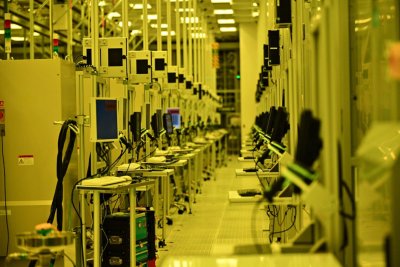
Intel Foundry generated $5.77 billion of second-quarter revenue, but only $293 million came from external customers. The segment lost $2.09 billion on an operating basis. Most of that revenue still reflects Intel manufacturing chips for its own product groups, so the total cannot yet be read as proof that the contract-manufacturing strategy has achieved outside scale.
This is the central counterargument to the bull case. A healthy server cycle can lift near-term results, but the stock's valuation is difficult to justify as a product-company recovery alone. Investors need evidence that external foundry revenue is moving beyond development work, that utilization is improving, and that losses are falling without compromising process investment.
The balance sheet buys time. Intel reported $29.73 billion of cash and short-term investments against $50.54 billion of debt at the end of the quarter, before the August equity proceeds. The new capital meaningfully reduces financing risk, although it does not by itself solve foundry economics. Intel's quarterly filing remains essential reading for investors tracking those capital commitments.
The Next Numbers That Can Move Intel Stock
Intel guided to third-quarter revenue of $15.8 billion to $16.8 billion, a 42% adjusted gross margin, and adjusted EPS of $0.38. Meeting that range would support the view that the product recovery is holding. Beating it without better foundry economics, however, would answer only half the valuation question.
Three measurements matter most now: external foundry revenue, foundry operating loss, and cash conversion after factory spending. Continued data-center pricing strength is the near-term upside lever. A weaker server mix, delayed customer ramps, or another quarter of roughly $2 billion in foundry losses would expose how little margin for disappointment remains at $106.
Intel is financially stronger and operationally healthier than it was a year ago. The stock price already recognizes that. From here, shareholders are paying in advance for proof that the turnaround can become a scalable manufacturing business, not merely a well-funded recovery in Intel's own chips.