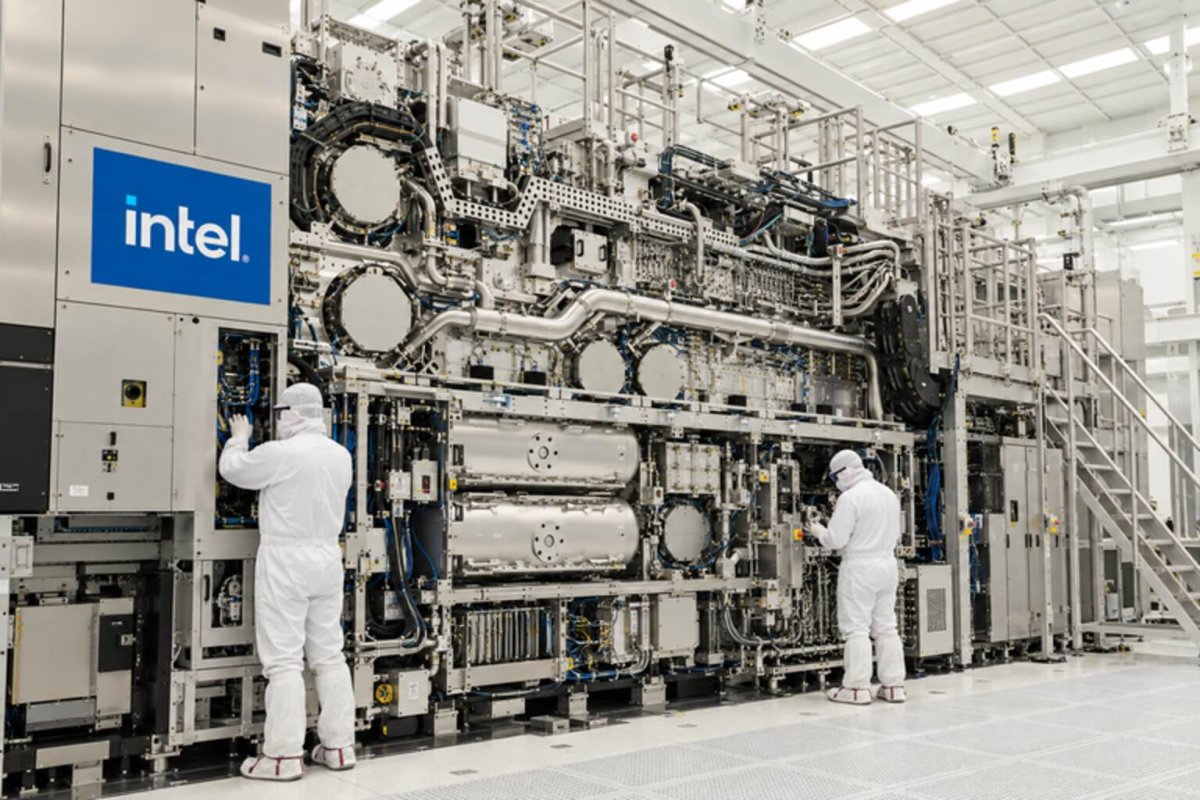
Intel shares were poised to open near $100 on Tuesday, following a joint announcement with ASML that more than one million wafers have processed through Intel's High-NA extreme-ultraviolet (EUV) lithography systems. The premarket indication, roughly 4.4% above Friday's close of $95.80, reflects investor optimism about the technical milestone, yet the company's foundry business still faces a critical commercial test.
What the 1 Million Wafer Milestone Really Means
The September 8 disclosure reveals that High-NA EUV is already in high-volume manufacturing for selected layers of Intel's Core Ultra Series 3 processors (codename Panther Lake). Intel states that overlay, throughput, and tool availability are meeting its foundry expectations, and on Intel 18A, High-NA layers deliver performance comparable to or better than those made with ASML's established 0.33-NA NXE platform.
This is more than a technical showcase. It signals that High-NA has crossed three critical gates: production readiness, operational targets, and competitive performance. For potential foundry customers, it offers a concrete design path using current 6-inch masks, either within a single field or via field stitching supported by Intel's process design kit.
However, the cumulative figure includes wafers used for tool certification, testing, and R&D, not just fully processed, saleable Panther Lake units. Investors should view it as evidence of operational experience, not a proxy for chip shipments, yield, or foundry sales.
The 3 Million Commercial Gap
Intel's latest filing highlights the disparity. Foundry segment revenue reached $5.765 billion in the June quarter, but external foundry revenue was just $293 million—about 5.1% of the total. Intel acknowledges that substantially all of the business still supports its own product divisions.
The segment posted an operating loss of $2.089 billion, an improvement from a $3.168 billion loss a year earlier, yet still more than seven times external revenue. Even the year-over-year jump in external sales, from $22 million, was driven primarily by Altera becoming an external customer after deconsolidation, not by new leading-edge foundry wins.
Bullish vs. Bearish Interpretations
Optimists see Intel building technical credibility before revenue materializes. Internal Panther Lake volume provides real production learning, and the million-wafer experience could reduce cost and schedule risks for outside designers. The narrowing loss also suggests progress.
Pessimists argue that proving Intel can manufacture for itself is not the same as winning third-party commitments. The filing also warns that higher-cost Intel 18A wafers reduced product profit, offsetting gains from Intel 3 and Intel 4.
Key Proof Points Ahead
To strengthen the equity story, Intel needs three things: a named, high-volume external customer; better foundry unit economics from cost, yield, and utilization improvements; and evidence that mask stitching works predictably for customers today, with a path to a 6-by-12-inch mask ecosystem that boosts productivity without new bottlenecks.
Intel and ASML are scheduled to present more details on mask requirements and stitching at the SPIE Photomask Technology + EUV Lithography conference on Tuesday. These presentations could clarify the manufacturing route, but the stock's sustained re-rating depends on contracts and margins.
Intel's second-quarter results show why the market is patient: company revenue rose 25% to $16.1 billion, Intel Products generated $4.817 billion in segment operating income, and the foundry loss narrowed sharply. Yet the same results underscore why a million wafers cannot close the case. At roughly $100, investors are paying for technical execution to become a third-party business, not just a more capable internal factory.