ASML Holding N.V. (NASDAQ: ASML) saw its shares climb 4.17% on Friday, adding approximately $26.5 billion to its market capitalization. The rally, however, was not sparked by a direct upgrade of the Dutch semiconductor equipment maker. Instead, it was a read-through from bullish commentary on two memory-chip manufacturers, highlighting the interconnected nature of the semiconductor supply chain.
Lynx Equity Strategies analyst K.C. Rajkumar raised price targets for Micron Technology Inc. (NASDAQ: MU) and Sandisk Corp. (NASDAQ: SNDK) to $1,325 and $2,450, respectively. In a note dated September 4, Rajkumar argued that the volatile memory market had become investable again. While the note did not rate ASML, the positive sentiment quickly spilled over, with financial media outlets linking ASML's rise to the memory-sector enthusiasm.
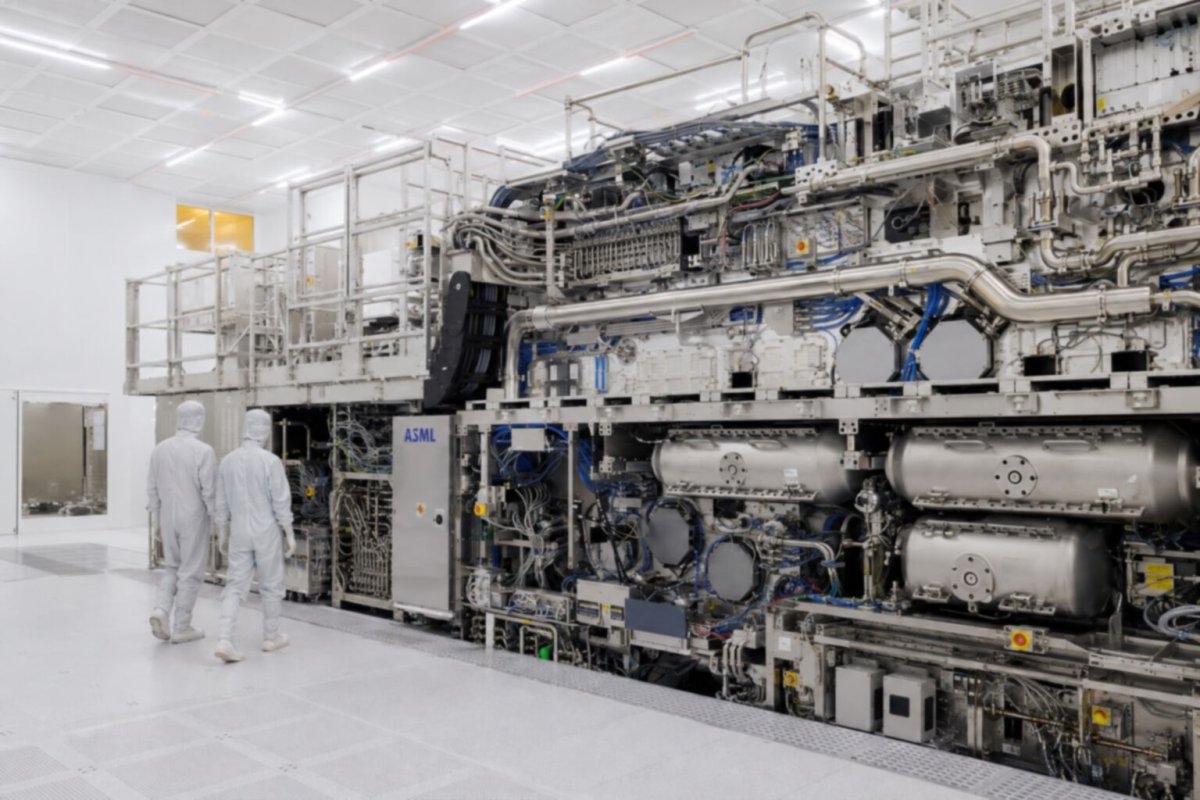
The logic behind the read-through is straightforward: the production of high-bandwidth memory and advanced DRAM requires additional wafer capacity, and ASML is the dominant supplier of the lithography systems essential for that expansion. As memory makers invest in new fabs, ASML stands to benefit from increased demand for its extreme ultraviolet (EUV) and deep ultraviolet (DUV) lithography tools.
Friday's gain helped repair some of the damage from a recent pullback. ASML's U.S.-listed shares closed at $1,714.88 on September 4, down from an August 17 peak of $1,883.12. The stock traded on volume of 1.29 million shares. Despite Friday's rebound, the shares remain 8.9% below the August 17 close and 14.3% off their 52-week high.
Company guidance supports the memory thesis. ASML has raised its 2026 sales outlook three times this year, with the latest range of €43 billion to €45 billion, up from €34 billion to €39 billion in January. Chief Executive Christophe Fouquet attributed the strength to "ongoing AI-related investments" driving demand for advanced logic and memory chips, with customers accelerating their capacity plans.
ASML's second-quarter results underscored the momentum: sales reached €9.33 billion, net income was €2.92 billion, and gross margin came in at 54%. The company expects third-quarter sales between €11 billion and €12 billion. Memory already plays a significant role in ASML's business, with €8.4 billion in memory-related net system sales in 2025, compared to €16.1 billion from logic and €8.2 billion from service and field options.
Looking ahead, ASML plans to increase 2027 output capacity by roughly 30% for both low-NA EUV systems and DUV immersion tools, signaling confidence in sustained demand. However, capacity is not booked revenue; customers can delay fab schedules, and supply chain constraints could slow the expansion.
The market's reaction reflects high expectations. With a market capitalization of $660.9 billion and a mean Buy rating from 15 analysts, the consensus one-year price target of $2,400 implies about 40% upside from Friday's close. Yet, the valuation leaves little room for a dull memory cycle.
Investors will be watching two key metrics: memory customers' capital spending and ASML's order intake. Strong bookings would confirm the link between chipmakers' improving economics and lithography demand, while softer orders would suggest Friday's rally was borrowed enthusiasm.
Risks remain, including export controls that could narrow ASML's addressable market and potential reversals in memory prices that might prompt customers to defer equipment deliveries. For now, the market is betting that AI's insatiable appetite for memory will keep ASML's tools in high demand.