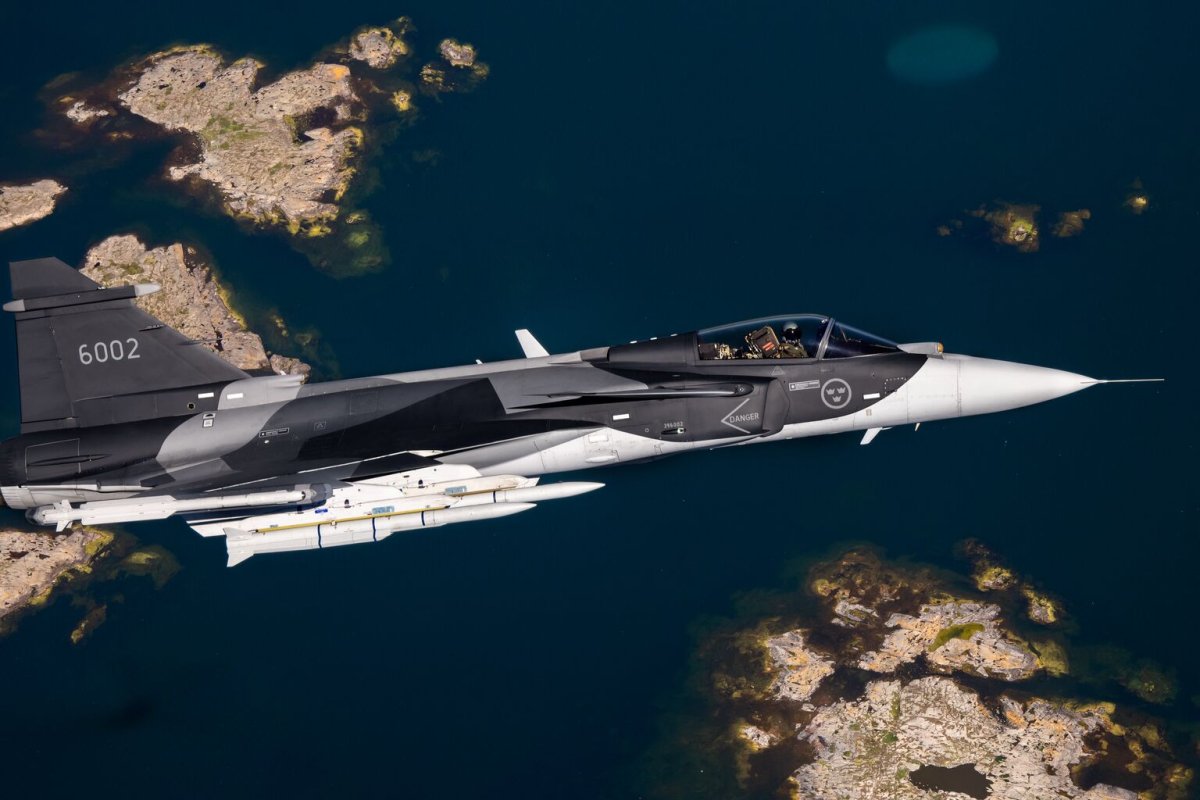
Swedish defense contractor Saab AB (SAABY) has not secured a Canadian order for its Gripen E fighter jet, nor has Ottawa initiated a new competition. However, the company has transformed a conceptual option into a concrete industrial proposal, stating that a minimum order of 40 aircraft would validate a complete Canadian assembly line involving roughly ten primary partners and 250 suppliers, as reported from Saab's Linköping headquarters.
That 40-aircraft threshold is the key metric for Saab investors to monitor. It would represent a significant program for the company's Aeronautics division, but currently it remains in the pipeline rather than in the backlog. Saab's B shares closed on Friday, September 11, at SEK 571.60, down 1.1% for the session, with the stock trading at approximately 44 times earnings, according to delayed Stockholm market data. At that valuation, a credible path from Canadian interest to a booked order matters more than another headline about political enthusiasm.
What Canada is actually deciding
Canada committed in 2023 to acquire as many as 88 Lockheed Martin F-35As in tranches, beginning with 16 aircraft. A Canadian defence briefing updated in April 2026 places the acquisition budget at C$27.7 billion and states that the government review, launched in March 2025, covers operational requirements, NORAD and NATO commitments, industrial benefits, strategic partnerships, and alternatives. The first eight Canadian aircraft are due at Luke Air Force Base in Arizona during 2026-27 for training, with the first arrival in Canada scheduled for 2028.
Saab is therefore pitching the Gripen as part of a possible mixed fleet, not claiming the contracted F-35s will vanish. Its newest industrial proposal goes beyond final assembly, outlining Canadian research hubs, domestic mission-software control, and broad regional supplier work. However, Canadian procurement officials told The Globe that engagement with manufacturers does not amount to a procurement launch, a commitment, or a requirements assessment.
The groundwork is tangible but conditional. Saab and CAE signed a July memorandum covering Canadian pilot training, simulation, and mission-systems support if Canada adds the Gripen E. Separately, GE Aerospace and Magellan Aerospace agreed on proposed Canadian maintenance for the F414-GE-39E engine, but GE's own announcement says the arrangement depends on a Canadian acquisition. The U.S.-built engine also means domestic assembly would not remove every cross-border licensing or supply-chain dependency.
The order would be meaningful—but do not price it yet
Saab entered the second half with ample business. Its June 2026 interim report showed a SEK 317.7 billion group order backlog, up 61% from a year earlier, while first-half sales rose 25% to SEK 44.6 billion. The headline backlog jump was heavily influenced by a SEK 47 billion Polish submarine order, however, not fighters.
Aeronautics provides a cleaner lens. The unit generated SEK 11.0 billion of first-half sales but booked only SEK 5.7 billion of orders, leaving its backlog at SEK 78.5 billion versus SEK 83.8 billion at the end of 2025. A Canadian Gripen award large enough to support another production line could refill that backlog and extend factory utilization well into the 2030s. Until Saab discloses aircraft count, package scope, price, and booking date, assigning a contract value would be guesswork.
Colombia illustrates why simple per-jet arithmetic misleads. Saab's confirmed 2025 contract was worth €3.1 billion for 17 Gripen E/F aircraft, but that package also included equipment, weapons, training, and services. Canada's local-production requirements, support structure, and potential fleet mix could produce very different economics.
What would convert the pitch into shareholder value
- A Canadian decision document: a formal procurement path, solicitation, or cabinet approval specifying Gripen's role alongside the F-35.
- A Saab order disclosure: aircraft count, contract value, timing, and the portion booked to Aeronautics—not another conditional memorandum.
- Execution evidence: funded Canadian facilities, supplier awards, and a delivery schedule that does not strain Saab's expanding commitments to existing customers.
The strongest counterargument is that a mixed fleet can duplicate training, maintenance, and logistics while weakening the interoperability benefits Canada sought from the F-35. Ottawa is also already investing in F-35 infrastructure, and its latest project status report says implementation continues even as tariff effects remain under review.
For Saab shareholders, Canada is a credible option with unusually visible industrial scaffolding—not a signed catalyst. The next decisive evidence is a government procurement action and a regulatory order announcement. Until both arrive, the 40-jet threshold belongs in the upside case, while the stock's demanding valuation should be anchored to the SEK 317.7 billion backlog Saab has already won.
