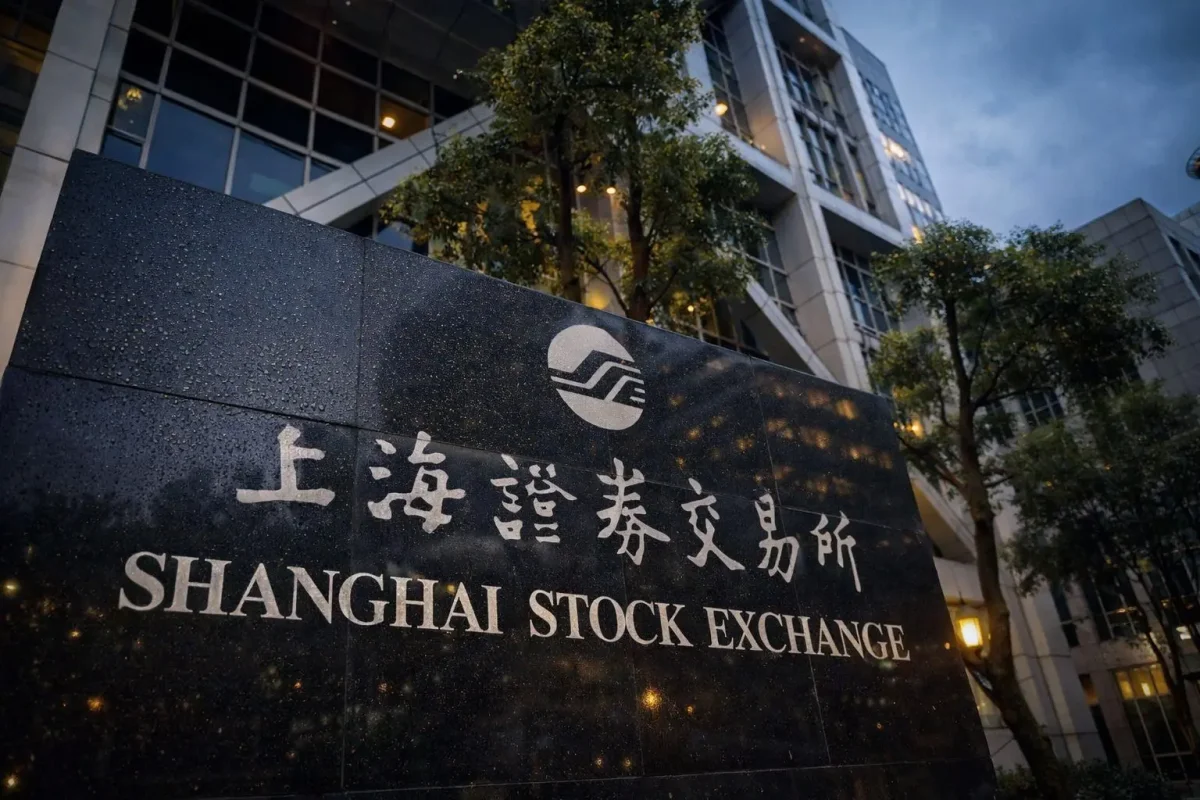
Chinese equities relinquished early gains to close the week lower, as a rally that propelled the Shanghai market to its highest level in ten years was cut short by escalating geopolitical risks and a sobering policy outlook from Beijing. The Shanghai Composite Index finished Friday's session at 4,124.19, marking a weekly decline of 0.9% from the previous week's close of 4,162.88.
Week Opens with Surge, Then Swift Reversal
The trading week began with a powerful surge, driven by safe-haven flows. On Monday, the Shanghai Composite soared to 4,182.59, a level not seen since June 2015, as investors piled into energy, gold, and defense stocks following a sharp escalation in Middle East conflict that jolted global oil markets. However, the optimism proved fleeting. "An oil shock risks igniting inflation worries and dampening risk appetite," noted Jeff Mei, chief operating officer at BTSE, highlighting the double-edged nature of the commodity rally.
The reversal was abrupt. On Tuesday, the Shanghai benchmark sank 1.43%, its steepest single-day drop in a month. The sell-off was broad-based, with the tech-heavy STAR50 Index plunging 5.21% and Shenzhen's startup-focused ChiNext board falling 2.57%. Sectors that had led the prior rally, including rare earths, semiconductors, and defense, were hit hard by profit-taking. Losses deepened on Wednesday, with state energy giants PetroChina, Sinopec, and CNOOC all issuing abnormal-trading alerts after their shares jumped more than 20% over just three sessions. The companies affirmed normal operations but warned of ongoing uncertainty linked to volatile crude prices.
Policy Pivot: Quality Over Speed
The market's stumble coincided with a pivotal shift in messaging from China's annual parliamentary session. Officials set a 2026 economic growth target in a range of 4.5% to 5%, signaling a tolerance for slower, more sustainable expansion. More notably, they unveiled a fresh five-year plan aggressively promoting the integration of artificial intelligence throughout the economy, underscoring a strategic pivot toward technological self-reliance and high-quality development.
"The policy stance is loud and clear on tech and domestic demand," said Liu Chenjie, chief economist at Upright Asset Management. The government's work report further outlined plans for 109 major projects this year, with total spending exceeding 7 trillion yuan. Finance Minister Lan Foan detailed a 100 billion yuan fiscal-financial coordination fund earmarked to stimulate consumption and private-sector investment.
Structural Reforms and Underlying Challenges
Regulators provided clearer direction on market structure. China Securities Regulatory Commission (CSRC) Chairman Wu Qing announced that Shenzhen's ChiNext board would adopt more tailored and inclusive listing rules, following the reform path pioneered by Shanghai's STAR Market. "This will better serve the development of local economies and the private sector," Wu stated, adding that the standards used for these innovation-focused boards would eventually roll out to the main board, channeling more capital to domestic tech leaders.
Despite the targeted support, significant headwinds remain. The government's report explicitly cited an "acute" mismatch between strong supply and insufficient demand, with the prolonged property downturn continuing to pose a threat to economic stability. These domestic concerns are amplified by a fraught global backdrop. According to Reuters, global stocks were on track for their steepest weekly slide in six years, pressured by spiking oil prices due to the conflict. Rising energy costs present a clear inflation risk that could trigger renewed volatility in Chinese markets, even as Beijing deploys its tech-focused stimulus.
Weekly Performance and Sector Moves
For the week, the CSI300 Index, which tracks large-cap stocks in Shanghai and Shenzhen, fell 1.1%, despite a 0.27% gain on Friday. Hong Kong's Hang Seng Index experienced more pronounced weakness, sliding 3.3% over the five-day period despite a 1.72% rally on the final trading day. On the mainland, consumer staples stocks outperformed, while oil-and-gas and non-ferrous metals sectors were among the notable laggards.
Thursday provided a brief respite as buyers returned following Premier Li Qiang's reinforcement of the lower growth target and emphasis on innovation spending. Shares in AI, semiconductor, and biotech firms advanced, though consumer and property shares continued to struggle. Marco Sun, chief financial market analyst at MUFG (China), characterized the government's approach as "broadly supportive," with a definitive tilt toward AI and other "new economy" sectors.
The week's action underscores a market in transition, caught between fleeting geopolitical shocks and a fundamental, long-term reorientation of China's economic priorities. While the ambition to lead in technology is unequivocal, the path is likely to be punctuated by volatility as global risks and domestic demand challenges test investor resolve.