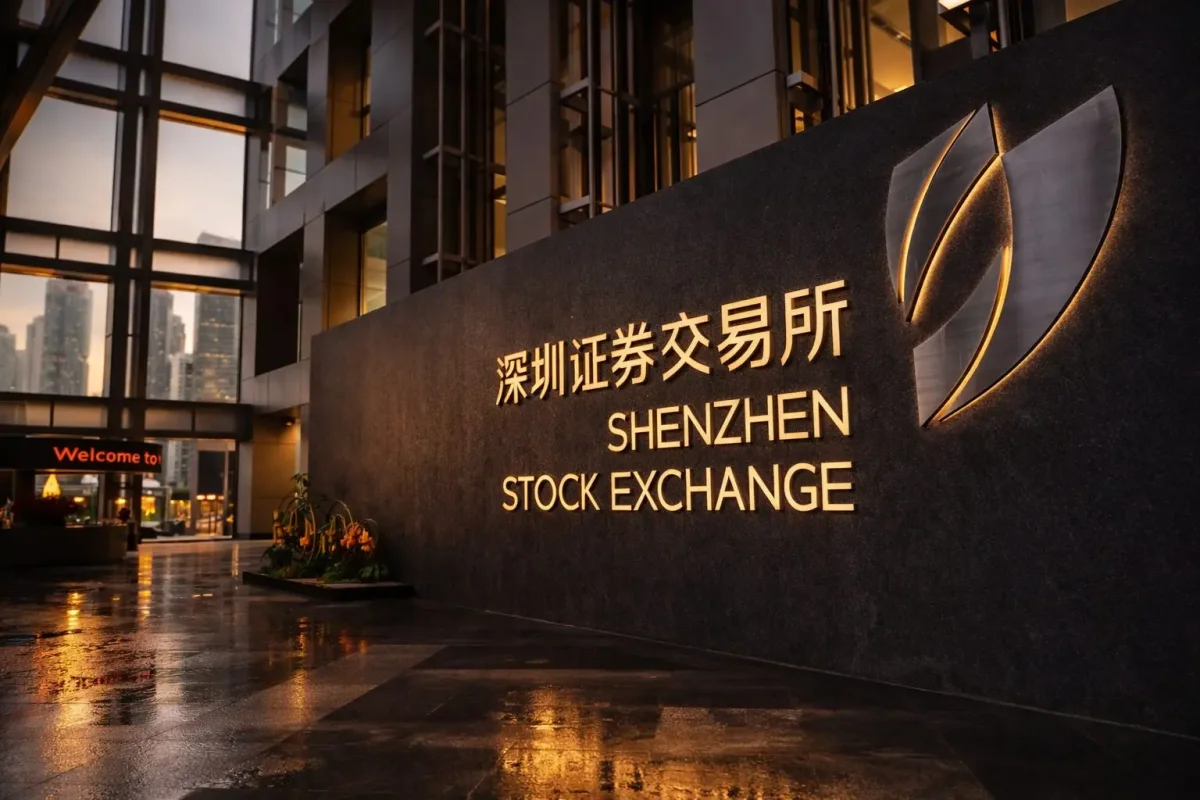
The trading week concluded with mixed results for Shenzhen's major indices. The Shenzhen Component Index finished Friday's session at 14,495.09, representing a marginal decline of 0.06%. In contrast, the growth-focused ChiNext board experienced a more pronounced selloff, dropping 1.04% to close at 3,310.3. Meanwhile, Shanghai's benchmark index managed a modest gain of 0.39%. Combined turnover for the Shanghai and Shenzhen exchanges approached 2.49 trillion yuan, indicating sustained investor activity. Sector performance was varied, with minor metals, lead, and zinc mining companies posting gains, while paper manufacturers and electronic chemical firms faced downward pressure.
Central Bank Intervenes on Yuan Strength
Market attention is firmly fixed on a significant policy adjustment from the People's Bank of China. Effective March 2, the central bank will eliminate the 20% risk-reserve requirement on foreign exchange forward contracts. This technical move is widely interpreted as an effort to cool the Chinese currency's sharp appreciation, which has climbed more than 7% against the U.S. dollar since April of last year. Analysts note that the rapid rise has begun to pressure export-oriented companies, with a growing number of listed firms citing exchange-rate related hits to profitability. "The PBOC's action signals intervention as the yuan's appreciation pace is deemed excessive," remarked Yuan Tao, an analyst at Orient Futures.
Policy Spotlight Shifts to the "Two Sessions"
The financial calendar grows increasingly crowded with political events that are poised to set the economic agenda. The annual gatherings of China's top political advisory body, the Chinese People's Political Consultative Conference (CPPCC), commence on March 4. This is immediately followed by the opening of the National People's Congress (NPC) on March 5. These concurrent meetings, collectively known as the "Two Sessions," are a critical forum for unveiling annual growth targets, fiscal budgets, and broad policy directives. In preparatory meetings, the Politburo has called for "more proactive" and better-coordinated economic policies, advocating for an active fiscal stance and a "moderately accommodative" monetary policy. The government work report, to be delivered at the NPC, will be scrutinized for signals on support for demand and private investment.
Economic Data and Real Estate Concerns Linger
Investors are also awaiting key macroeconomic indicators that could introduce further volatility. The release of China's official Purchasing Managers' Index (PMI) for February has been rescheduled to March 4 due to the Lunar New Year holiday. This closely-watched gauge of business activity, where a reading above 50 indicates expansion, will provide an early snapshot of post-holiday economic momentum. Concurrently, the property sector continues to cast a shadow over market sentiment. A private survey revealed that new home prices across 100 Chinese cities fell 0.04% in February, marking the steepest monthly decline in over three years. Analysts like Larry Hu of Macquarie suggest that recent sector-easing measures may offer only a short-term boost, doubting they can reverse the broader down-cycle without more substantial intervention. Official data for 70 cities is expected on March 16.
Corporate Activity and Market Implications
Despite the macroeconomic headwinds, corporate deal flow suggests a degree of persistent risk appetite. Several Shenzhen-listed firms are tapping offshore capital markets, with four companies launching Hong Kong listings recently. Among them, Shenzhen Zhaowei Machinery & Electronics and Estun Automation are scheduled to begin trading on March 9 and 10, respectively. "We expect the positive momentum for such listings to continue throughout the year," observed Art Karoonyavanich, managing director at DBS, while cautioning that investor selectivity may increase as the pipeline of deals builds.
For Shenzhen's market, particularly its cyclical industrial and export-oriented constituents, the interplay of currency dynamics, policy signals, and property sector health creates a complex investment landscape. The ChiNext board, with its concentration of growth and technology stocks, remains highly sensitive to shifts in financing conditions and sector-specific policy cues. The immediate downside risk is clear: a disorderly retreat in the yuan or a perceived lack of concrete supportive measures from the upcoming legislative meetings could swiftly erode risk appetite. The March 4 PMI release and the March 5 NPC opening thus represent critical near-term catalysts that will shape market direction for the world's second-largest economy.