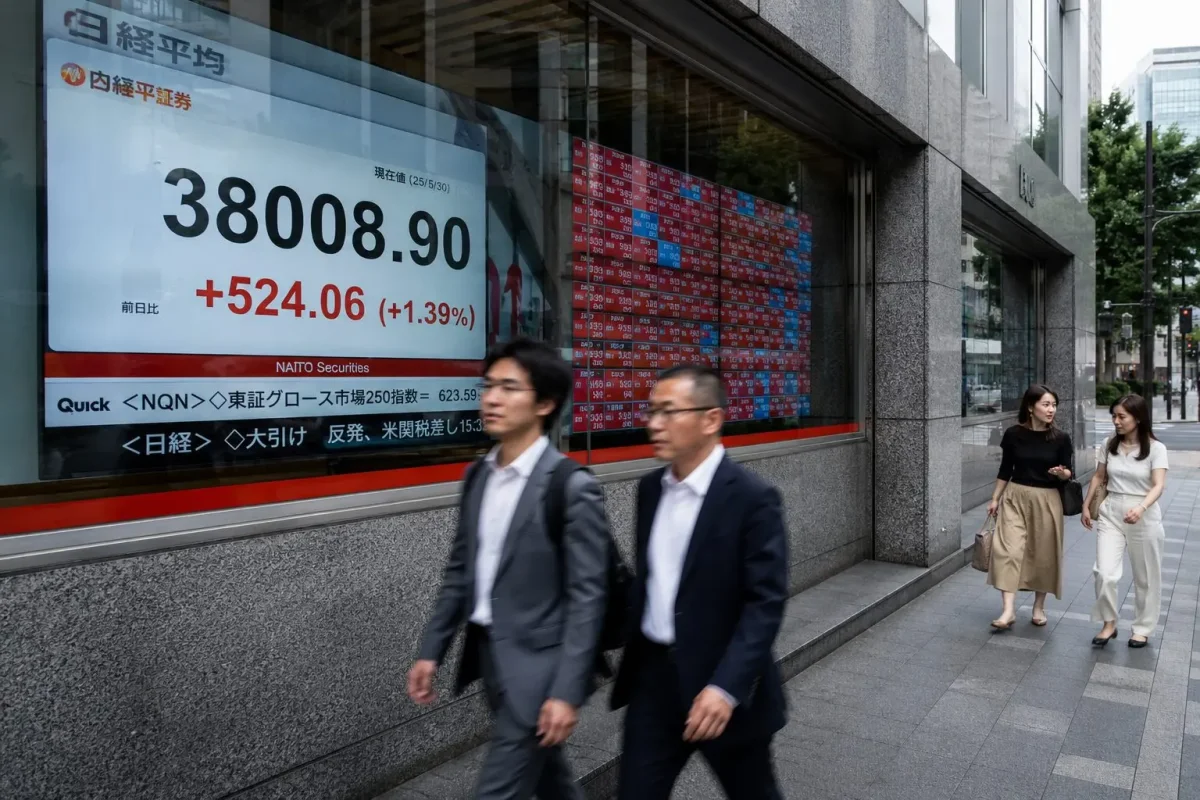
Asian equity markets ended the week on a mixed note, as the artificial intelligence trade continued to fuel gains in Japan, Taiwan, and South Korea, while India and mainland China saw declines. Investors are now bracing for a data-heavy first week of June, with key economic reports and central bank decisions on the horizon.
Japan Leads the AI Charge
Japan's Nikkei 225 soared 2.53% to close at 66,329.50 on Friday, extending its winning streak as foreign investors poured capital into the market. Data showed net purchases of Japanese equities reached 1.08 trillion yen ($7.2 billion) in the week ending May 23, marking eight consecutive weeks of inflows. AI-related stocks, including SoftBank Group and chip designer Socionext, were among the top gainers, while lower oil prices also supported sentiment. However, analysts remain cautious about the rally's sustainability. IG Markets' Tony Sycamore warned clients of a potential 20% pullback before year-end, while Nomura Securities' Yunosuke Ikeda described market mood on AI as 'choppy.'
Taiwan's Growth Outlook Brightens
Taiwan's stock market also benefited from the AI boom, with Foxconn jumping 9.9% after Chairman Young Liu said the typical mid-year slowdown for tech suppliers is not happening this year. 'The second half of the year looks very good,' Liu said, barring a severe 'black swan' event. The government raised its 2026 GDP growth forecast to 9.64%, the fastest pace in 16 years, driven by AI, high-performance computing, and cloud infrastructure. Exports are expected to surge 39.77%. Kevin Wang from Masterlink Investment Advisory noted that Taiwan's central bank is likely to keep rates unchanged this year. Next week's Computex trade show in Taipei, featuring a keynote from Nvidia CEO Jensen Huang, is expected to keep the tech trade in focus.
South Korea's Pension Fund Boosts Domestic Stocks
South Korea's KOSPI index has climbed nearly 90% this year, prompting the National Pension Service to raise its end-2026 target for domestic stocks to 20.8%. Barclays analyst Bum Ki Son pointed to strong gains from semiconductor exports, which he believes could continue for another two to three years.
China and India Under Pressure
In contrast, China's Shanghai Composite slipped 0.73%, and Hong Kong's Hang Seng edged up just 0.70% to 25,182.39. A Reuters poll indicated Chinese home prices could fall 3.5% this year, with only a modest recovery expected in 2027. Yingxue Ren at S&P Global China Ratings said policymakers aim to avoid 'a sharp loss of momentum' rather than engineer a full property rebound.
India's Sensex dropped 1.44% to 74,775.74, and the Nifty 50 fell 1.5%, both posting monthly losses. Investors locked in profits amid lingering uncertainty over a potential U.S.-Iran peace deal. Arun Malhotra at CapGrow Capital said Indian stocks are unlikely to rise consistently until that geopolitical risk is resolved. Meanwhile, India's finance ministry warned that retail inflation could pick up if fuel prices rise and monsoon rains remain weak, calling any disruption at the Strait of Hormuz the 'single most consequential variable' for the country's external balance.
Macro Headwinds and Key Events Ahead
Rising U.S. interest rates pose a challenge for Asian growth stocks. Several Federal Reserve officials have signaled that rates may need to increase again, with markets pricing in a hike from the current 3.50%-3.75% range by year-end. Higher U.S. yields could make it harder to justify elevated valuations for Asian equities, especially if oil prices stay high.
Looking ahead, China's official manufacturing PMI for May is expected to dip to 50 from 50.3, according to a Reuters poll. Other key events include India's interest rate decision on June 5, Computex updates from Taipei, and U.S. reports on jobs and ISM manufacturing. Investors will be watching closely to see if the AI rally can maintain momentum amid persistent inflation worries.