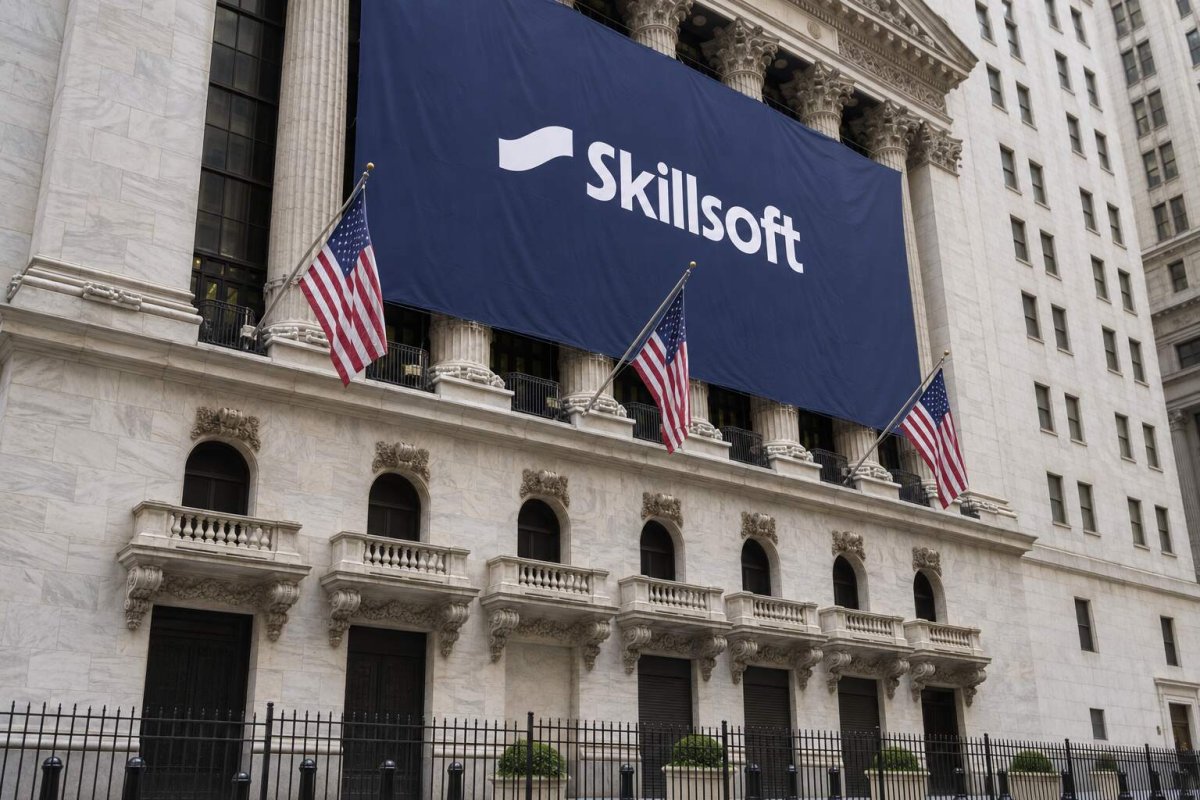
Skillsoft Corp. (NYSE: SKIL) experienced a sharp decline in its share price during Wednesday's after-hours trading, falling approximately 9% following the company's decision to lower its full-year revenue guidance. The market's reaction underscores growing concerns about the company's ability to manage its financial obligations amid a contracting top line.
The selloff was not driven by the company's profit margins, which actually improved during the quarter. Instead, it reflects the precarious position of a company facing both shrinking revenue and a significant debt maturity in July 2028. This combination leaves little margin for error in its operational execution.
Quarterly Results Show Mixed Picture
For the fiscal second quarter ended July 31, Skillsoft reported a 3% decline in continuing-operations revenue to $98.2 million. The net loss from continuing operations narrowed to $15.0 million from $18.0 million in the prior-year period, while adjusted EBITDA rose 7% to $33.0 million. The adjusted EBITDA margin expanded to 34% from 31%.
This combination of lower revenue but higher adjusted profit highlights the dual nature of the investment case. On one hand, cost discipline is clearly working. On the other, demand remains insufficient to drive growth. The company noted that its enterprise business performed as expected, but continued weakness in direct-to-consumer offerings weighed on overall sales.
Skillsoft also highlighted early adoption of its AI-powered products, with customers using its CAISY simulation tool growing 9% from the previous quarter and learner usage increasing 23%.
Guidance Reduction Raises Execution Bar
The key catalyst for the selloff was the guidance revision. In its September 9 results release, Skillsoft reduced its fiscal 2027 revenue outlook to $380 million-$390 million, down from the previous $388 million-$406 million range. The midpoint of the new guidance is $12 million lower, representing a 3% reduction. Management maintained its adjusted EBITDA guidance at $108 million-$116 million and free-cash-flow guidance at $14 million-$22 million.
At the new midpoints, Skillsoft is targeting approximately $112 million of adjusted EBITDA on $385 million of revenue, implying a 29.1% margin. This is a stronger implied margin than under the previous sales range, but it also raises the bar for execution: preserving the profit target now requires more cost savings for every dollar of revenue that fails to materialize.
Valuation and Debt Overhang
Using the after-hours price and the 9.06 million shares reported outstanding on July 31, Skillsoft's equity value was approximately $52.6 million. The company's balance sheet showed $90.3 million in cash and $573.6 million in current and long-term debt, along with $1.0 million drawn on its receivables facility. This puts simplified net debt at approximately $484.3 million—more than nine times the market value of the common stock.
Adding net debt to equity value yields an implied enterprise value of about $537 million, or 4.8 times the midpoint of management's adjusted EBITDA outlook. While this multiple appears low on the surface, the equity represents a thin slice beneath a large fixed claim. Skillsoft reported $578.6 million of term-loan principal, with $569.0 million scheduled to mature in fiscal 2029; the credit agreement matures on July 16, 2028. A $300 million portion carries a fixed cash interest rate of 8.94% under swaps, while the remainder is priced off SOFR plus a credit premium and a 5.25-point margin. Interest expense totaled $28.0 million in the first six months of the fiscal year.
Management has identified the debt maturity as a key financial priority, and a special board committee is evaluating refinancing or other alternatives. This process is likely to be more critical to the stock's future than conventional software valuation metrics. A refinancing on manageable terms could transfer significant value to the small equity base, while expensive terms, dilution, or a revenue miss could have the opposite effect.
Additional Cash Flow Concerns
Skillsoft completed the sale of Global Knowledge to an affiliate of Enduring Ventures in July, sharpening its focus on its core learning platform. However, the filing reveals that the consideration is not entirely in cash. The buyer missed a $3.4 million payment due July 31 on a seller note; only $0.5 million had been paid by September 1. The buyer has indicated it expects to pay the remaining note balance by October 31. An additional $8 million of deferred consideration is due in five quarterly installments beginning nine months after closing.
While these sums are modest relative to the term loan, they are meaningful compared to the $52.6 million equity value. Collection progress represents a real, observable test of balance-sheet execution.
What Would Change the SKIL Thesis
The bullish case for Skillsoft requires three things to occur together: enterprise revenue must stabilize the top line, adjusted margins must remain near the new implied level, and free cash flow must move toward the $14 million-$22 million target. Evidence that AI Coach, CAISY, and the broader Percipio platform are improving renewals or expanding customer spending would make the margin story more durable.
The counterargument is that a revenue cut this early in the year makes the held profit target increasingly dependent on cost actions, while negative second-quarter free cash flow of $20.5 million shows how uneven cash conversion can be. The next decisive catalyst may not be the next earnings report; it may be a refinancing announcement that tells investors how much of Skillsoft's operating improvement will ultimately belong to common shareholders.