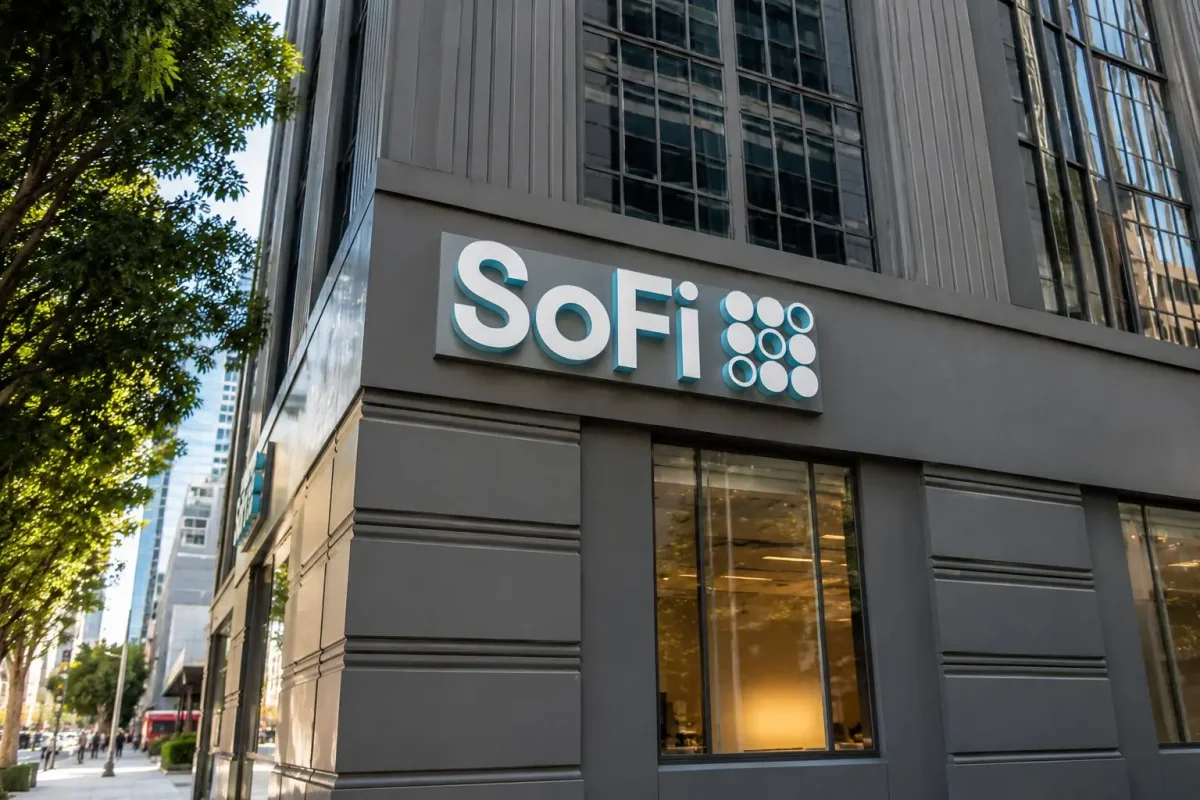
SoFi Technologies (SOFI) ended last week sharply lower, with shares closing at $16.03 on Friday after a 12% decline from the prior week's $18.22 close. The sell-off came as a stronger-than-expected U.S. jobs report reignited concerns that interest rates could remain elevated, putting pressure on growth stocks across the board.
The Nasdaq Composite tumbled 4.18% on Friday, while the S&P 500 fell 2.64%. The U.S. economy added 172,000 payrolls in May, topping analyst forecasts, according to Reuters. Higher rates tend to compress valuation multiples for growth companies, as future earnings are discounted more heavily. "After the record run we've seen, the dam just broke," said Ryan Detrick, chief market strategist at Carson Group. Ohsung Kwon, chief equity strategist at Wells Fargo, attributed the move to positioning rather than fundamentals, noting that crowded trades can reverse quickly even without company-specific news.
SoFi's decline occurred despite the company unveiling several new initiatives. On Tuesday, the digital lender launched SoFi Coach, an AI-powered financial coaching feature that provides personalized money advice within its app. The tool will initially be available to SoFi Plus members. CEO Anthony Noto stated that many people lack access to essential financial guidance, while Brian Walsh, SoFi's head of advice and planning, emphasized that basic financial help "shouldn't be a luxury."
Meanwhile, SoFi's stablecoin, SoFiUSD, remained in the spotlight. The company allows members to buy, sell, hold, and convert the digital asset within its platform. Noto described it as a product that combines the "speed and versatility" of blockchain with the "trust of a bank." However, the broader crypto sell-off weighed on sentiment, with bitcoin prices falling and dragging down shares of Coinbase (COIN), which lost $11.69 to close at $152.40, and Robinhood (HOOD), down $5.86 to $82.47.
SoFi's first-quarter results earlier this year provided some optimism. Adjusted net revenue surged 41% year-over-year to $1.1 billion, while adjusted EBITDA jumped 62% to $340 million. The company also posted record total loan originations of $12.2 billion and a 35% increase in members to 14.7 million. However, not all metrics were positive. Tech-platform revenue fell 27% to $75.1 million after losing a major client, and enabled accounts dropped 16% to 133 million, giving bears a point that growth is uneven across segments.
Risks remain on multiple fronts. Higher interest rates could dampen loan demand and hurt credit quality. If SoFiUSD adoption fails to gain traction, the stablecoin narrative weakens. The company itself warns that SoFi Coach does not constitute financial advice, may contain errors, and could steer users toward revenue-generating products. Digital assets are not FDIC-insured and carry significant risk.
The next major catalyst for markets is Wednesday's release of the May Consumer Price Index (CPI) by the Bureau of Labor Statistics at 8:30 a.m. ET. A hotter-than-expected reading could reinforce the rate fears that triggered Friday's sell-off. For SoFi investors, the focus will also be on the company's annual meeting scheduled for June 17 at 10:00 a.m. ET, which will be held virtually and include a Q&A session where management may address credit trends, digital asset strategy, and the impact of new products on earnings.