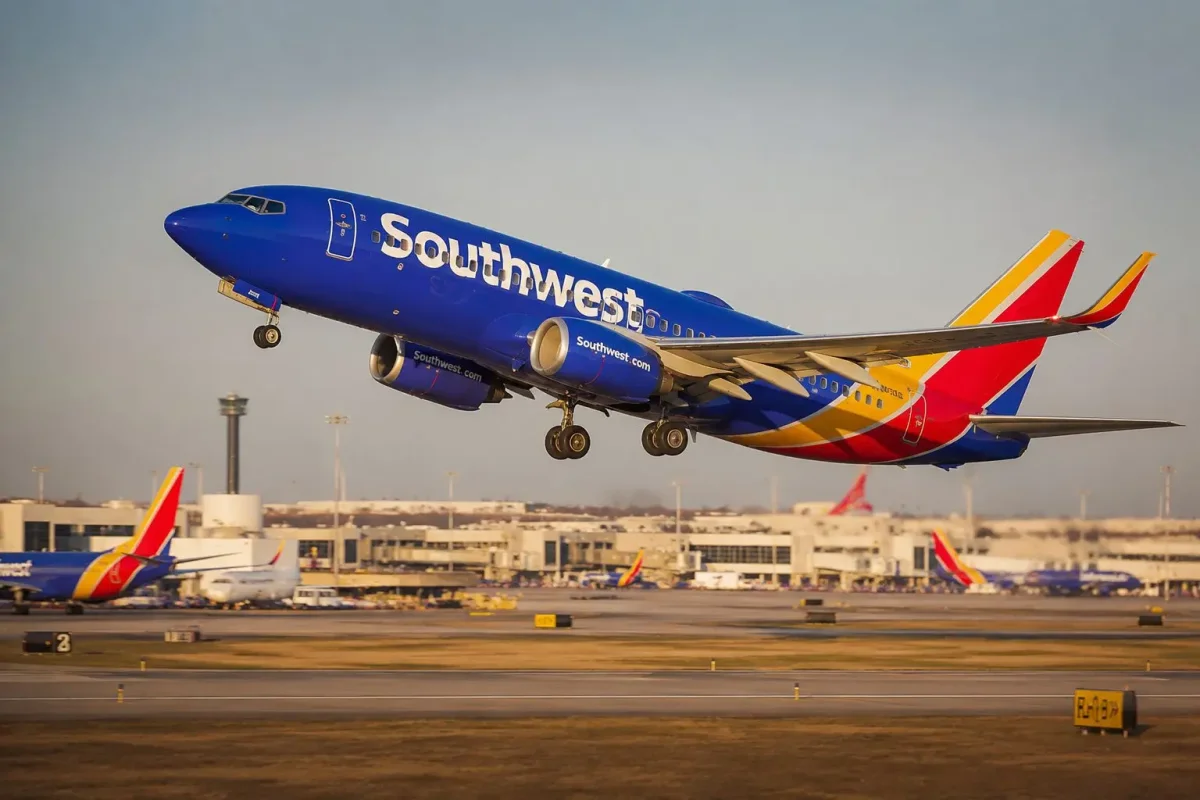
Southwest Airlines (NYSE:LUV) experienced a minor operational hiccup on Monday when one of its Boeing (NYSE:BA) 737-800 aircraft was diverted to Charleston, South Carolina, after the crew reported a possible fuel leak. The incident, while raising safety concerns, appears to have a negligible financial impact on the carrier, which is set to report its second-quarter earnings later this week.
Incident Details
Southwest flight WN4761, operating from Orlando to Manchester, New Hampshire, was cruising at 37,000 feet when pilots detected a suspected fuel leak. The crew declared an emergency using squawk code 7700 and safely landed in Charleston. No injuries were reported, and a substitute aircraft, N8881L, completed the journey to Manchester. Maintenance teams are investigating the cause of the issue.
The affected aircraft, N8662F, was built in 2015 and is part of Southwest's 737-800 subfleet, which has an average age of 11 years. With the carrier's total fleet standing at 800 aircraft as of its most recent report, the diverted jet represents just 0.125% of the fleet, and 0.51% of the 196-strong 737-800 subfleet.
Market Context and Earnings Preview
Southwest's stock closed Monday at $48.34, up 0.54%, outperforming the S&P 500, which slipped 0.19%. However, the stock has declined 0.7% over the past week, while rivals Delta Air Lines (NYSE:DAL) and United Airlines (NASDAQ:UAL) fell 3.7% and 8.4%, respectively, in the same period. Southwest had previously outperformed both carriers.
Investors are now focused on the company's second-quarter earnings release, scheduled for Thursday at 10:00 a.m. EDT. Preliminary consensus estimates call for adjusted EPS of $0.51, up from $0.48 a month ago and one cent above the midpoint of management's guidance range of $0.50. Fuel costs remain the primary driver of earnings volatility, with first-quarter fuel expenses exceeding initial forecasts by $164 million, translating to a 22-cent EPS impact. Southwest's initial Q2 fuel guidance, set in April, was $4.10 to $4.15 per gallon.
Strategic Priorities and Risks
CEO Bob Jordan emphasized in April that "demand continues to be strong" and that management remains focused on cost control. Thursday's update will test that commitment. The company also continues to prioritize fleet operations, expecting to receive 66 Boeing MAX 8 aircraft this year while retiring nearly 60 older planes. This reliance on Boeing and the FAA remains a key risk factor.
While the financial impact of the diversion appears limited, risks remain. If the fuel-system issue is confirmed, recurring incidents or an FAA investigation could lead to higher expenses or grounding. However, based on available data, the incident is unlikely to materially affect Southwest's near-term performance, with the earnings call providing more significant catalysts for the stock.