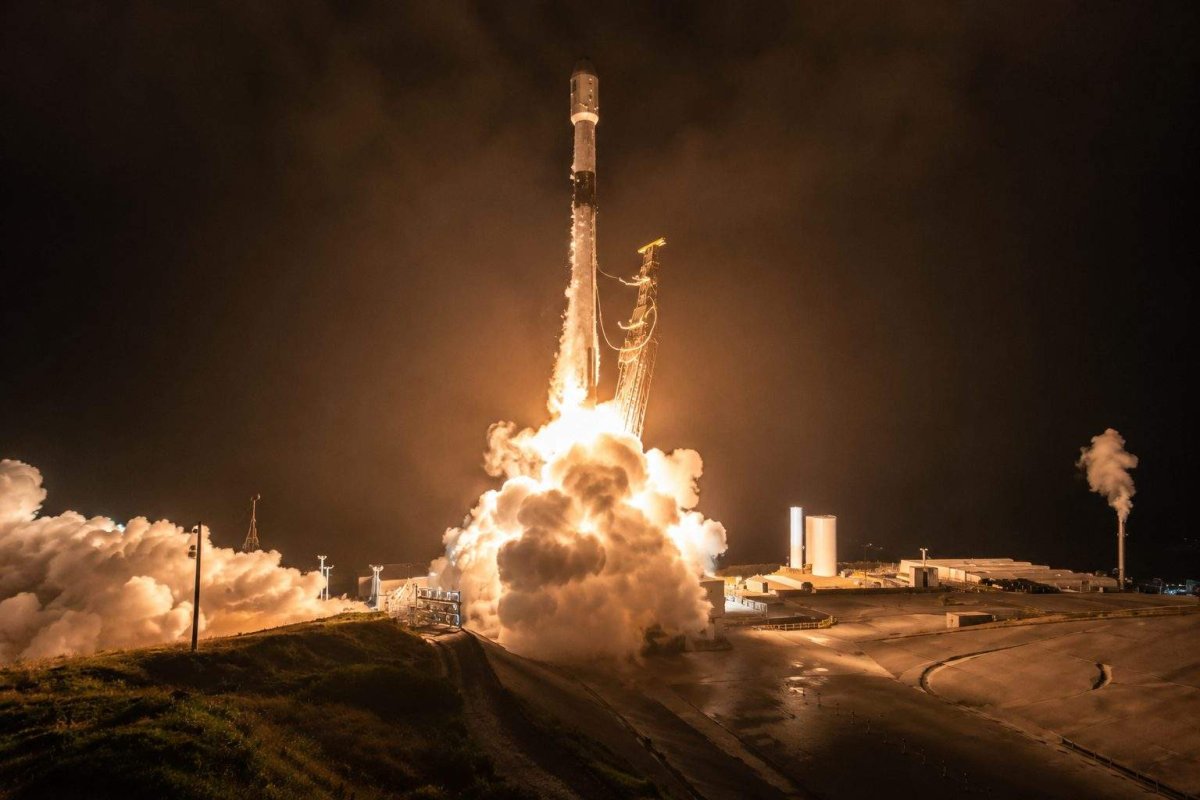
SpaceX continued its aggressive launch cadence late Tuesday, sending 24 Starlink internet satellites into orbit from Vandenberg Space Force Base in California. The Falcon 9 rocket lifted off from Space Launch Complex 4 East at 8:59:19 p.m. PDT, carrying the latest batch of satellites for the company's growing broadband constellation, which now exceeds 10,000 units in low Earth orbit.
The mission, designated Starlink 17-29, utilized booster B1081 on its 24th flight. Approximately eight minutes after liftoff, the first stage successfully landed on the droneship "Of Course I Still Love You" stationed in the Pacific Ocean. The launch was cleared by the U.S. Space Force and marked SpaceX's 55th flight of 2026, according to Next Spaceflight.
This launch comes as SpaceX transitions Starlink from a high-growth project into a steady revenue generator. The company is ramping up capacity in low Earth orbit, providing internet with lower latency than traditional geostationary systems. The Vandenberg location is ideal for polar and sun-synchronous orbits, allowing satellites to pass over regions at consistent local solar times.
SpaceX's May schedule remains packed. Another Starlink launch from Vandenberg is slated for May 10, though it was pushed back from May 9. On May 12, NASA's CRS-34 cargo mission is scheduled to lift off from Cape Canaveral Space Force Station's Space Launch Complex 40. The Dragon spacecraft will deliver supplies and scientific equipment to the International Space Station, docking approximately 38 hours later on May 14.
The competitive landscape is intensifying. On April 27, United Launch Alliance launched 29 satellites for Amazon's Project Kuiper, now branded as Amazon Leo. That launch raised Amazon's total to 270 satellites in orbit, with plans to expand beyond 3,200. Amazon's network will rely on optical inter-satellite links and a ground infrastructure of gateway stations and fiber, positioning it as a credible challenger to Starlink, though it still lags in deployed spacecraft.
Industry analysts see the next battleground shifting from traditional satellite dishes to mobile devices. David Barden of New Street Research suggests that satellite operators like Starlink and Amazon Leo should pursue "durable wholesale agreements" with major wireless carriers. Viasat's Robert Brown, head of business development and strategic partnerships, described such mobile virtual network operator (MVNO) deals as "inevitable" within the next five years, as reported by Broadband Breakfast.
Despite the high launch tempo, schedules remain fluid. Spaceflight Now's manifest shows the next Vandenberg Starlink flight, Starlink 17-37, moved from May 9 to May 10, while Starlink 17-42 slipped from May 16 to May 17. Weather, range availability, and technical approvals continue to influence launch dates, even with elevated activity across SpaceX's fleet and pads.