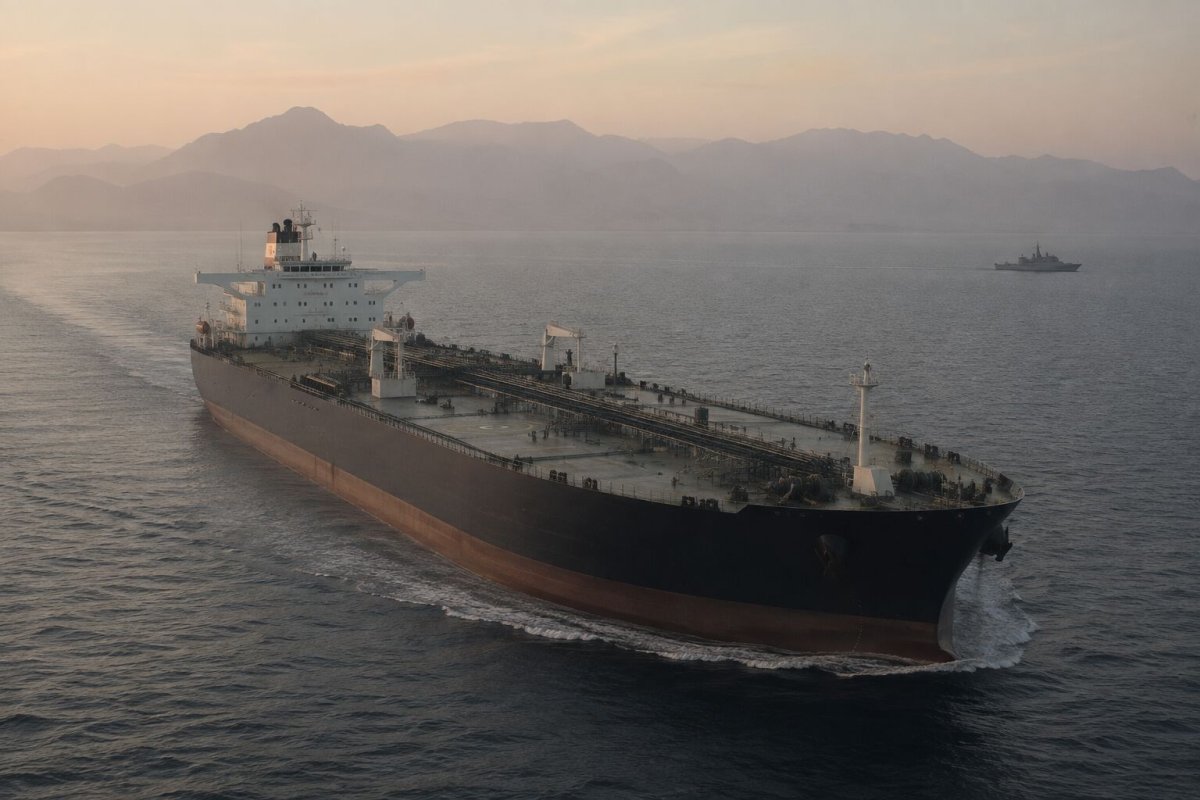
LONDON — Commodity vessel traffic through the Strait of Hormuz has slipped to its lowest level since May, underscoring persistent supply concerns in the region. Over the ten days through Sunday, an average of just 10 ships per day traversed the critical waterway, according to data from Kpler reported by Reuters. Weekend crossings were particularly sparse, with only two vessels on Saturday and six on Sunday.
More notably, no very large crude carriers (VLCCs) have exited the strait since Wednesday. This is a more significant supply signal than the overall ship count, which can be influenced by smaller grain carriers or vessels carrying minimal oil. A single VLCC can transport roughly two million barrels of crude, making its absence a key indicator of potential supply tightness.
Brent crude futures rose $1.20 to $97.48 a barrel at 7:27 a.m. GMT Monday, a 1.25% gain that follows a 7.8% advance last week. Both moves were attributed to renewed U.S.-Iran attacks around the waterway, as reported by Reuters.
Key Numbers Behind the Strait's Risk
The physical traffic data weakens the case for a quick recovery in oil flows. The 10-day average of 10 ships per day is the lowest since May, and the weekend saw only eight crossings combined. Meanwhile, Brent futures are trading at $97.48, reflecting a significant risk premium that has been built into the market.
According to the U.S. Energy Information Administration (EIA), oil flows through Hormuz averaged 4.9 million barrels per day in the second quarter of 2026, a dramatic drop from 21.6 million barrels per day in the fourth quarter of 2025 — a 77% decline.
The Duration of the Disruption
The bottleneck is not new, but the weekend attacks challenge the expected recovery path. In its August Short-Term Energy Outlook, the EIA assumed severely constrained traffic through August, followed by a slow increase in September. The agency forecast another 3.8-million-barrel daily draw from global inventories during the third quarter.
The EIA projected third-quarter Brent at an average of $85 and fourth-quarter at $78. Monday's futures price of $97.48 stands about 15% above the third-quarter forecast and 25% above the fourth-quarter estimate. While this isn't a like-for-like comparison — one is an intraday futures quote, the others are quarterly spot-price forecasts — the gap highlights a significant disagreement between traders and the agency.
Traders are now assigning more weight to a delayed reopening than the EIA did when it completed its forecast on Aug. 6. Priyanka Sachdeva, head of market insights at Phillip Nova, told Reuters that materially slower tanker traffic could force the market to price in a much larger supply shock. The latest data suggests that process has already begun, with last week's 7.8% rise indicating part of the adjustment has occurred.
Data Reliability Concerns
Automatic Identification System (AIS) signals have become unusually unreliable around Hormuz, as ships may switch them off for security or sanctions reasons. The EIA now supplements vessel signals with origin, destination, and cargo analysis, and frequently revises 2026 flow estimates. This makes the absence of an outbound VLCC more decision-useful than a single day's total crossing count.
Operational guidance remains restrictive. A current U.S. Maritime Administration advisory warns of high risk of attacks on commercial shipping and instructs U.S.-flagged vessels to maintain a 30-nautical-mile distance from U.S. military ships and coordinate voyage planning with naval authorities.
What to Watch Next
Tehran plans to announce an exclusion zone outside the strait, according to the Associated Press, though its location and enforcement rules remain unclear. American commanders have also denied Iran's claim that it hit an uncrewed U.S. vessel on Sunday. Neither assertion settles the oil trade, but a sustained outbound VLCC movement would weaken the immediate bull case, while another week near 10 commodity ships per day — especially with more tanker damage — would support it.
The next scheduled checkpoint arrives Wednesday, when the EIA releases its September outlook on Sept. 9. A cut to the assumed flow recovery or a larger inventory draw would tell crude holders that Monday's premium has a new fundamental base. U.S. cash equities are closed Monday for Labor Day, so energy shares will first absorb the full weekend signal on Tuesday. Brent's holiday-session move should therefore be read with some humility.