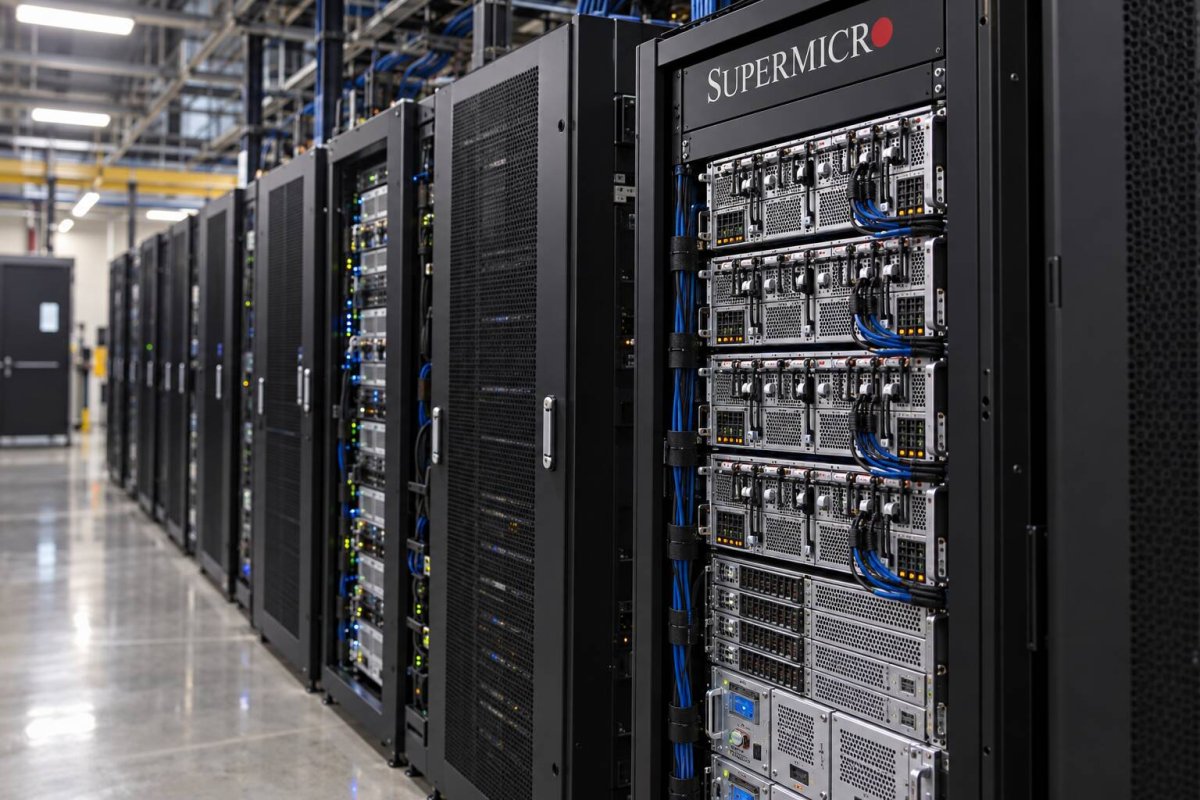
Super Micro Computer (SMCI) saw its shares climb 1.7% in Tuesday's regular session, closing at $40.26 on September 8. However, the modest daily gain masks a far more consequential narrative: the company is betting its future on a staggering revenue projection that will test its operational and financial discipline. Management has guided to fiscal 2027 sales between $65 billion and $72 billion, a midpoint of $68.5 billion—representing a 75.4% jump from the $39.06 billion expected for fiscal 2026. The market is being asked to underwrite this aggressive growth while the company grapples with a massive inventory buildup and lingering regulatory scrutiny.
The Immediate Test: First-Quarter Guidance
For the September quarter, Super Micro expects revenue in the range of $14.5 billion to $15.5 billion, with a midpoint of $15 billion. That would mark a 35% sequential increase from the June quarter's $11.12 billion, but it still only accounts for about 21.9% of the full-year target. In other words, even hitting the center of the guidance would leave roughly $53.5 billion in sales to be generated over the final nine months of the fiscal year. This underscores the critical importance of order timing, customer acceptance, and the mix of complete rack-scale systems—factors that will determine whether the company can scale as rapidly as it did in fiscal 2026, when annual revenue surged 77.8%.
The .9 Billion Inventory Conundrum
The company's year-end inventory ballooned to $12.90 billion from $4.68 billion, a 176% increase, representing 33% of fiscal-year sales. Accounts receivable also expanded significantly, from $2.20 billion to $6.13 billion. While these working-capital investments can support a rapid shipment ramp, they also amplify the risks if product transitions, customer schedules, or component prices move unfavorably. The working-capital build contributed to a negative operating cash flow of $6.81 billion for the year, even as Super Micro ended June with $7.52 billion in cash. To finance this expansion, the company issued $1.41 billion in common stock and $4.23 billion in preferred stock, alongside higher borrowings. Investors should closely monitor the company's Form 10-K to see whether inventory converts into revenue and cash or remains stuck on the balance sheet.
Margins: The Valuation Question
At Tuesday's close, Super Micro traded at approximately 12.3 times fiscal 2026 GAAP diluted earnings of $3.26 per share. That multiple may look undemanding relative to the sales forecast, but it is backward-looking and does not address the core issue: how much profit the company retains from each dollar of rack-scale revenue. The June quarter provided some encouragement, with GAAP gross margin at 17.5%, but the full-year margin was only 10.8%, down from 11.1% the prior year. A sustained shift toward higher-value enterprise and integrated data-center solutions could make the earnings multiple appear cheap. Conversely, renewed price pressure or an unfavorable customer mix would diminish the value of the revenue target to shareholders.
The Compliance Overhang
On August 20, Super Micro announced that a board-led independent investigation found no evidence that current senior management knew of alleged product diversion to restricted locations, nor that such diversion made its financial statements unreliable. The company also said it took personnel actions and adopted the review's recommendations. While this is a positive development, it does not constitute regulatory closure. The company's own update acknowledges that government investigations remain ongoing and that it is cooperating. Thus, investors face two distinct checkpoints: operational conversion of inventory into cash, and external resolution of compliance scrutiny.
Two Divergent Scenarios
The bullish thesis for Super Micro hinges on both sales and gross profit scaling without another massive working-capital draw. The bearish thesis does not require a collapse in AI spending; it only needs deliveries to slip, margins to disappoint, or compliance costs to remain elevated. The upcoming September-quarter report will provide critical evidence on which side is gaining ground. As the company prepares for another investor appearance at the Goldman Sachs conference on September 10, the market will be watching closely to see if management can convince investors that the $68.5 billion target is not just a number, but a realistic trajectory backed by solid execution.