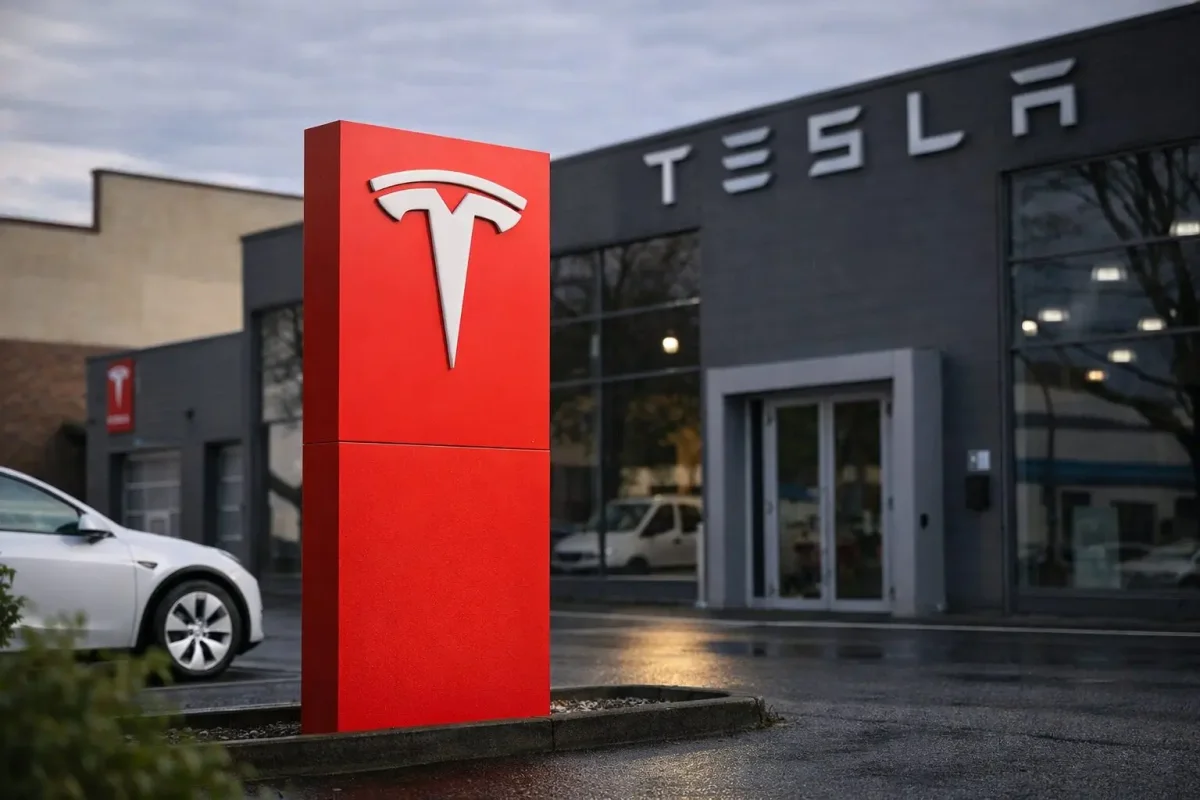
Tesla Inc. saw its stock price increase by approximately 0.9% in late-morning trading on Tuesday, March 24, 2026, reaching $384.46. This uptick coincided with the release of new registration data from Europe, which showed the electric vehicle maker's first monthly sales growth in over a year. The broader U.S. market, however, opened lower, capping the magnitude of Tesla's gains.
The European Automobile Manufacturers' Association (ACEA) reported that Tesla's new car registrations in the EU, UK, and EFTA markets rose by 11.8% in February compared to the same period last year. This increase snapped a streak of 13 consecutive months of declining sales on the continent. Despite this positive development, Chinese automaker BYD posted a more than 100% surge in its European sales for the month, resulting in both companies holding a 1.8% share of the total European market.
Overall, the European automotive market grew modestly, with total new car registrations up 1.7% in February. Demand for electric vehicles continued to outpace the general market, with battery-electric vehicle sales jumping 20.6% and plug-in hybrid registrations rising 32.1%. This indicates a resilient appetite for EVs, even as Tesla faces intensified competition for market share.
The sales rebound comes at a critical juncture for Tesla, as Wall Street analysts have significantly reduced their delivery growth forecasts for 2026. Current projections now sit at just 3.8%, a sharp decline from the 8.2% growth anticipated in January. Some analysts, including Seth Goldstein of Morningstar, are now forecasting a third consecutive annual decline in Tesla's vehicle deliveries for 2026. Goldstein cited headwinds such as the phasing out of U.S. federal EV tax credits for certain models and heightened competition, particularly in Europe. He also noted weaker-than-expected demand for Tesla's more affordable vehicle trims.
Beyond the core automotive business, competition is also heating up in the autonomous vehicle sector. Amazon.com Inc.'s Zoox unit announced on Tuesday that it is expanding its robotaxi service in San Francisco and Las Vegas and will begin testing in Austin and Miami. Alphabet Inc.'s Waymo remains a leader in the space. Tesla's own robotaxi ambitions, centered on its Full Self-Driving (FSD) software, face a significant regulatory hurdle. Last week, the U.S. National Highway Traffic Safety Administration (NHTSA) escalated its investigation into approximately 3.2 million Tesla vehicles equipped with FSD by opening an engineering analysis. This step increases the possibility of a future recall for the system, which requires active driver supervision.
Regulatory approval is also key for Tesla's ambitions in Europe. The company is seeking a decision from Dutch authorities on its FSD Supervised system by April 10, with potential clearance for the broader EU market possible by summer. Any delays could hinder Tesla's ability to roll out the technology in what analysts describe as an intensely competitive European market.
Financially, Tesla concluded 2025 with $44.06 billion in cash, cash equivalents, and investments. However, with Wall Street expecting capital expenditures to exceed $20 billion this year and projections pointing to negative free cash flow—which would break a seven-year streak of positive cash flow—debates over the company's valuation and spending priorities are likely to persist. A substantial portion of Tesla's market value remains tied to its long-term bets on autonomy and robotics, rather than its current automotive operations.
In a separate development over the weekend, CEO Elon Musk suggested that SpaceX could establish advanced semiconductor fabrication plants, or "Terafabs," in Austin, Texas, citing a strategic need for proprietary chips. No specific timeline for this project was provided.