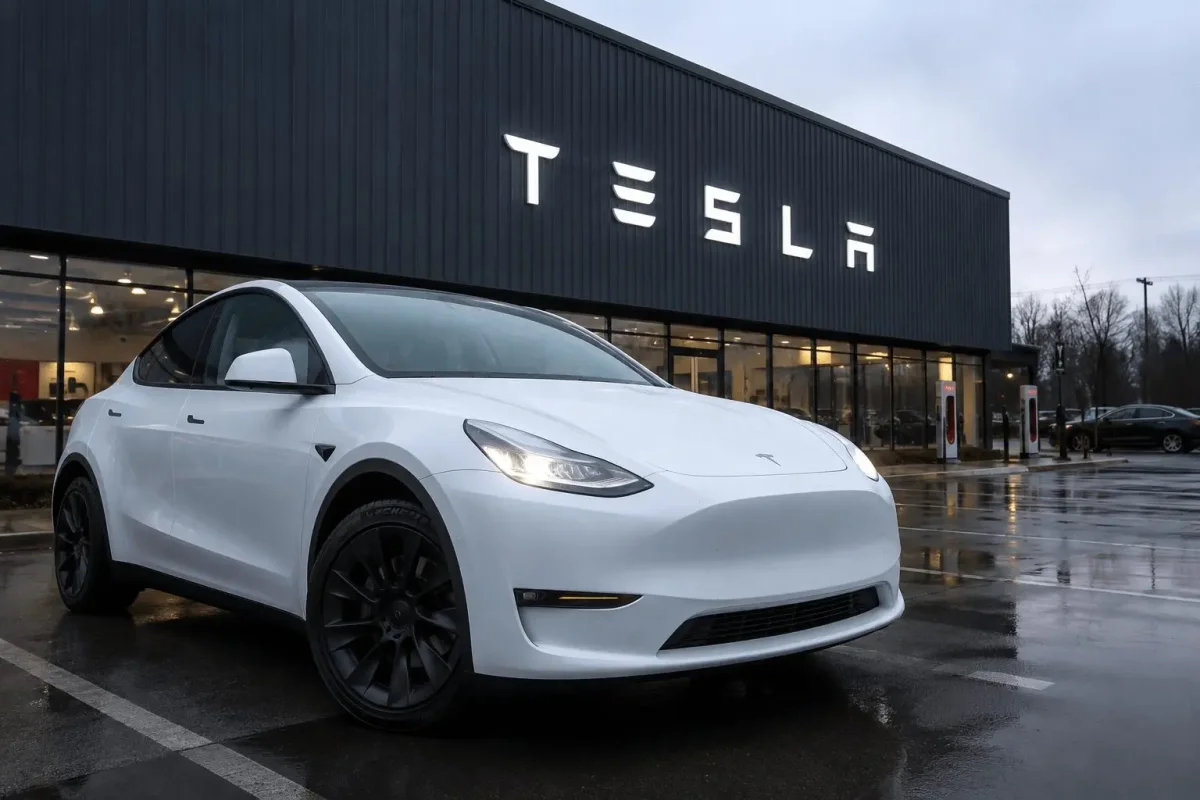
Tesla (NASDAQ:TSLA) shares climbed 3.7% to $322.65 in late trading on Monday, adding roughly $40.5 billion to the company's market capitalization. The surge, which lifted Tesla's valuation to approximately $1.14 trillion, came amid a broader market rally fueled by lower oil prices and easing geopolitical tensions.
The equity value increase was nearly 102 times Tesla's operating income for the second quarter, which totaled just $398 million. At that quarterly pace, the one-day gain represented about 25 years' worth of operating earnings—a stark illustration of the divergence between Tesla's current profitability and the valuations investors are assigning to its future in autonomy, robotics, and artificial intelligence.
The move outpaced both electric-vehicle rivals and traditional automakers. Rivian Automotive (NASDAQ:RIVN) rose 2.2% to $15.56, while General Motors (NYSE:GM) fell 0.8% to $88.15 and Ford Motor (NYSE:F) dropped 1.1% to $14.52. The Nasdaq Composite advanced 2.2%, and the S&P 500 gained 1.5%.
European sales data released on Monday painted a mixed picture. Registrations—a proxy for demand—varied wildly across markets. France saw an 86% year-over-year increase in July, and Denmark rose 52%. However, five other markets posted declines of more than 60%, including Sweden (-60%), Portugal (-69%), Italy (-77%), Spain (-81%), and Norway (-97%).
Andy Leyland, co-founder of SC Insights, cautioned against overinterpreting Norway's sharp drop. "Such a large change is usually reflective of either shipment timings, or a taxation change," he told Reuters. Data from Britain and Germany, both larger markets, are due later this week and could provide a clearer picture of Tesla's regional trend.
Tesla's second-quarter results, released after the market close on July 22, showed vehicle deliveries of 480,126—up 19.2% from the consensus estimate of 402,776. Production reached 451,758, meaning deliveries outpaced production by 28,368 units. Revenue grew 25.5% year-over-year to $28.236 billion, but operating income fell 56.9% to $398 million as operating expenses surged 47% to $4.35 billion, including a 49% jump in research and development spending to $2.37 billion.
The company expects capital expenditures to exceed $25 billion in 2026, driven by investments in AI computing, data centers, and AI-enabled assets. Capital spending in the first half more than doubled to $8.28 billion.
Monday's rebound recovered only a portion of the losses suffered after the earnings report. Tesla shares closed at $374.01 on July 22, then fell to $298.32 by July 29—a 20.2% drop. By July 31, they had recovered to $311.21, and Monday's late-session price of $322.65 still left the stock 13.7% below its pre-earnings close.
In regulatory news, U.S. authorities are investigating approximately 1.2 million Model 3 and Model Y vehicles following 156 complaints related to suspension issues. No crashes, injuries, or fatalities have been linked to the problem, but a recall could be ordered if a defect is confirmed.
Investors now look to Britain and Germany for near-term demand signals, while the key question remains whether Tesla's heavy AI investment will eventually translate into sustained operating profit growth.