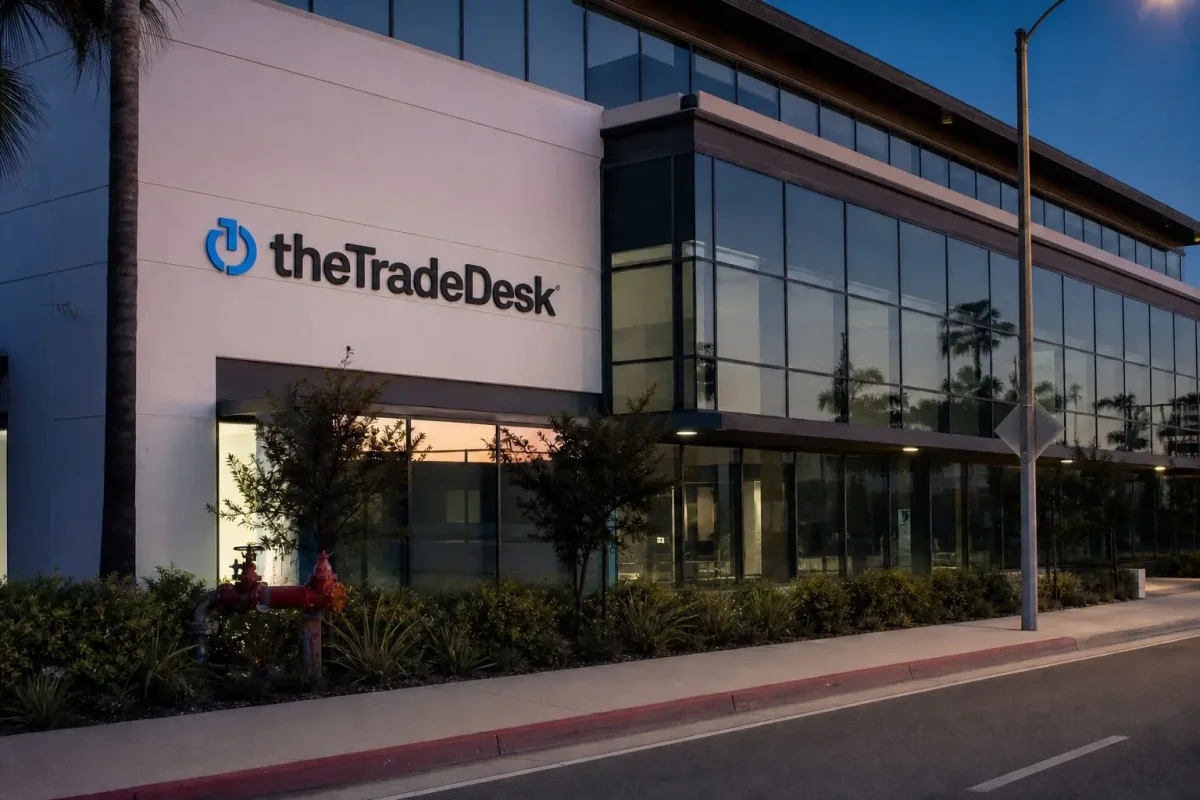
The Trade Desk (NASDAQ: TTD) experienced a sharp selloff on Friday, with shares closing down 21.9% at $13.80, marking the stock's lowest level since January 2019. The decline came after the company issued third-quarter guidance that signaled a significant slowdown in revenue growth and a substantial contraction in profitability, prompting a wave of analyst downgrades and price target cuts.
According to the company's outlook, third-quarter revenue is expected to be at least $650 million, representing a minimum 12% decrease compared to the $739 million reported in the same period last year. More concerning for investors, adjusted EBITDA is projected to be approximately $160 million, a 49.5% plunge from the $317 million generated in Q3 2025. This implies an initial adjusted EBITDA margin of just 24.6%, down sharply from 42.9% a year earlier.
The guidance fell well short of Wall Street expectations, with the revenue forecast coming in 19.4% below the consensus estimate of $806.5 million. The disappointing outlook underscores the challenges the company faces in a competitive digital advertising environment, where clients are increasingly favoring lower-cost media options.
Q2 results already hinted at the emerging trends. While revenue grew 3% year-over-year to $715.1 million, this was below management's minimum target of $750 million. Adjusted EBITDA of $241.3 million also missed the prior guidance of $260 million, and the margin narrowed by approximately 5.3 percentage points. Operating expenses rose 6.3%, with platform operations costs surging 22.1%, indicating that the company is spending more to generate less growth.
CEO Jeff Green acknowledged the disappointing performance, stating, "This quarter did not meet the standard we set for ourselves." He emphasized that the leadership team is focused on improving execution, enhancing the platform, and concentrating efforts on key areas to drive recovery.
The market's reaction was severe, with trading volume reaching 132.8 million shares, approximately 6.5 times the 65-day average. The stock's weekly decline of 23.5% contrasted sharply with the Nasdaq Composite's 5.19% gain over the same period, highlighting the company-specific nature of the selloff. The market capitalization dropped by roughly $1.8 billion on Friday, bringing it to $6.49 billion.
Analysts were quick to adjust their ratings and price targets. Raymond James downgraded the stock to Underperform, while Truist, Susquehanna, RBC, Evercore, and Citigroup all lowered their recommendations or price targets. New targets range from $6 to $20, reflecting a wide divergence in views on the company's near-term prospects.
The broader ad-tech sector showed mixed performance, with PubMatic jumping 32% and Magnite gaining 1.6%, while AppLovin rose 3.3%. This suggests that Trade Desk's troubles are not entirely sector-wide but rather company-specific issues related to pricing and execution.
Despite the challenges, the company maintains a solid balance sheet with $1.49 billion in cash and short-term investments, representing about 23% of its market capitalization. It also has $269 million remaining under its share repurchase authorization, which could provide some support to the stock.
Looking ahead, investors will be watching upcoming economic data, including the July CPI report on Wednesday, PPI on Thursday, and retail sales on Friday, which could influence advertising spending trends. The wide range of analyst price targets indicates uncertainty about the company's ability to navigate these headwinds, and further estimate cuts could occur if pricing pressures persist or execution issues continue.