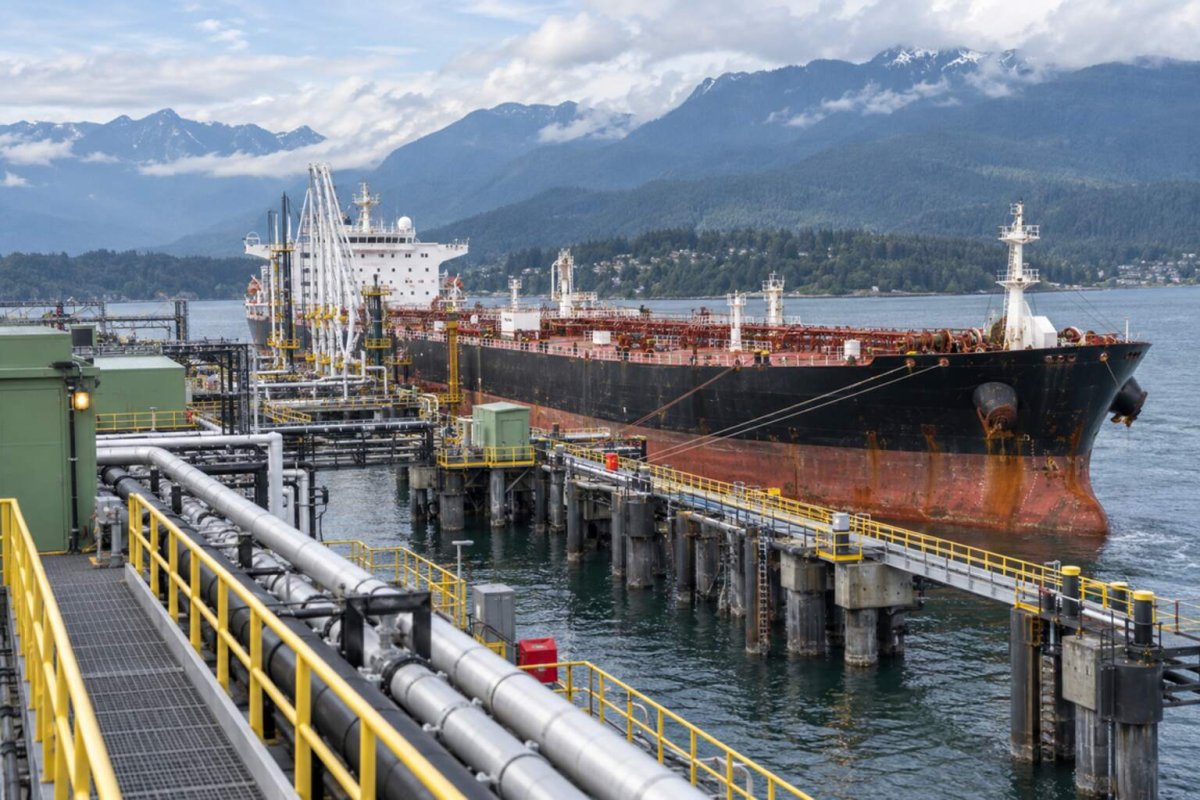
Trans Mountain's bullish outlook on Asian demand has been widely misinterpreted. The claim that 70% of Canadian oil will flow to Asia is not about total exports—it's about the tanker traffic leaving the Westridge Marine Terminal. CEO Mark Maki clarified that roughly two-thirds of ships already sail to Asia, and he expects most incremental capacity to follow that route.
What the 70% forecast really means
Speaking at the APPEC conference in Singapore, Maki said China will remain the largest customer, with Thailand, India, Japan, South Korea, and Vietnam also buying. Trans Mountain's own data shows that over 65% of 2025 seaborne shipments from Westridge went to Asian ports, and since the expanded pipeline opened in May 2024, more than 280 shipments have reached 26 Asian terminals.
This is an extension of the existing tanker mix, not a transformation of Canada's entire export book. For context, Canada exported roughly 4.34 million barrels per day in June, with only about 12.6% going to non-U.S. destinations. Even Trans Mountain's full capacity of 1.19 million barrels per day would represent just 27% of that national export rate.
The 300,000-barrel expansion still matters
The planned optimization would add up to 300,000 barrels per day by the end of 2028, with the first 90,000 barrels possible as early as the fourth quarter. While this is only about 6.9% of Canada's June export pace, oil differentials are set by the marginal barrel. When pipeline space tightens, the last barrels face higher transport costs or lower prices, so even a modest capacity cushion can have an outsized effect on producer netbacks.
Impact on WCS differentials
Western Canadian Select was quoted at $79.13 on Sept. 8, while WTI was $93.96, a gap of $14.83. More Pacific capacity could reduce the transportation component of that discount and give producers bargaining power by adding Asian refiners. However, WCS also trades at a discount because it's a heavy, sour crude—no pipeline expansion removes that quality gap.
Listed oil-sands producers like Canadian Natural Resources, Suncor, Cenovus, and Imperial Oil are exposed to this mechanism. But there's no direct Trans Mountain stock—it's a federal Crown corporation. The listed infrastructure angle is Pembina Pipeline, which would hold a 10% economic interest in a separate west-coast line under a Canada-Alberta plan.
What could change the thesis
The bullish case hinges on regulatory approval, timely delivery of the first 90,000 barrels, and sustained Asian loadings. Watch the WCS-WTI spread alongside pipeline utilization. The main risk is that production growth refills the pipe; Canada's Energy Regulator expects output to exceed last year's record, and the larger 210,000-barrel project is more than two years away.
For investors, the takeaway is less dramatic than a 70% export shift but still meaningful: Asia already dominates Trans Mountain's marine mix, and the next 300,000 barrels could defend heavy-oil pricing—if approvals and construction arrive before supply growth consumes today's cushion.