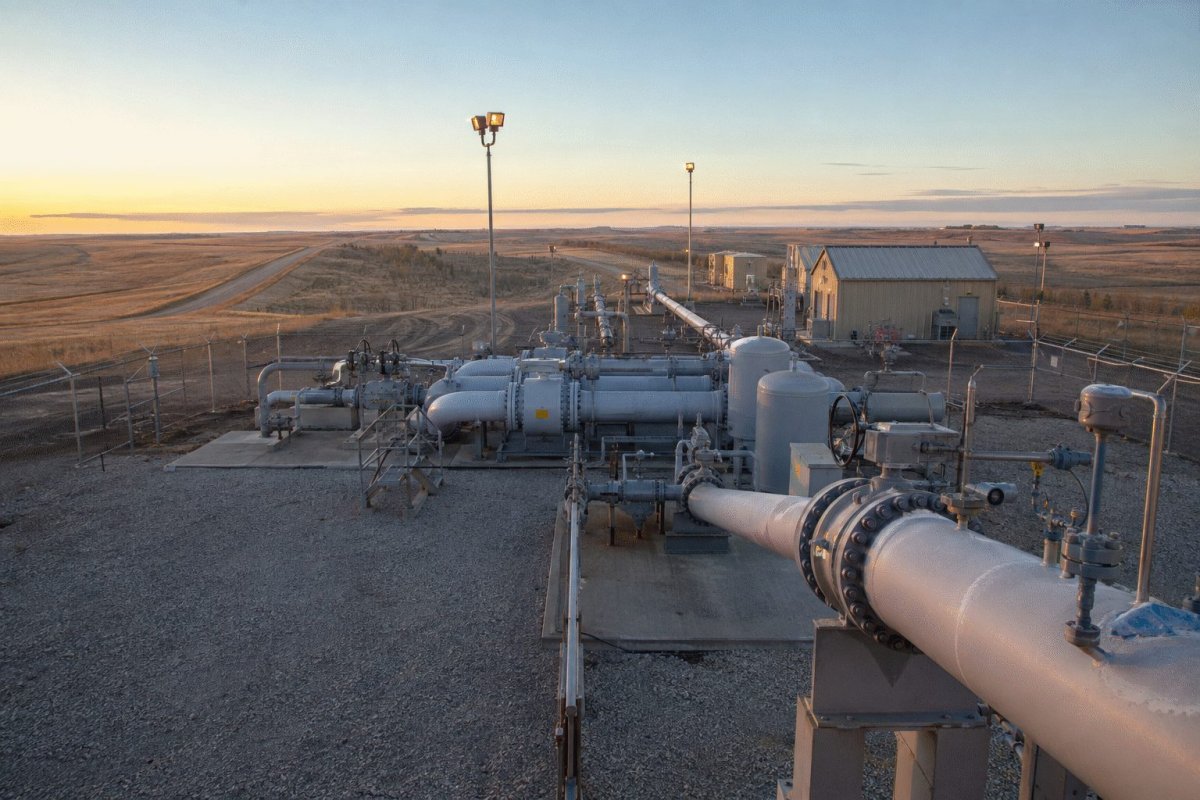
CALGARY – As U.S. stock futures moved in premarket trading on Tuesday, Canadian markets remained closed, but investor attention is increasingly turning to a scaled-down revival of the Keystone XL pipeline. The project, now dubbed the Prairie Connector, has emerged as a focal point after the collapse of U.S.-Canada trade negotiations sparked a surge in online searches for the original pipeline.
The Prairie Connector, proposed by South Bow Corporation (NYSE:SOBO) alongside privately held Bridger Pipeline, would transport 550,000 barrels of Canadian crude per day. That figure represents about two-thirds of the capacity originally planned for Keystone XL, which was scrapped in 2021 when the U.S. revoked its presidential permit. The new project also differs in scope, route, and commercial structure, making it a distinct investment proposition.
Commercial Backing and Capacity
South Bow has already secured 20-year firm service agreements for 450,000 barrels per day of the planned capacity, covering roughly 82% of the project. These binding contracts, finalized after an open season, provide a strong revenue foundation. However, the remaining 100,000 barrels per day are not yet under contract, adding an element of volume risk.
The proposed capacity of 550,000 bpd is close to the 585,000 barrels that the existing Keystone system averaged in 2025, according to Canada's energy regulator. That figure was down from a record 624,000 barrels per day in 2024, following pressure restrictions imposed after an April spill. The similarity in volumes highlights the potential for the Prairie Connector to replace or supplement existing export capacity.
Political and Regulatory Hurdles
The revival comes amid heightened trade tensions. Canada halted trade talks after rejecting updated U.S. proposals, with Prime Minister Mark Carney stating that Washington “asked too much and offered too little.” In response, Canada plans to impose matching tariffs on U.S. goods, affecting approximately C$28 billion in trade.
The U.S. granted a presidential permit on April 30 for a 36-inch border crossing in Montana, but this is only one of many approvals required. Federal, state, and local permits are still pending, and the existing permit remains subject to amendment or revocation. Legal challenges from environmental groups are also a possibility, adding to execution risk.
Market Reaction and Investor Sentiment
Investors have not yet priced in a breakthrough. South Bow shares fell 1.09% on August 24 to close at $37.31 in New York. Other energy stocks also declined, including Canadian Natural Resources (NYSE:CNQ), Suncor Energy (NYSE:SU), Cenovus Energy (NYSE:CVE), and Enbridge (NYSE:ENB). Oil prices slipped as well, with West Texas Intermediate falling 2.35% to $85.01 and Brent dropping to $92.17, masking any pipeline-specific momentum.
Policy Scenarios and Implications
The project's fate is closely tied to the political climate. If trade tensions ease, permitting could become more certain, reducing the risk premium. However, if tariffs remain in place, cross-border coordination may weaken, increasing the discount rate and potentially delaying the project. Alternatively, if Canada redirects more exports to western tidewater markets, the Prairie Connector could face reduced urgency.
For investors, the key takeaway is to focus on the Prairie Connector rather than the original Keystone XL. The project is commercially viable, with long-term contracts underpinning its outlook, but it is not immune to political and regulatory risks. The next major milestone is a final investment decision expected by mid-2027. Until then, the market will continue to weigh these factors, with the discount largely determined by the trajectory of U.S.-Canada relations.