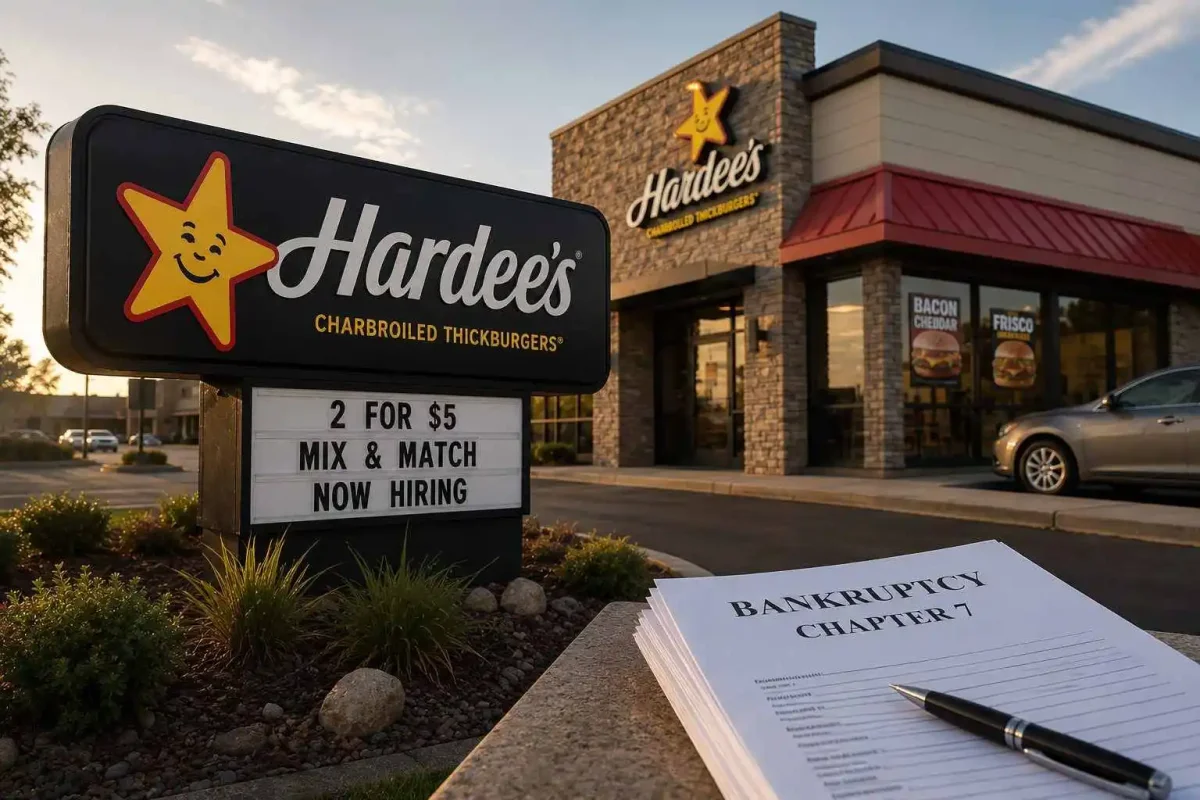
Two U.S. consumer-facing companies have filed for Chapter 11 bankruptcy protection within a 24-hour period, bringing at least $9.31 million in mall guarantees and deal financing into the bankruptcy courts. Sneaker City Albany filed on Friday, July 10, while Superior Star, which operates 59 Hardee's restaurants, filed on Thursday, July 9. Chapter 11 allows companies to continue operations while they restructure their debts.
Not a Consumer Demand Issue
The filings highlight that the core financial strain is not from recent operating expenses but from legacy costs tied to past expansion. For Sneaker City Albany, the primary liabilities are lease guarantees on already-closed stores. Superior Star's filing centers on a disputed seller-financed note from its 2023 acquisition of 93 Hardee's locations. This shifts the investor focus away from consumer demand and toward the burden of aging leases and acquisition debt as smaller operators retrench.
Sneaker City Albany: Debt Swamps Assets
Sneaker City Albany filed with $47,636 in assets against $2.38 million in liabilities, a debt-to-asset ratio of nearly 50 times. The company operates one store and a website, with five related store businesses already closed. Seven mall-related claims total $2.272 million, representing about 95.5% of liabilities. Revenue for 2026 through the filing date was $162,000, down from $479,000 in all of 2025 and $392,000 in 2024. Inventory valued at liquidation prices accounts for roughly $42,500 of assets.
The mall creditors appear on the public center list of Simon Property Group (NYSE:SPG). Their total claims of $2.272 million are less than 0.2% of Simon's $1.208 billion in first-quarter real estate funds from operations (FFO), a key cash flow metric for property firms. Simon reported 96% occupancy, with rent per square foot up 5.2% and tenant sales per square foot rising 11.8%. CEO Eli Simon cited "continued leasing momentum" in the company's earnings release.
Broader Footwear Context
The Sneaker City filing should not be interpreted as a broad signal of weakening sneaker demand. Nike (NYSE:NKE) reported a 4% gain in fourth-quarter wholesale revenue, though Nike Direct fell 7% and digital sales dropped 12%. Full-year revenue remained flat. CFO Matthew Friend noted that "sell-through remains challenged," indicating that wholesale expansion can occur even if retailers face pressure.
Superior Star: Acquisition Debt in Focus
Superior Star's bankruptcy centers on its 2023 purchase of 93 Hardee's stores, now reduced to 59 locations—a 36.6% decline. The key issue is a $7.04 million seller note, which is disputed and subject to setoff. Superior Star claims it may have counterclaims that could reduce the amount owed. Five additional major creditors are owed at least $736,000 for items such as ended leases, settlements, supplies, and rent. Hardee's parent CKE Restaurants attributed the bankruptcy to Superior Star's own financial and operational issues.
Hardee's has faced systemic challenges, closing more stores than it opened each year since 2017, with nearly 400 closures, according to Nation's Restaurant News. After franchisee ARC Burger failed, Hardee's brought back 25 locations as company stores. In contrast, Restaurant Brands International (NYSE:QSR), which operates Burger King, posted a 5.8% gain in U.S. same-store sales for the first quarter. CEO Josh Kobza described the results as "clear outperformance," cautioning that chain sales and individual franchisee performance do not always align.
Outlook and Key Dates
The wave of bankruptcies may remain contained if Sneaker City Albany successfully challenges its mall debt and Superior Star resolves the acquisition note. A successful restructuring could allow both companies to continue operations after reworking debts and leases. Failure could lead to more store closures, scrapped financing, and losses for landlords, suppliers, and the franchisor.
Superior Star filed on Thursday, July 9, and Sneaker City Albany on Friday, July 10. U.S. cash equity markets will reopen at 9:30 a.m. EDT on Monday, July 13. Next week's court filings on cash positions, lease obligations, store counts, and the seller note will clarify recovery prospects. Investors should monitor the ratio of old fixed obligations to remaining business value. While store sales may fluctuate, lease guarantees and acquisition notes typically persist, often long after the original stores have closed.