Uber Technologies (UBER) shares traded lower on Friday, slipping 1.3% to $71.60, even as CEO Dara Khosrowshahi's recent $10 million open-market purchase remained slightly profitable. The divergence between insider buying and market sentiment offers a telling signal: while the CEO's conviction is clear, investors remain locked in a debate over autonomous vehicles, reinvestment strategies, and the platform's future margin potential.
At 3:29:46 p.m. Eastern on September 11, Uber's stock was quoted at $71.60, down from Thursday's close of $72.56, after trading in a range of $71.04 to $73.77. This timestamped snapshot may differ from the final closing price, but it underscores the market's cautious stance.
CEO's Purchase: A Modest Gain
According to a Form 4 filed with the SEC, Khosrowshahi acquired 141,000 shares on September 10 at a weighted average price of $70.9642. The transaction, coded as "P" for open-market purchase, involved multiple trades ranging from $70.73 to $71.18. The total outlay was $10,005,952.20.
Marked at $71.60, the newly purchased block was worth $10,095,600, reflecting an unrealized gain of approximately $89,648, or just 0.9%. The filing also revealed that Khosrowshahi's direct holdings rose to 1,367,100 shares, valued at roughly $97.9 million at the same quote. This represents an 11.5% increase in his direct stake.
While a CEO buying shares with personal capital is a stronger signal of confidence than equity compensation, a gain of less than 1% is hardly market validation. One trading session is insufficient to judge the timing of the purchase.
Insider Cluster: Two Executives Buy
Khosrowshahi wasn't alone in buying. President and COO Andrew Macdonald purchased 70,000 shares on September 4 in two tranches: 54,325 shares at $75.6526 and 15,675 at $76.4425, totaling $5.31 million. At $71.60, that stake was down approximately $296,000, or 5.6%.
Together, the two executives committed $15.31 million for 211,000 shares within six days. This concentration amplifies the message: two leaders independently accepted the same business risk. However, it also highlights that insider buying is not a guarantee of a price floor.
Corporate Buyback: The Bigger Picture
While the executives' purchases are notable, they pale in comparison to Uber's corporate repurchase program. In its latest quarterly filing, Uber disclosed it repurchased and retired 6.9 million shares for $510 million during the second quarter, with approximately $15.7 billion remaining under authorization as of June 30. The company paid average prices of $73.84 in April and $74.79 in May—both above Khosrowshahi's $70.96 basis.
Uber's cash generation supports this program. Second-quarter results showed gross bookings of $58.0 billion, up 24% year over year, with operating income of $1.9 billion and free cash flow of $2.8 billion. Adjusted EBITDA margin reached 4.9% of gross bookings, up from 4.5% a year earlier. The company ended the quarter with $5.4 billion in unrestricted cash and short-term investments.
The core bullish thesis is not that an insider found a bargain, but that a platform growing bookings at a double-digit rate can continue to expand profitability, fund autonomous vehicle partnerships, and reduce its share count. Management guided for third-quarter gross bookings of $58.25 billion to $60.25 billion and non-GAAP earnings of $0.84 to $0.88 per share.
What the Purchase Doesn't Answer
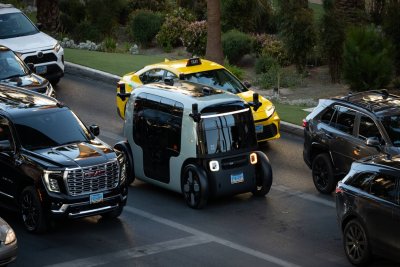
The bear case remains intact despite insider buying. Uber is positioning itself as a distribution layer for autonomous fleets, but investors must judge whether robotaxi operators will remain partners, become competitors, or force lower economics for the marketplace. Insurance, regulation, and driver incentives could also absorb operating leverage. Additionally, the company's recent decision to reduce its workforce by about 10%, as described in a September 2 employee message from Khosrowshahi, creates a near-term execution test even if the savings are intended to fund growth.
For the next earnings report, key metrics to watch include adjusted EBITDA margin, free-cash-flow conversion, share count, and investment in autonomous capacity. Faster bookings with rising margins would validate the executives' timing. Slower growth, stalled margins, or heavier capital needs would make the purchases appear more symbolic.
Bottom line: Khosrowshahi's $10 million purchase remains slightly profitable at $71.60, while Macdonald's earlier $5.31 million purchase is underwater. The cluster of insider buying deserves attention because both were genuine purchases, not compensation. It is evidence of insider conviction—but not a substitute for the cash-flow and margin proof that will determine Uber's next move.