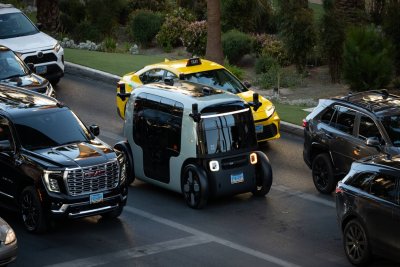
Spain has issued its first national permit for Level 4 autonomous passenger vehicles to Uber Technologies Inc. (NYSE: UBER) and Chinese autonomous driving firm WeRide, marking a significant regulatory step for self-driving technology in Europe. However, the authorization, designated FVA-02/2026, applies to a fleet of just 20 supervised test vehicles and does not permit commercial driverless rides.
According to Spain's Directorate General of Traffic registry, the permit lists AVOMO Cars, WeRide, and Uber as joint operators. The vehicles, classified as SAE Level 4 robotaxis, are authorized for testing purposes only. Level 4 autonomy means the system can perform all driving tasks within a defined operational design domain, but it does not enable fully driverless operation in all conditions. The registry showed zero kilometers recorded under the authorization as of September 10, underscoring the early stage of the program.
The companies plan to use the permit to map roads, validate routes, and test operational readiness in high-demand areas of Greater Madrid. During the initial phase, each vehicle will have an in-car vehicle specialist supervising operations. Despite the limited scope, the corporate announcement describes this as Spain's first national “operating permit,” language that some industry observers say overstates the nature of the approval.
Uber and WeRide, along with AVOMO, have indicated that commercial operations could begin by the end of 2026, subject to meeting operational and regulatory milestones. The September 10 release also highlights this as the first national approval for WeRide's GXR vehicle in the European Union. However, it is not an EU-wide commercial license, and the year-end launch target remains aspirational rather than an approved start date.
The market reaction to the news was measured. Uber shares dipped 1.7% to $71.32 in afternoon trading on Friday, while WeRide's U.S.-listed shares rose approximately 1.1% to $5.76. The divergence reflects the differing implications for the two companies. For WeRide, the permit validates its GXR vehicle in a new jurisdiction, providing a crucial foothold in Europe. For Uber, the financial significance hinges on whether a 20-car mapping fleet can eventually scale into a profitable paid service.
The Madrid project is the fourth city in the WeRide-Uber partnership, which aims to expand to 15 cities by 2030 and eventually deploy tens of thousands of autonomous vehicles. This collaboration exemplifies Uber's asset-light strategy in autonomy: WeRide supplies the driving technology and vehicles, AVOMO manages the fleet, and Uber contributes its app, customer base, and trip marketplace. This structure allows Uber to avoid the heavy capital and technical risks of manufacturing its own driverless fleet while positioning itself to benefit from multiple autonomous driving systems.
Despite the strategic appeal, the financial impact of 20 test cars on Uber's massive operations is negligible. Uber completed 3.87 billion trips in the second quarter and served 208 million monthly active platform consumers. Mobility gross bookings reached $29.0 billion, generating $2.22 billion in operating income, while companywide free cash flow was $2.79 billion. Even a successful launch with hundreds of vehicles would not move these numbers materially.
The real value of the permit lies in optionality. It shortens the path from partnership announcement to real-world data collection in one of Europe's largest urban mobility markets. Investors should watch for key milestones: kilometers driven and incident reports in the DGT registry, removal of the in-car specialist, a separate approval for commercial passenger service, availability through the Uber app, and fleet expansion beyond 20 vehicles.
Spain's approval is genuine progress for autonomous vehicle deployment in the EU, providing WeRide's GXR with its first national foothold and giving Uber another testbed for its platform model. However, it is not yet evidence that robotaxis will boost Uber's near-term earnings. The investable signal will come when supervised testing evolves into repeatable, paid service—and when Uber demonstrates that partner-operated autonomous rides improve its cash economics rather than merely shifting who gets paid.