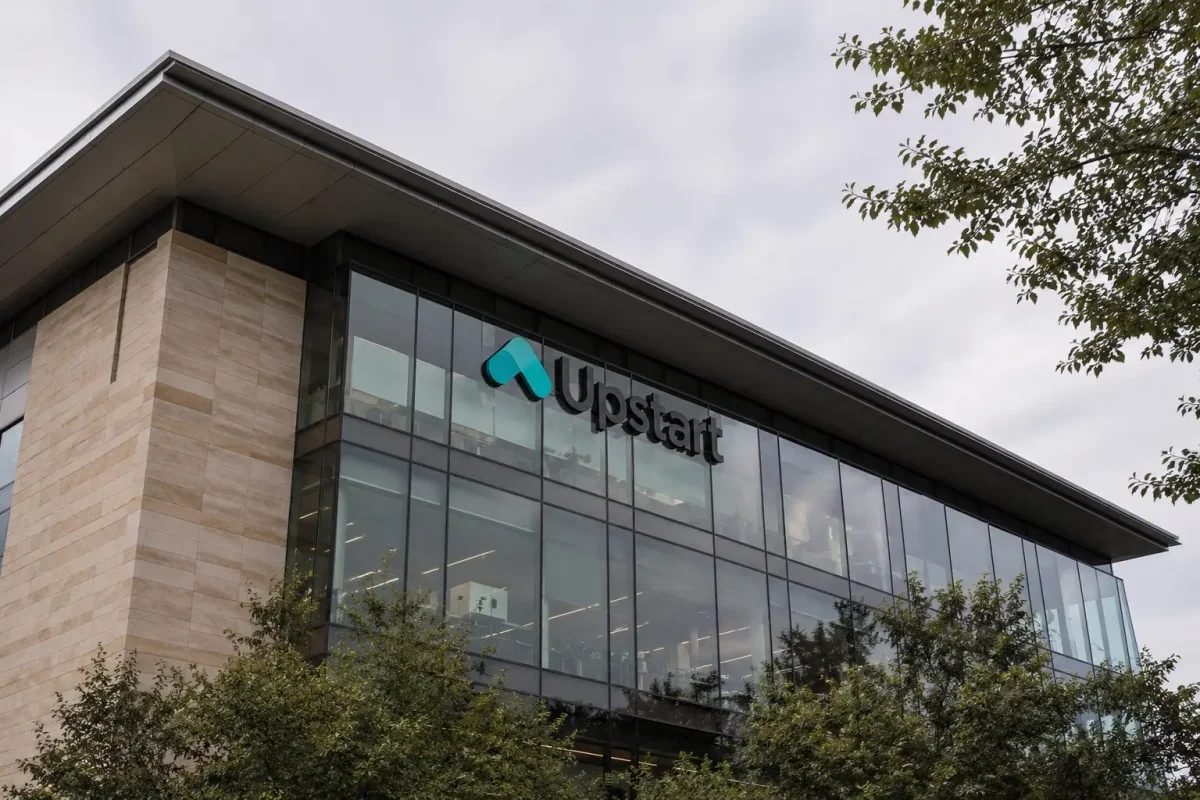
NEW YORK, August 4, 2026 – Upstart Holdings Inc. (NASDAQ: UPST) saw its shares jump 10.2% to $33.42 in after-hours trading on Tuesday, following the release of its second-quarter earnings report. The stock had already gained 3.0% during the regular session to close at $30.32. The post-market rally was driven by stronger-than-expected revenue and adjusted EBITDA, which overshadowed a slight miss on GAAP earnings per share.
The company reported revenue of $364.7 million for the quarter, surpassing the consensus estimate of $356.7 million by 2.2%. Adjusted EBITDA came in at $76.9 million, an 18.7% beat over the $64.8 million forecast. However, GAAP diluted EPS of $0.16 fell short of the $0.19 expected, a 15.8% miss. Revenue grew 42% year-over-year, and net income reached $16.5 million. Contribution profit hit a record $193 million.
Investors focused on the quality of growth, particularly the company's capital-light model. Originations increased by $782 million sequentially to $4.227 billion, a 23% rise, while loans held on the balance sheet grew by only about $50 million to $1.064 billion. This means the balance sheet absorbed just 6.4% of the incremental originations, the lowest intensity in nearly two years. The held-loan share of outstanding principal dropped to 5.9%, its lowest point in two years. CEO Paul Gu highlighted that the expansion was funded without adding equity capital, calling core personal loans “our superpower.”
In the first half of 2026, institutional investors purchased 61% of originated principal, lending partners retained or acquired 31%, and Upstart kept only 8%. The company also secured capital agreements providing up to $10.8 billion in additional capacity, underscoring the strength of its funding network.
Product group performance varied. Unsecured lending originations rose 20% sequentially, with fee revenue up 23% to $326 million and contribution margin improving 6 points to 62%. Secured products, including auto and home loans, saw originations jump 45%, but fee revenue was just $22 million, up 86%, and contribution margin remained deeply negative at -35%, though it improved by 61 points. Executives expect secured lending to reach break-even by the fourth quarter. CFO Andrea Blankmeyer noted that Upstart is “no longer a single-product company.”
Despite the strong quarter, the company left its full-year guidance unchanged. Revenue is still expected at approximately $1.4 billion, with adjusted EBITDA of $294 million. This implies second-half revenue of about $727.1 million, or $363.5 million per quarter, roughly flat compared to Q2’s $364.7 million. The subdued outlook suggests the rally is more about funding durability and margin recovery than accelerating sales growth.
One key risk is the company’s macro-risk index (UMI), which climbed to 1.50, up 9% from the start of the quarter and at the upper end of the range guided in February. A reading of 1.50 implies a 50% higher risk of repayment default compared to Upstart’s baseline. Preliminary July originations were $1.397 billion, or $51 million per day, the strongest since January but still below the 2024 peak.
Upstart also received conditional approval from the Office of the Comptroller of the Currency (OCC) to form Upstart Bank, with FDIC approval still pending. Leadership targets a launch in early 2027, which could further enhance its capital-light model.
Analysts note persistent risks: secured products still carry negative contribution margins, and the company retains over $1 billion in loans, exposing it to credit losses and fair value adjustments. Elevated UMI readings could dampen demand and affect third-party funding. The next challenge is execution—maintaining low balance-sheet intensity, achieving break-even in secured lending, and sustaining quarterly revenue near the implied $364 million level.