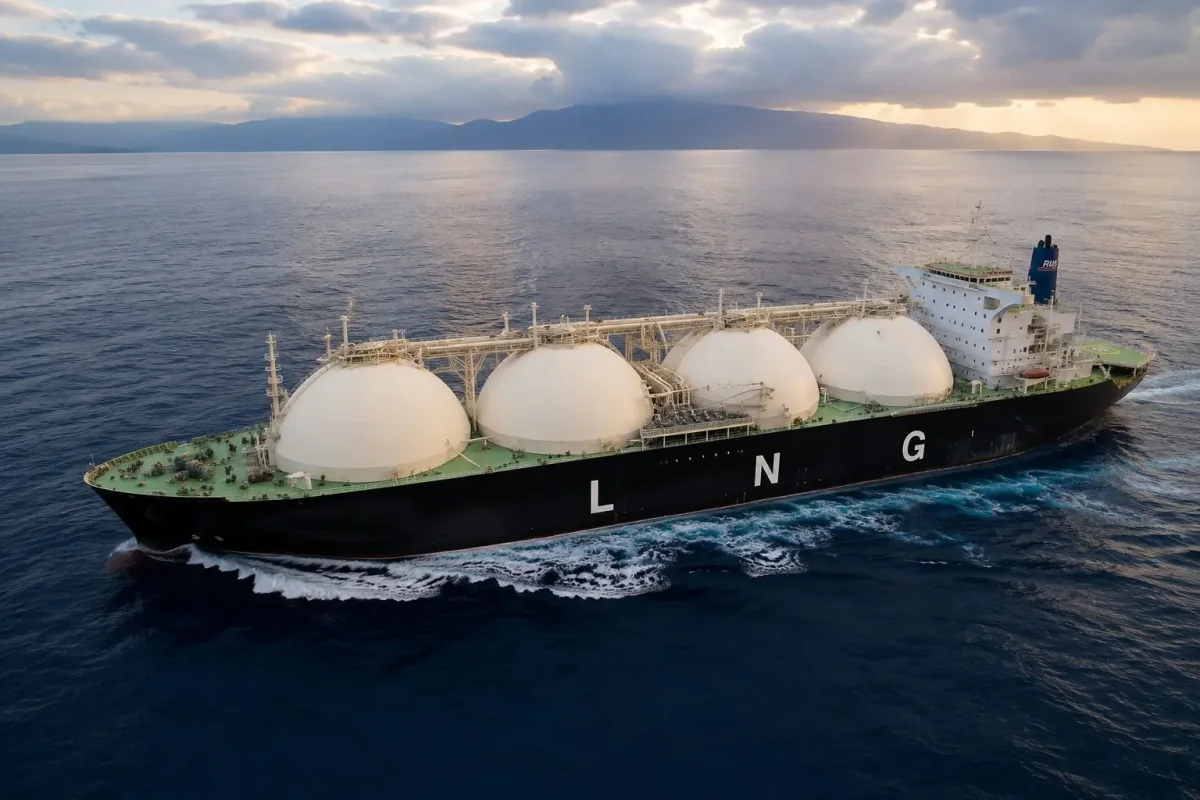
BRUSSELS, May 19, 2026, 22:45 CEST — Europe’s rapid shift away from Russian pipeline gas has created a new vulnerability: an overwhelming reliance on liquefied natural gas from the United States. According to fresh data from the Institute for Energy Economics and Financial Analysis (IEEFA), the U.S. is poised to supply roughly two-thirds of Europe’s LNG this year, with Poland emerging as one of the most dependent buyers.
In the first quarter, U.S. LNG accounted for 63% of Europe’s total LNG imports, up from 58% in 2025. Poland’s share stood at 75%, placing it among the top U.S.-linked importers alongside Germany, Croatia, the UK, the Netherlands, and Greece. The report projects that U.S. supplies could reach 80% of EU LNG by 2028 if current trends continue.
“Europe’s move from pipeline gas to LNG hasn’t delivered on security or diversification,” said Ana Maria Jaller-Makarewicz, lead Europe energy analyst at IEEFA. She described LNG as the region’s “Achilles’ heel,” leaving Europe exposed to price spikes and supply disruptions. Between 2022 and 2025, EU nations spent approximately €281 billion on LNG, with €131.5 billion going to U.S. cargoes alone. U.S. LNG has consistently been pricier than alternative sources, with Greek buyers paying €38.7 per megawatt-hour in 2025 — 12% above the EU average.
Poland is pressing ahead with infrastructure expansion. Gaz-System announced Tuesday that its floating storage and regasification unit for the Gdańsk project was launched at HD Hyundai Heavy Industries in South Korea. The unit is scheduled to arrive in the Bay of Gdańsk in late 2027, with regasification operations beginning in the first quarter of 2028. The facility will process over 6 billion cubic meters annually, complementing Poland’s existing Świnoujście terminal, which ran at 94% utilization in the first quarter.
The European Commission is taking steps to mitigate the risks. On April 22, it unveiled the AccelerateEU plan, aimed at limiting exposure to volatile fossil-fuel markets through clean energy, electrification, and grid upgrades. However, the EU still imports 57% of its energy as fossil fuels. The EU has set rules to ban Russian pipeline gas and LNG by the end of 2027, but some analysts warn that the rush to build new LNG terminals could lock in long-term U.S. reliance even as policy seeks to reduce overall gas consumption.
IEEFA projects European gas use will drop 14% from 2025 to 2030, with LNG demand falling about 23% in the same period. Already, nine of the EU’s 30 LNG terminals posted utilization rates below 30% in the first quarter, raising questions about the need for additional capacity. “Europe may be adding too much LNG capacity for a fuel it plans to cut back on,” the report noted.
The U.S. could surpass Norway as Europe’s top gas supplier this year. Meanwhile, Russia remains the EU’s second-largest LNG supplier despite the phase-out strategy, while Qatar’s share has declined due to export disruptions linked to Middle East conflicts. ACER, the EU’s energy regulator, has flagged that growing dependence on U.S. LNG could prompt concern over sticking with just one main supplier. Romania’s energy state secretary Cristian-Silviu Busoi told Reuters that while the U.S. is more dependable than Russia, work remains in the partnership.