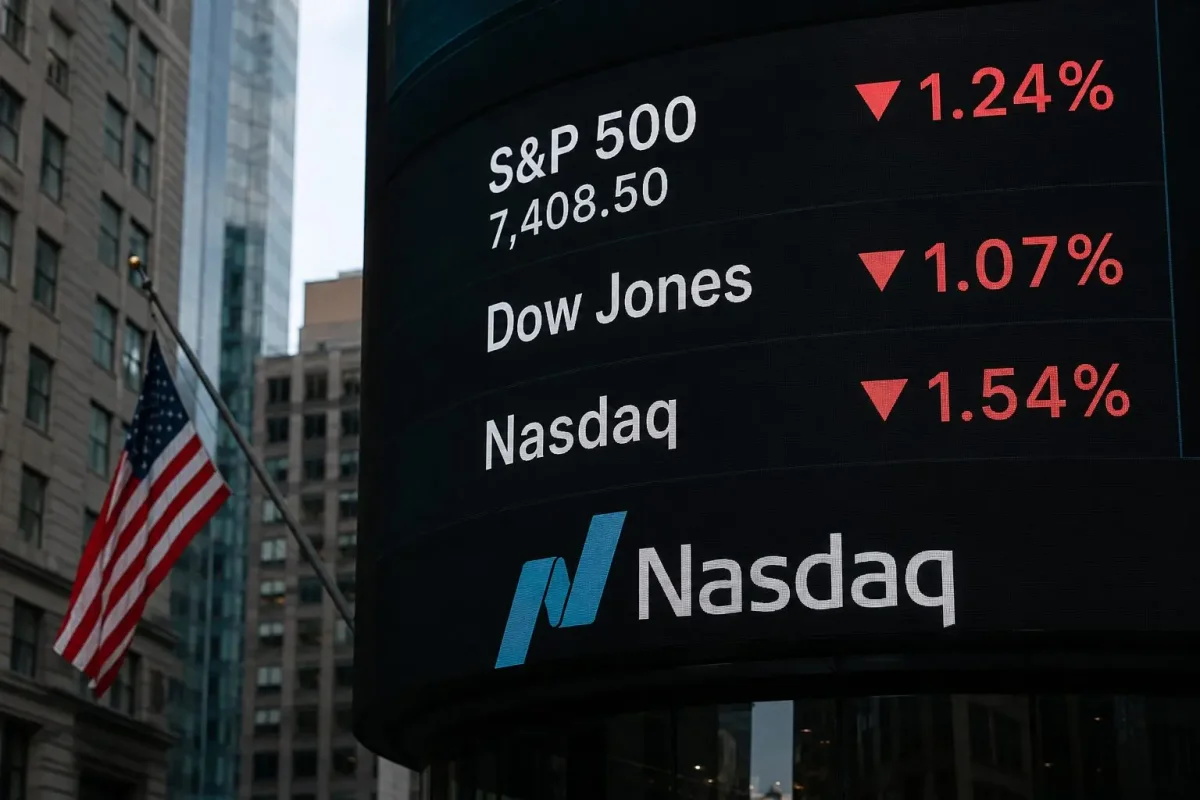
U.S. equities retreated on Friday, snapping a recent record run as renewed inflation concerns weighed on investor sentiment. The S&P 500 declined 1.24% to close at 7,408.50, while the Dow Jones Industrial Average fell 1.07% and the Nasdaq Composite gave up 1.54%. The broad market weakness was driven by a sharp pullback in semiconductor stocks and a surge in bond yields, with declining issues outpacing advancers.
The 10-year Treasury yield rose to 4.599%, returning to levels last seen in May 2025. The 30-year bond yield climbed to 5.131%, reflecting growing unease about persistent price pressures. "The market had gotten way ahead of itself on the AI trade," said Kenny Polcari, chief market strategist at Slatestone Wealth. The rise in yields made bonds more attractive relative to equities, particularly high-valuation tech shares, triggering a rotation out of risk assets.
Oil prices added to the pressure, surging over 3% as geopolitical tensions around the Strait of Hormuz resurfaced. "Bond investors are starting to price in the risk that a quick energy-price reversal isn't going to happen," noted Mike Sanders, head of fixed income at Madison Investments. The combination of higher energy costs and rising yields created a challenging backdrop for stocks, especially those with lofty valuations.
Inflation data released this week reinforced the cautious tone. Consumer prices rose 3.8% year-over-year in April, the fastest annual increase since May 2023. Energy costs accounted for more than 40% of the monthly gain. Producer prices also accelerated, rising 1.4% month-over-month and surging 6.0% year-over-year, the highest annual leap since December 2022. The figures, while largely in line with expectations, underscored the difficulty the Federal Reserve faces in bringing inflation back to its 2% target.
Despite the inflation uptick, markets continue to price in a pause from the Fed. Prediction markets show a 98% probability of no rate change at the June meeting, with 94% odds against a move in July and 81% for September. Boston Fed President Susan Collins noted this week that while additional rate hikes are not her baseline forecast, she "could envision a scenario" where further tightening might be necessary to achieve the inflation target. The Fed's next decision will be closely watched for any shift in tone.
Corporate earnings have been a key support for the market, helping stave off a correction. According to LSEG data cited by Reuters, S&P 500 first-quarter earnings surged 28.2% year-over-year, with full-year 2026 earnings expected to rise 22.6%. Deutsche Bank's Binky Chadha described the growth as "arguably the strongest in two decades" when excluding special items. However, the strong earnings backdrop was not enough to prevent Friday's selloff, as investors weighed the implications of higher rates and energy costs on future profits.
AI-related capital expenditure remains a bright spot. Five major AI hyperscalers are projected to invest $751 billion in capex by 2026, benefiting not just software but also hardware, electricals, and construction sectors. Yet even this theme faced headwinds on Friday, with the Philadelphia semiconductor index falling 4%. Shares of Nvidia, AMD, and Intel all ended lower, highlighting the vulnerability of even the most favored trades to macro headwinds.
On the economic front, U.S. manufacturing output rose 0.6% in April, the strongest monthly increase in over a year, driven by higher orders for cars and technology equipment. Michael Gapen, chief economist at Morgan Stanley, described the manufacturing sector as steady for now but noted downside risks from supply chain disruptions and rising costs. The mixed economic signals leave the outlook uncertain, with traders focused on key indicators such as the 10-year yield, crude prices, chip stocks, and market breadth.
Looking ahead, the sustainability of the current rally hinges on upcoming earnings reports and whether Friday's decline represents a temporary positioning adjustment or the beginning of a more sustained downturn. "Earnings are the lifeblood of this rally," said Michael Arone, chief investment strategist at State Street Investment Management. With inflation still running hot and energy prices elevated, the market's next moves will depend on how companies navigate these headwinds and whether the Fed's stance evolves in the coming months.