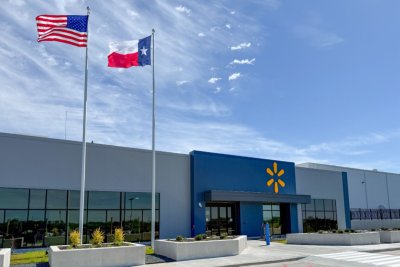
In a dramatic turn on Thursday, Walmart Inc. (NASDAQ: WMT) saw its shares tumble 9.15% to $103.84, erasing approximately $83.2 billion in market capitalization. The selloff came despite the retail giant reporting better-than-expected earnings and raising its full-year guidance, highlighting investor concerns about the underlying quality of its profit growth and softening domestic sales.
Earnings Beat Overshadowed by Refund Reliance
Walmart's second-quarter fiscal 2027 results, released before the market open, showed adjusted earnings per share of $0.81, surpassing the consensus estimate of $0.74. Revenue climbed 5.9% year-over-year to $187.9 billion, also beating expectations of $186 billion. However, the market's reaction was decidedly negative, driven by a closer examination of the profit composition.
The company booked nearly $2.9 billion in tariff reimbursements, which management said contributed 750 basis points to the 17.4% increase in adjusted operating income at constant currency. This means refunds accounted for roughly 43% of the total operating income growth, a detail that did not sit well with investors seeking organic, sustainable earnings expansion.
U.S. Comparable Sales Disappoint
The most concerning metric was U.S. comparable store sales, which rose only 2.6%—the slowest pace since late 2020 and well below the 3.7% analysts had projected. Pharmacy price controls created a 125-basis-point drag on the category, while elevated fuel prices above $4 per gallon prompted shoppers to make trade-offs. Core merchandise comparable sales managed a modest 3.4% increase, but the overall softness signaled a potential slowdown in consumer spending.
Chief Financial Officer John David Rainey had warned in June that such trade-offs were becoming "a little more obvious." The company has implemented over 11,000 price rollbacks in the U.S. to counter these pressures, but the gains from tax refunds were partially offset by higher fuel costs and ongoing price investments.
Digital and Advertising Growth Remain Bright Spots
Despite the domestic sales weakness, Walmart's digital initiatives continued to perform strongly. Worldwide e-commerce grew 23%, with Walmart U.S. e-commerce up 24%. Global advertising revenue advanced 38%, and membership income rose 17%. These faster-growing, higher-margin segments are improving the overall sales mix, though they were insufficient to prevent a recalibration of comparable sales expectations.
Guidance Raised but Still Below Consensus
Walmart updated its full-year guidance, now projecting net sales growth of 4.0%–5.0% (up from 3.5%–4.5%) and adjusted operating income growth of 7.0%–8.5% (up from 6.0%–8.0%). Adjusted EPS guidance was lifted to $2.80–$2.87, compared to the prior range of $2.75–$2.85. However, the midpoint of $2.835 remains roughly 4.5% below the earlier consensus of $2.97.
Rainey advised investors to "consider Q2 and Q3 performance together," noting that refunds received in Q2 are intended to support pricing initiatives in the second half of the year. The company guided third-quarter net sales growth of 3.0%–3.75%, with adjusted EPS of $0.62–$0.64, reflecting the impact of Flipkart's timing.
Valuation Concerns Persist
Despite the sharp decline, Walmart's stock still trades at a significant premium. At Thursday's close, the trailing P/E ratio stood at 40.25x, compared to Costco's 46.96x and Target's 16.50x. Investors continue to pay a hefty premium for Walmart's scale, defensive characteristics, and growth potential, but the recent earnings report has raised questions about whether that premium is justified.
Analyst sentiment remains cautiously optimistic, with a consensus rating of "Moderate Buy" and an average price target of $137.44, implying 32.4% upside from current levels. However, two recent downgrades—from Gordon Haskett and Oppenheimer—suggest that some on Wall Street are losing patience with the premium valuation amid slowing comparable sales.
Market Context and Risks
The broader market also faced headwinds on Thursday, with the Dow Jones Industrial Average falling 704 points as surging bond yields and oil prices weighed on investor sentiment. Walmart's decline was responsible for only 13% of the Dow's drop, but the retail giant's performance set a cautious tone for consumer discretionary stocks.
Key risks to Walmart's outlook include continued pressure on comparable sales from fuel costs, pharmacy regulatory changes, tariff uncertainties, and potential consumer downgrading. The timing of refunds could also skew margins in future quarters. Conversely, rapid growth in e-commerce and advertising suggests that the market's selloff may be overdone.
The critical test will come in the third quarter, as investors look for core operating income to approach the 7%–10% range without the benefit of further refunds. If that fails to materialize, Walmart's premium valuation may remain at risk.