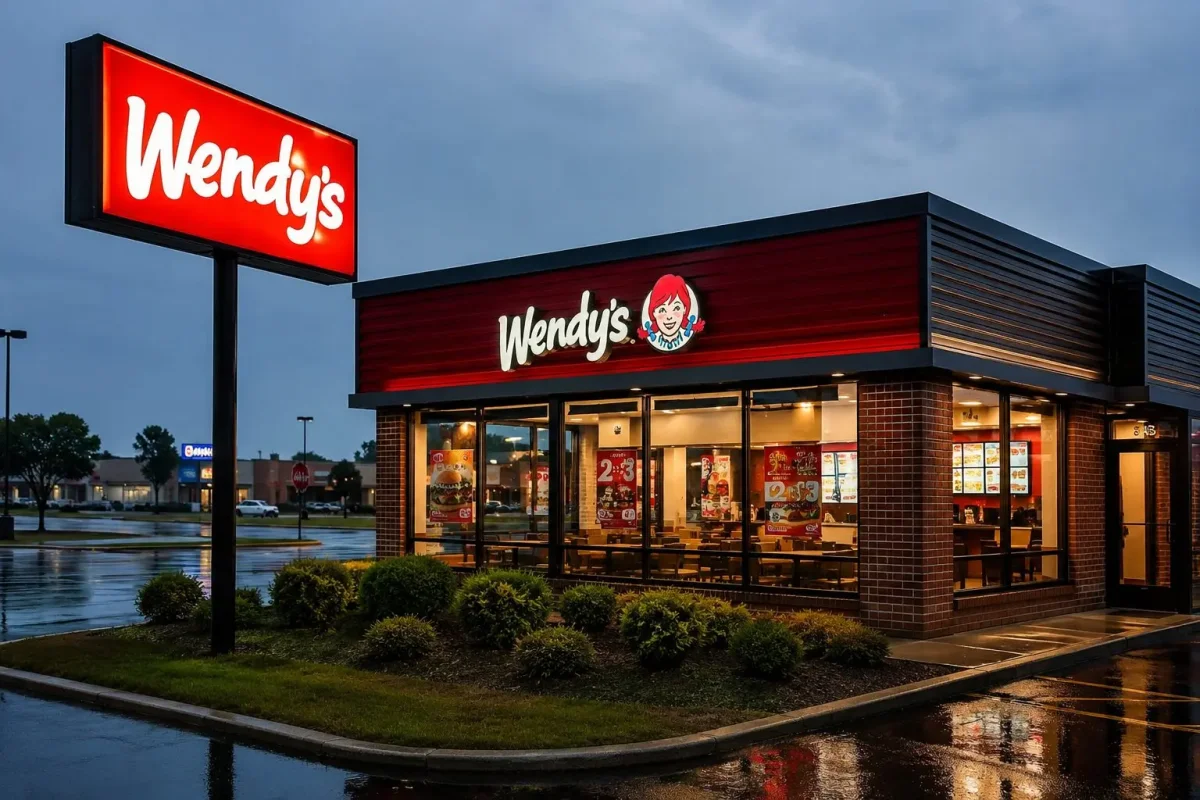
NEW YORK, August 7, 2026 – Wendy's Company (NASDAQ: WEN) announced Friday that it is cutting its quarterly dividend in half to $0.07 per share, a strategic move to conserve cash as U.S. comparable sales decline sharply. The fast-food chain also withdrew its full-year 2026 guidance, citing a challenging operating environment. The stock opened at $7.08 and traded around $7.39 by mid-morning, reflecting a muted reaction to the news.
The dividend reduction, effective immediately, is expected to save the company approximately $53.4 million annually, based on shares outstanding at the end of the second quarter. This figure closely mirrors the $55.3 million in net income Wendy's reported for the first half of the year. The decision marks a significant shift in capital allocation, prioritizing liquidity and operational investments over shareholder payouts.
Q2 2026 Financial Performance
Wendy's reported adjusted earnings per share of $0.18, surpassing the consensus estimate of $0.16. Revenue came in at $570.6 million, beating expectations of $557.1 million. However, the headline numbers masked underlying weakness. U.S. same-restaurant sales fell 7.0% year-over-year, a steep decline compared to the 4.7% drop analysts had projected. This marks a deterioration from the 3.6% decline recorded in the same period last year.
Adjusted EBITDA declined 15.4% to $124.1 million, and U.S. company-operated restaurant margins contracted by 240 basis points to 13.8%. The company attributed the margin pressure to commodity inflation, higher labor costs, and reduced customer traffic.
Revenue Quality and Segment Trends
While reported revenue grew 1.7% year-over-year, adjusted revenue actually fell 1.4%, reflecting a divergence driven by advertising fund reallocations, vendor incentives, and restaurant acquisitions. Franchise royalty and rental income decreased during the quarter, indicating softness across the system.
International operations offered a slight bright spot, with systemwide sales up 3.4%, though comparable sales still declined 2.3%.
Competitive Landscape
Wendy's underperformance is stark when compared to its burger peers. McDonald's (NYSE: MCD) posted a 0.8% increase in U.S. comparable sales, while Burger King, owned by Restaurant Brands International (NYSE: QSR), surged 8.5%. This leaves Wendy's trailing McDonald's by 7.8 percentage points and Burger King by 15.5 points.
CEO Bob Wright acknowledged the challenges in a statement: “Today we are clearly not performing at our potential.” He outlined five key areas for improvement: menu value, marketing, operations, digital frequency, and restaurant experience.
Capital Allocation and Analyst Sentiment
The dividend cut frees up substantial cash. At the previous annual rate of $0.56 per share, the payout cost approximately $106.8 million. The new rate of $0.28 per share reduces that to around $53.4 million, retaining nearly $53.4 million annually. This retained cash represents roughly 44.4% of Wendy's first-half free cash flow of $120.3 million.
Wall Street remains cautious. According to MarketBeat data over the past 12 months, analysts have issued six sell ratings, thirteen holds, and three buys, with an average price target of $8.04. Recent adjustments include Citigroup's Jon Tower lowering his target to $7.25 (Neutral) and JPMorgan's Rahul Krotthapalli downgrading to Underweight with a $6.00 target.
Valuation and Outlook
Wendy's shares trade at approximately 9.5 times trailing earnings, a significant discount to McDonald's (22.7x) and Restaurant Brands (19.7x). However, this valuation gap is complicated by the withdrawn guidance and uncertain recovery prospects.
Investors will be watching for details on Wright's turnaround strategy, including spending priorities, franchisee return targets, and concrete measures to reverse U.S. traffic declines. The dividend savings provide financial flexibility, but success hinges on execution.
Key risks include ongoing traffic erosion, rising beef and labor costs, and intensifying competition from larger rivals. A rapid recovery driven by value offerings could challenge bearish sentiment, but until then, Wendy's faces an uphill battle to regain its footing.