XRP (XRP-USD) traded near $1.42 on Sunday, showing little change over the past 24 hours, after a Bank for International Settlements (BIS) research paper detailed a prototype using the XRP Ledger for data verification. The token's market capitalization stood at roughly $89.1 billion, with prices remaining below Thursday's close of $1.4516. The modest market reaction reflects the narrow scope of the test, which ran on the XRP Ledger's DevNet environment rather than the live mainnet.
What the BIS Prototype Achieves
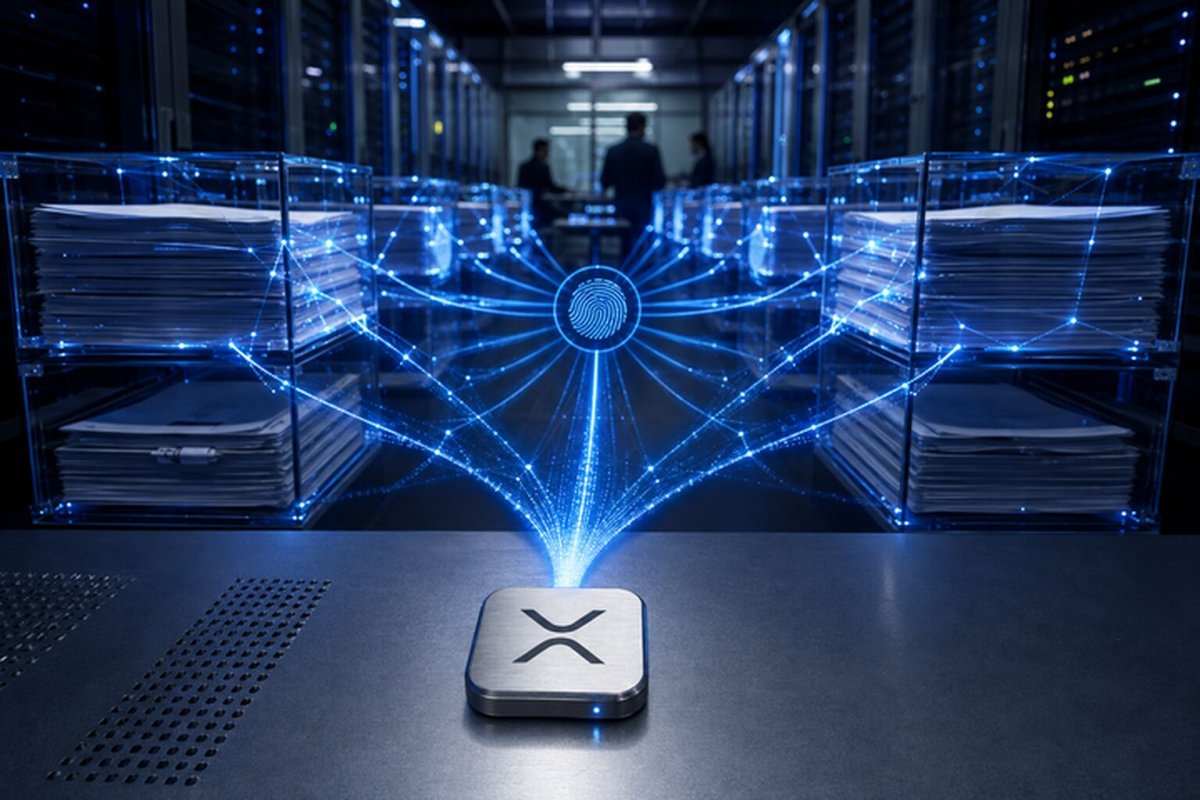
The September 2 working paper addresses a genuine challenge in official statistics: proving that published data hasn't been altered after release. Current SDMX files—the standard format for statistical data exchange—lack built-in mechanisms for verifying source and integrity. The five authors developed a system that creates a cryptographic fingerprint for each dataset, combines these fingerprints into a Merkle tree, and records the root hash on the XRP Ledger.
This approach allows anyone to verify the publisher and the integrity of the data with a single ledger lookup, while keeping the actual statistics off-chain. Confidential information never touches the public ledger, addressing privacy concerns that often accompany blockchain-based solutions.
Key Technical Details
The prototype's workflow involves four steps: canonicalizing each SDMX file into a stable form, hashing the file and its individual series, combining many hashes into a single Merkle root, and anchoring that root on the XRPL. The researchers reported that publication took three to five seconds, while verification took one to two seconds—speeds that could support automated checks before trading models consume economic releases.
The paper is explicitly clear about its limitations, stating that the figures describe a proof of concept rather than a hardened production system. Tests used synthetic files on a single developer workstation, without measuring sustained mainnet load, enterprise firewall configurations, or hardware-backed key security. Adversarial conditions were also outside the trial's scope.
Token Economics Remain Minimal
Perhaps the most significant takeaway for XRP investors is the negligible impact on token supply. A standard XRPL transaction currently destroys at least 10 drops (0.00001 XRP), and the fee is paid to nobody. At $1.42 per XRP, that minimum fee costs about $0.0000142. Roughly 70,423 minimum-fee transactions would burn just one dollar worth of XRP.
Batching further weakens any potential supply squeeze. If one transaction anchors 1,000 datasets, then about 70.4 million datasets would consume one dollar at the minimum fee. This arithmetic shows that even widespread adoption of this use case would have a negligible effect on XRP's circulating supply.
Broader Implications
Despite the modest token impact, the research could hold reputational and architectural value. A public audit trail for GDP, inflation, or regulatory filings could become useful infrastructure. The paper also extends the design to XBRL financial reporting and AI-agent verification, suggesting potential future applications.
However, analysts caution against letting narrative outpace evidence. At a valuation near $89 billion, XRP requires demand driven by substantial capital flows, not microscopic fee burns. This prototype provides credibility for the XRP Ledger's technical capabilities but does not, by itself, justify a token supply narrative. The market's muted response reflects that reality, with XRP remaining below its recent high as traders weigh the long-term potential against the current lack of production deployments.