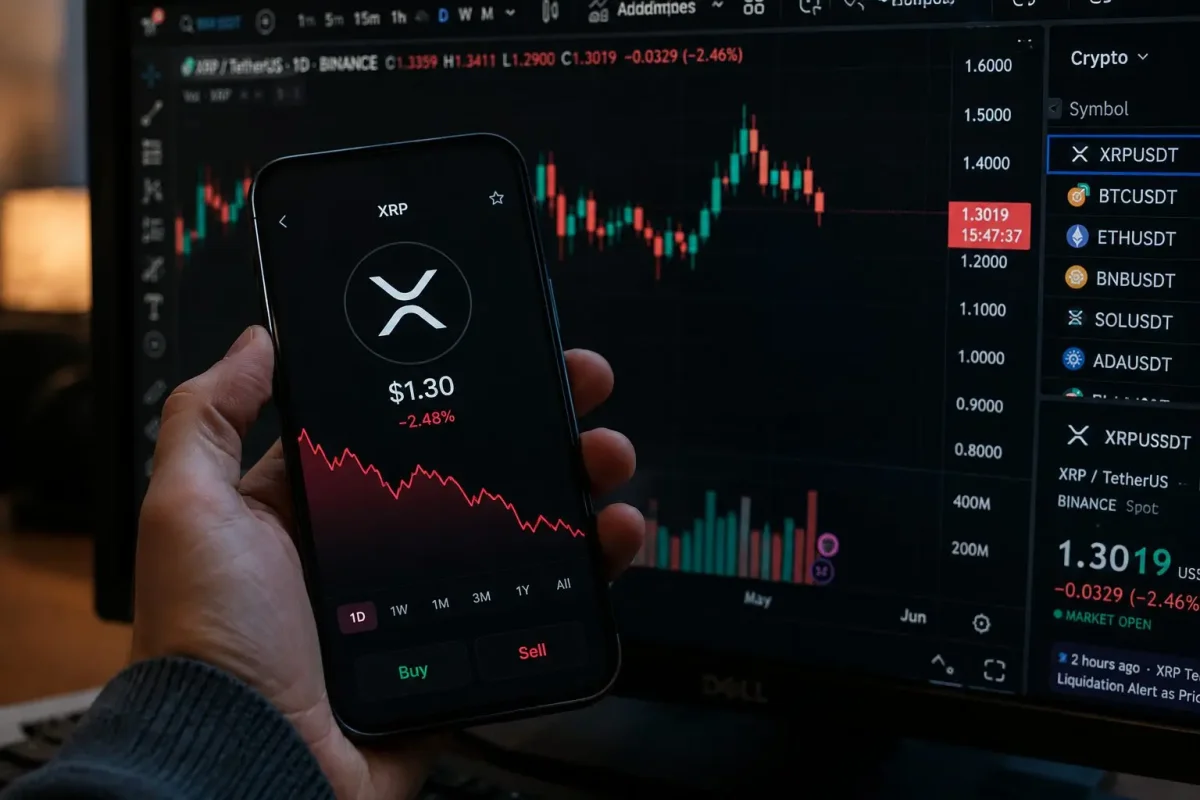
XRP steadied near $1.32 late Thursday, clawing back some ground after slipping below the psychologically important $1.30 mark earlier in the day. The digital asset, which serves as the native token for the Ripple-linked XRP Ledger, traded between $1.27 and $1.33 over the past 24 hours, according to data from CoinGecko. Trading volume stood at approximately $2.38 billion, while its total market capitalization hovered around $81.7 billion.
The dip below $1.30 drew attention from market participants who had been monitoring that level as a support threshold. CoinDesk reported that XRP fell from $1.3267 to $1.2993, briefly touching $1.2931, as sellers pushed through the $1.3150 area. In the hour starting at 2300 UTC on May 27, roughly 64 million XRP tokens changed hands.
CME Group’s 24/7 Crypto Futures Launch
In a significant development for institutional crypto trading, CME Group announced it will extend its cryptocurrency futures and options trading to a 24/7 schedule, effective from 4 p.m. Central Time on Friday, May 29. This move brings regulated derivatives closer to the round-the-clock nature of spot crypto markets, where trading never stops. While spot markets already operate continuously, futures allow traders to speculate on or hedge price movements without directly holding the underlying assets. CME’s XRP products are CFTC-regulated futures and options tied to the CME CF XRP-Dollar Reference Rate, a benchmark for the token. The exchange also confirmed that XRP options are now live, offering firms additional exposure tools beyond spot trading.
Market Sentiment Weighed Down by Geopolitical Tensions
Risk appetite remained subdued across the crypto landscape. Barron’s reported Thursday that Bitcoin, Ether, XRP, and Solana all declined following new U.S.-Iran strikes that stoked geopolitical unease, pushing oil prices higher and clouding expectations for interest rate cuts. Paul Howard, a trader at crypto firm Wincent, told Barron’s that sentiment was weak and liquidity thin. Bitcoin traded near $73,683, and Ether hovered at $2,021, both down on the day. XRP’s decline was less pronounced against this backdrop, but movements in the two largest cryptocurrencies often set the tone for large-cap altcoins during periods of macro stress.
Regulatory and Industry Developments
Regulatory uncertainty continues to hang over the sector. Ripple CEO Brad Garlinghouse commented, “The Anti-Crypto Army was defeated by the courts, by the voters, and by Trump,” referencing the ongoing U.S. crypto struggle. He argued that efforts against financial innovation were designed to preserve the existing system. Meanwhile, a debate emerged around XRP staking and taxation after David Schwartz, Ripple’s former chief technology officer, weighed in. Schwartz discussed how staking rewards could be taxed if the XRP Ledger ever introduced staking features, though the ledger does not currently offer native staking. “If the staking rewards are created by the staking process, then it’s just like if you knitted a sweater,” Schwartz wrote.
On the payments front, RedotPay rolled out new features this week, allowing users to pledge XRP as collateral for a credit line with a 50% loan-to-value ratio. That means $1,000 in XRP backs $500 in spending. The firm also introduced a service to send XRP and deliver Nigerian naira to local accounts or wallets.
Technical Outlook and Risks
Despite the intraday bounce, risks remain. If Bitcoin and Ether stay weak due to geopolitical concerns, or if XRP fails to hold above $1.30, the recovery could prove fragile. Thin liquidity can amplify moves in both directions, but when prices are sliding, support levels often break more quickly. XRP remains a top-tier crypto asset by market capitalization, but traders are currently focused on whether buyers can defend key levels rather than the token’s underlying payments story.