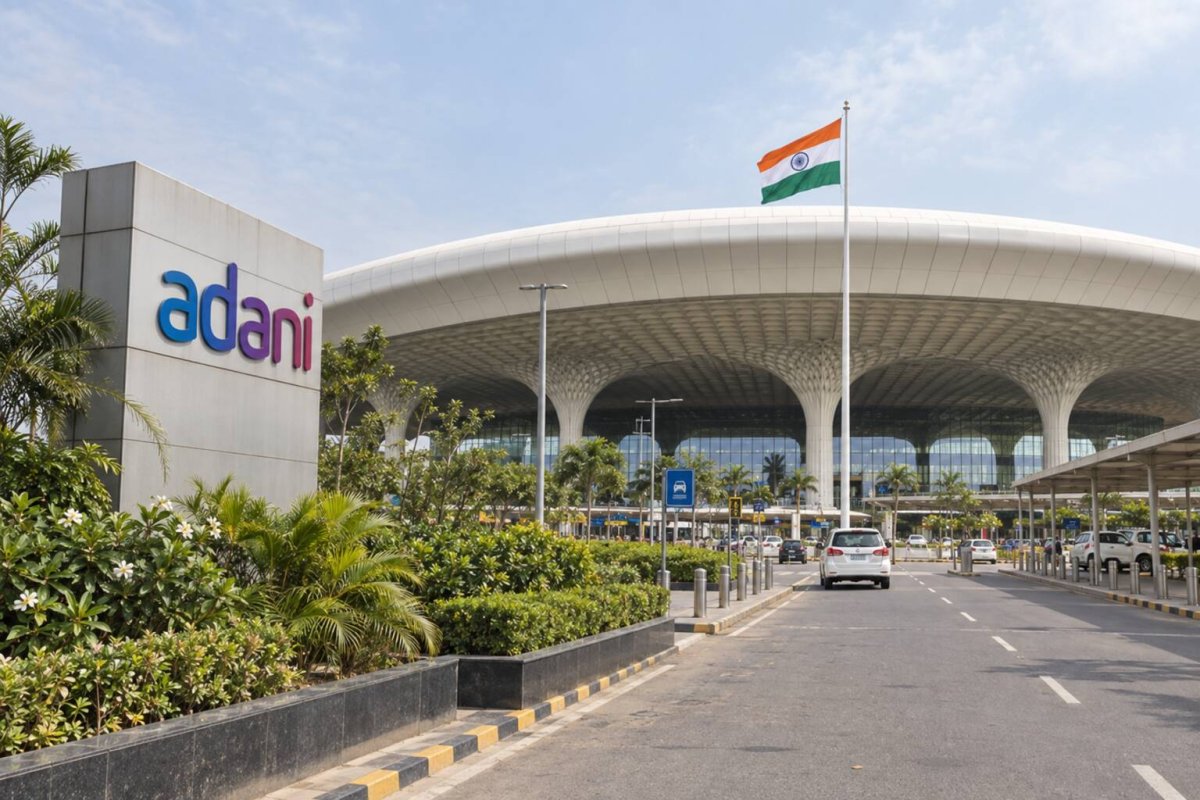
Shares of Adani Enterprises Ltd. climbed sharply on Wednesday after the conglomerate announced a major capital infusion into its airport subsidiary, a move that both validates the unit's valuation and reduces the parent company's funding burden.
The company said Adani Airport Holdings Limited (AAHL) has entered into binding agreements to raise approximately ₹98.25 billion (about $1 billion) through the issuance of new primary equity. The investors participating in the round include Alpha Wave Global, Premji Invest, Temasek, and funds managed by BlackRock. The transaction values AAHL at roughly $18 billion on a pre-money basis.
On the National Stock Exchange, Adani Enterprises closed at ₹3,104.70, up 5.13%, after touching an intraday high of ₹3,142. Trading volume surged to 5.32 million shares, compared to 971,374 shares in the prior session, according to exchange data.
Deal Structure and Purpose
The investment will be made in three tranches, with the final tranche expected to be completed by July 2027. When fully executed, the consortium will collectively own about 5.54% of AAHL. The transaction is subject to customary approvals and conditions.
Importantly, this is primary capital, meaning the funds will go directly into AAHL's balance sheet to support expansion, rather than being a secondary sale that would channel cash to Adani Enterprises or its promoters. The proceeds are earmarked for airport expansion and modernization, the first phase of a 22 million square feet mixed-use airport-city development, and growth in ground handling and other non-aeronautical services. AAHL's long-term goal is to handle about 200 million passengers annually.
Valuation Implications
The $18 billion pre-money valuation is an equity figure, not enterprise value, and should not be directly compared to revenue or EBITDA without accounting for debt. Nevertheless, it provides a rare external benchmark for a business that is otherwise consolidated within Adani Enterprises' diversified portfolio.
At the current exchange rate of approximately ₹95.10 per dollar, the valuation translates to about ₹1.71 trillion. Adani Enterprises' market capitalization stands near ₹4 trillion, implying that the airport unit alone is valued at roughly 40% of the parent's total market value—before considering other businesses such as green energy, roads, data centers, copper, and mining services.
While shareholders cannot simply add this value to the parent's market cap—AAHL has its own liabilities and capital needs, and the new minority investors will share future economics—the deal signals that sophisticated institutional investors are willing to back the airport platform at a specific price.
Operational Strength
Airports have become a key growth driver for Adani Enterprises. In the fiscal first quarter ended June, AAHL's total income rose 39% year-over-year to ₹37.63 billion, while EBITDA increased 49% to ₹16.33 billion. The airport segment contributed about 29% of the parent's record quarterly EBITDA of ₹56.42 billion.
Passenger traffic grew a more modest 3% to 24.2 million, but the mix was encouraging: aeronautical revenue rose 16%, while non-aeronautical revenue jumped 53%, driven by retail, hospitality, parking, and property services. These higher-margin businesses are crucial for improving revenue per passenger.
However, the airport segment reported a pre-tax loss of ₹1.94 billion, partly due to higher depreciation following the capitalization of Navi Mumbai International Airport. The new equity will help fund capacity, but it does not eliminate depreciation, interest costs, or the execution risk of filling new assets.
Value Unlock or Dilution?
For Adani Enterprises shareholders, the transaction is a double-edged sword. It validates a significant portion of the group's sum-of-the-parts valuation and reduces the need for the parent to fund AAHL alone. At the same time, it transfers 5.54% of the airport platform's future upside to new investors.
The timing is also notable. Adani Enterprises raised ₹150 billion through a qualified institutional placement in July. Combined with the airport deal, the group has secured ₹248.25 billion of new equity at the parent and subsidiary levels within a short period, demonstrating access to substantial capital pools—but also highlighting how capital-intensive the incubation model is.
Investors should note that the announcement does not disclose each investor's allocation, governance protections, or specific conditions attached to each tranche. The involvement of reputable names should not substitute for a thorough analysis of the deal's terms.
What to Watch
The first test is closing: all three tranches must be completed by July 2027, subject to approvals. The second is whether AAHL can translate the capital into faster passenger growth and continued double-digit non-aeronautical revenue growth. The third is cash generation after depreciation, interest, and maintenance spending—not just EBITDA.
Investors should also monitor the airport segment's leverage and the parent's future equity needs. While a primary investment can ease balance-sheet pressure, large infrastructure projects can absorb cash for years before reaching mature returns. A weaker rupee and oil prices above $100 add macro risks for construction costs, airlines, and discretionary spending.
